
What is agility in football and why is it essential?
Agility in football is defined as the ability to change direction quickly and efficiently while maintaining balance and ball control. Unlike speed exercises, which develop linear acceleration, football agility exercises focus on multidirectional movements, sudden stops, and explosive changes of pace. This physical quality combines explosive strength, coordination, and reaction ability, allowing players to perform feints, dribbles, and pivots without losing control.
It is essential because, in real game situations, players constantly need to change direction to beat opponents, receive between the lines, or adjust defensive positioning. Implementing football agility routines in your physical preparation will significantly improve performance when combined with speed training. While speed develops linear power, agility refines the ability to apply that power in multiple directions and game situations.
3 specific agility exercises for football players
Agility ladder with ball control
This exercise combines foot coordination with ball control, developing the football-specific agility needed in dribbling and tight-space ball carrying situations.
How to perform it:
- Place an agility ladder (or mark 40 cm squares with cones)
- Each player dribbles the ball while performing different foot patterns: two touches per square, one foot per square, lateral steps
- Vary the execution speed: slow for technique, fast for intensity
- Perform 3 sets of 10 meters with 45 seconds of rest
Benefits: Improves foot-ball coordination, enhances control during fast movements, and refines first touches under pressure.
Multidirectional square drill
Multidirectional football agility exercises are essential to prepare players for sudden changes of direction that constantly occur in matches.
How to perform it:
- Create a 5×5 meter square using 4 cones
- The player starts in the center and reacts to the coach’s signals: forward, backward, left, right
- Upon reaching each cone, the player touches the ground with their hand and quickly returns to the center
- Add visual (colors) or auditory stimuli to increase difficulty
- 4 sets of 30 seconds with 60 seconds of recovery
Benefits: Develops reaction ability, improves explosive direction changes, and enhances stability in lateral movements—key for both defensive and offensive situations.
High-speed cameras with motion analysis can capture up to 1000 frames per second, allowing each technical and tactical action to be broken down with great precision. Football match analysis now includes advanced biomechanics and detailed performance evaluation.
Slalom with pace changes and finishing
This professional football agility exercise simulates real situations where players must navigate obstacles, change speed, and execute a final technical action.
How to perform it:
- Place 6 cones in a zigzag pattern, 3 meters apart
- The player dribbles through the cones with changes of pace: accelerate in straight lines, decelerate during turns
- At the end of the slalom, perform a shot, pass, or directional control
- Alternate dominant and non-dominant foot
- 5 repetitions per set, 3 total sets with 90 seconds of rest
Benefits: Integrates speed exercises and agility with technical skills, simulates wing play situations, and develops the ability to execute technical actions after high-intensity efforts.
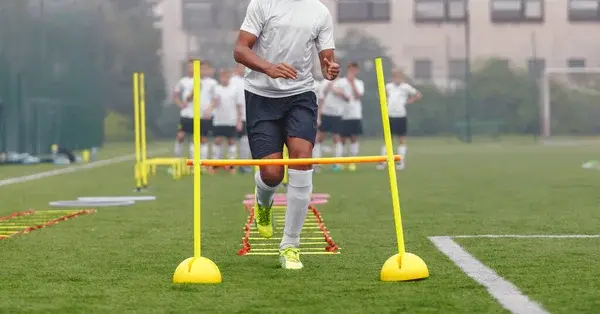
Speed exercises vs agility exercises: key differences
Speed exercises develop the ability to accelerate and maintain high speed in straight lines, building explosive power through sprints and progressive accelerations. These are essential for counterattacks, runs down the wing, and situations requiring maximum speed in linear paths. In contrast, football agility exercises focus on rapid direction changes, multidirectional balance, and reaction to stimuli, using ladders, slaloms, and reaction drills.
Professional football agility is crucial for dribbling, marking, and receiving between the lines, while speed is essential for fast transitions. In a complete physical preparation program, football agility routines must complement speed training: speed provides the foundation of explosive power, while agility teaches how to apply that power effectively in multiple directions, creating more dynamic and efficient players.
Common mistakes when training agility in football players
One of the most common mistakes when implementing football agility exercises is training without proper progression in intensity or complexity. Many coaches start directly with high-speed drills without first establishing correct change-of-direction technique, which can lead to injuries and limit the development of professional football agility. Another common mistake is training agility without the ball, reducing transfer to real match situations. It is essential to start with controlled movements, perfect braking and landing techniques, and gradually increase speed and intensity.
The second critical mistake is failing to integrate football agility routines with existing speed exercises in physical preparation. Training agility in isolation significantly reduces its effectiveness, as both qualities are combined in real football scenarios. Additionally, many coaches fail to include reaction stimuli (visual or auditory), even though real agility requires quick responses to unpredictable situations. The key is to design exercises that combine technique, execution speed, and reaction ability, following a logical progression aligned with player adaptation principles.
How to Include Agility Exercises in a Training Session
To achieve real results, football agility exercises must be properly integrated into the weekly training plan. The best approach is to perform them at the beginning of the session, after the dynamic warm-up, when players are not yet fatigued. This allows movements to be executed with greater technical precision and a lower risk of injury.
An effective structure can include basic coordination and activation drills first, followed by multidirectional exercises, and finishing with football-specific tasks that combine the ball, reaction, and decision-making. It is also important to control training volume, since sessions that are too long or repetitive can reduce movement quality and negatively affect performance.
A balanced combination of speed and agility exercises helps develop more complete football players who can react quickly, change direction efficiently, and maintain technical control during high-intensity actions.
Example of an Agility Training Session Structure
| Training Phase | Objective | Example Drill | Approximate Duration |
|---|---|---|---|
| Dynamic Warm-Up | Activate muscles and mobility | Skipping, joint mobility, and light jogging | 10 minutes |
| Coordination and Technique | Improve body control | Agility ladder with different foot patterns | 10–15 minutes |
| Multidirectional Agility | Develop change of direction ability | Reaction square drill with cones | 15 minutes |
| Football-Specific Agility with Ball | Transfer skills to real-game situations | Slalom drill with finishing action | 15–20 minutes |
| Cool Down | Recovery and injury prevention | Stretching and light mobility exercises | 5–10 minutes |
Take your physical preparation to the professional level
Football agility exercises are just a sample of what you can achieve with specialized training. To implement elite-level physical preparation programs that effectively combine speed exercises, agility, and all key physical qualities of modern football players, advanced knowledge and practical experience in professional clubs are essential.
The Football Strength & Conditioning Master’s Program by FSI Training provides the tools required by top-level clubs to design football agility routines and comprehensive performance programs. With guaranteed internships in over 40 professional clubs worldwide, you will be able to apply this knowledge directly in real professional football environments. Take the next step in your career and become the strength and conditioning coach elite players need to maximize their physical and technical potential.

Do you want to stay up to date with the latest news?
Stay informed about everything happening at FSI Training by subscribing to our newsletter and following us on social media.