What we know for certain about creatine
Before getting into the debate about its specific usefulness during a match, it's worth making one thing clear: creatine is one of the most studied sports supplements in existence. Its efficacy and safety profile is well documented.
The International Olympic Committee (IOC) consensus defines it, alongside other supplements, as an ergogenic aid with a good level of evidence for those who follow certain protocols (Maughan et al., IOC consensus)

Improves the ability to repeat high-intensity efforts
Creatine's most studied mechanism of action is its ability to speed up phosphocreatine resynthesis in the muscle. This helps maintain energy production during repeated high-intensity efforts.
This is the physiological basis behind most studies on football, although as we'll see later, its real-world application during a match raises more questions than it seems to answer.
Supports glycogen synthesis
One of its lesser-known but highly relevant benefits for football is creatine's role in muscle glycogen resynthesis.
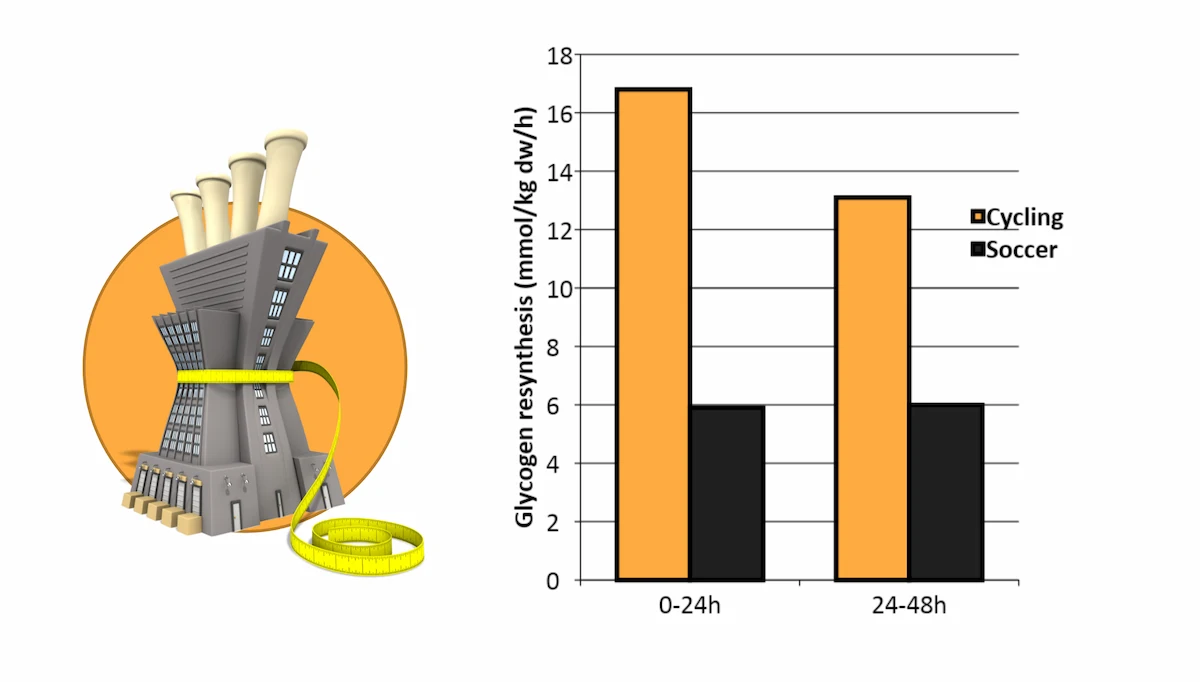
A study with professional players comparing a standard diet against a high-carbohydrate, high-protein diet showed clear differences in the speed of glycogen recovery at 24 and 48 hours (Gunnarsson et al., SJMSS 2013).
And when creatine is added to a carbohydrate load, the effect is boosted even further: one study found that combining creatine and carbohydrates significantly increased glycogen resynthesis compared to placebo, with differences that held up even after 6 days of supplementation (Roberts et al., Amino Acids 2016).
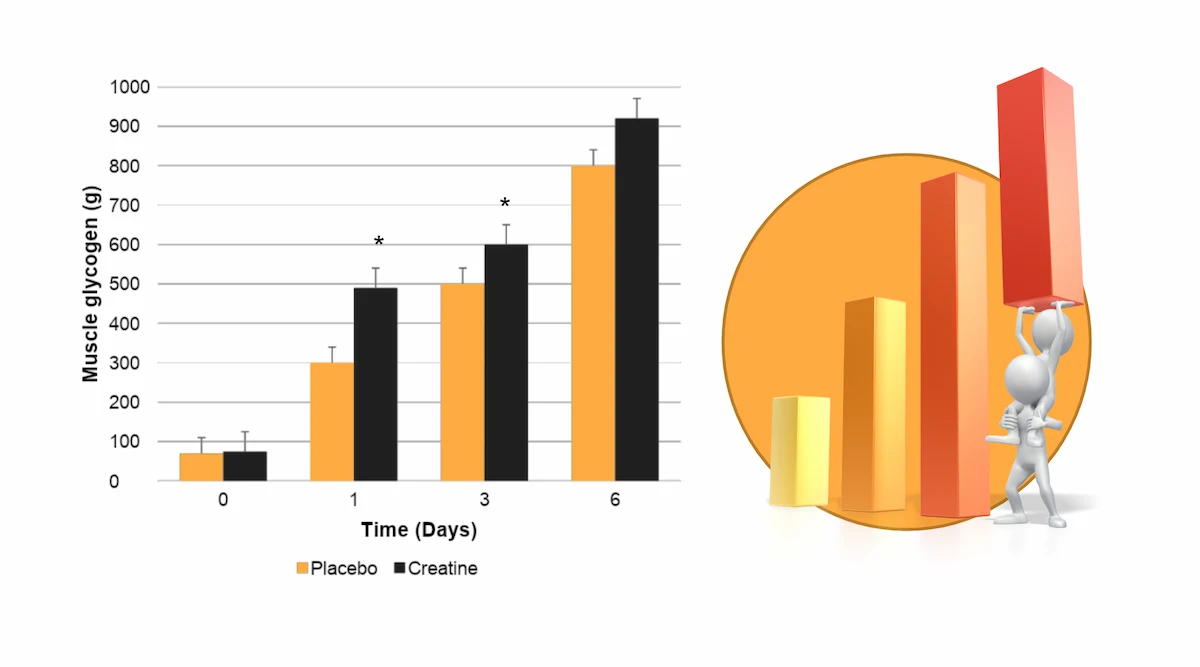
This is especially relevant during congested fixture schedules, where quickly restoring glycogen stores between matches can make a real difference.
Boosts chronic training adaptations (lean mass, strength, power)
Here the evidence is solid. Creatine appears to stimulate the expression of growth factors and genes related to muscle adaptation. This translates into greater gains in lean mass, strength, and power when combined with strength training. (Rawson et al., IJSNEM 2018)
It may also be useful in the context of injury: some studies suggest creatine could reduce muscle atrophy during immobilization and speed up strength recovery during rehabilitation (Tipton, 2015).
What do studies say about creatine and football performance?
5 studies, mixed results: neither clearly positive nor negative
There are five studies that have specifically investigated the effect of creatine on football performance. The results are far from unanimous: only one reported a negative effect on sprinting (not confirmed by the others), between a third and 40% found no clear benefit, and roughly half did observe an improvement in physical performance (Le Meur, FSI Training).
The underlying problem: lab protocols don't mimic a real match
Most of these studies assess creatine using repeated sprint tests, based on a simple logic:
more creatine in the muscle = better phosphocreatine resynthesis = greater ability to repeat intense efforts
The problem is that this scenario (several maximal sprints with very little recovery) is far more common in a lab than in a real match, as we'll see with the GPS tracking data in the next section.
What Big Data says: this is what repeated sprints actually look like in a real match
This is where real match analysis comes in to put the lab-based logic to the test.
Chris Carling's study (80 matches, Ligue 1): over 1 minute of recovery between sprints
An analysis of 80 Ligue 1 matches in France showed that when a player runs at more than 20 km/h, they typically get more than 1 minute of recovery before the next similar action. In fact, the average player is only forced to string together 3 consecutive sprints with less than 20 seconds of rest between them once per match (Le Meur, FSI Training, citing C. Carling).
The study on the German national team (19 matches): only 35 repeated sprints in total
A later study, using data from 19 matches played by the German national team, reached a similar conclusion using a stricter threshold (25 km/h): across those 19 matches, only 35 repeated sprint sequences were recorded (at least 3 sprints with short recovery) (Le Meur, FSI Training).
Phosphocreatine levels during a match never actually run out
The most striking data point comes from direct measurements: muscle phosphocreatine levels after the most intense moments of a match sit at around 60-70% of resting values. For comparison, after an intermittent yo-yo test they drop to around 40%, and after lab-based repeated sprint protocols (for example, 10 sprints of 6 seconds with only 30 seconds of recovery) they can fall as low as 10% (Le Meur, FSI Training).
In other words: during a real match, phosphocreatine stores rarely reach a critical point of depletion.
So, does creatine not help in football at all?
With this data on the table, the question isn't really "does creatine work?" but rather "does it work for what we thought it did in football?" And the answer turns out to be more nuanced than it first appears.
Why the "repeated sprint" argument loses strength
If the main case for creatine in football is that it helps repeat high-intensity efforts, and that scenario barely occurs during a real match, the argument loses quite a bit of weight. It's not that creatine "doesn't work": it's that the context in which it's supposed to make a difference (phosphocreatine depletion from consecutive sprints) almost never happens over 90 minutes of play.
The benefits that do hold up (outside the match itself): training, strength, recovery
That said, this doesn't mean creatine has no place in football. Its most solid benefits don't depend on what happens during the match, but on what happens around it:
- Training adaptations: greater gains in lean mass, strength, and power.
- Glycogen recovery: speeds up resynthesis, useful during congested fixture schedules.
- Injury context: may help reduce muscle mass loss and support strength recovery.

How to use creatine if you decide to supplement (practical protocol)
Loading phase and maintenance phase
The standard protocol is split into two phases (Le Meur, FSI Training; Roberts et al., Amino Acids 2016):
| Phase | Recommended daily dose | Duration | Main goal |
|---|---|---|---|
| Loading | ~20g (split into four 5g doses) | 5-7 days | Quickly saturate muscle stores. |
| Maintenance | 3-5g (single dose) | Ongoing | Maintain optimal phosphocreatine levels. |
Combining it with carbohydrates
Taking it alongside a carbohydrate source (or protein + carbohydrates) improves muscle uptake thanks to the insulin response.
Side effects to keep in mind
It's safe long-term when the right protocol is followed; the most common side effect is water retention of 1-2 kg, with no significant clinical relevance.
The decision isn't purely scientific: the final takeaway
Before wrapping up, one nuance Le Meur highlights that's rarely mentioned: how a supplement is presented to a player can influence its actual effect.
Shaping a player's beliefs about a product's usefulness (explaining clearly why and what it's for) can influence the response they get from it. Trust in the intervention matters just as much as the substance itself.
With all this on the table, is creatine worth it in football? The short answer is: it depends on what you expect from it.
If you're hoping it will get you fresher for that decisive sprint in the 90th minute, the Big Data evidence casts doubt on whether that scenario happens often enough to notice a difference. But if you value it for what it brings around the match itself (better response to strength training, faster glycogen recovery during tight schedules, support when returning from injury), it remains one of the best-supported supplements that exist.
The key, as is so often the case, is to adjust expectations to the real context of football, not that of a laboratory.
Powered by Froala Editor