
This is the part of football nutrition that nobody puts in a paper. Everyone knows the numbers: 6–8 g/kg of carbs before a match, 30–60 g/h during, protein every 3–4 hours. Fine. The hard part is turning those numbers into food that 25 players actually eat, at home, in a hotel in another country, or on a plane at midnight after a match.
So here’s my toolbox: what I do every week with the team, and what I would tell myself ten years ago.
Why a nutritionist on the staff? (the short theory)
Two numbers convinced me that planning the menu matters. In the Premier League, players ate 6.4 g/kg of carbs on match days but only 4.2 g/kg on training days, and they still stayed under the guidelines on MD-1 and in the post-match recovery (Anderson et al., 2017). They knew what to eat. They just didn’t do it.
The second number comes from an article I published. At our club we compared the senior squads of 2014/15 (no structured nutrition programme) with those of 2022/23 (programme led by a sport nutritionist): 88 Serie A players, 44 men and 44 women. In the men’s team, the sum of 7 skinfolds dropped from 54.5 to 44.0 mm, and body cell mass went up. In the women’s team it went from 88.6 to 61.4 mm, although there the 2014/15 squad was still non-professional, so part of that change is the move to full-time football (Petri et al., 2024). Same club, same city, different system.
That’s it for theory. The guidelines are in the UEFA statement (Collins et al., 2021) and in the ACSM position stand (Thomas et al., 2016). Read them once. The rest of this article is about how to make them happen.
Rule zero: one staff, one goal
Technical staff, medical staff, chefs, kit men, directors. Different jobs, different priorities. The coach wants intensity, the doctor wants zero injuries, the chef wants nice plates, the player wants his mum’s pasta. My job is to make them work as one team with one common goal: winning matches.
In practice this means I talk every day with the fitness coach about the load of the session. No load data, no menu. If tomorrow is a heavy MD-3, the chef cooks more carbs. If it’s a recovery day, the plate changes.
Toolbox 1: the weekly menu
Build it week by week
For the first team I write the menu every week, around the fixture calendar and the training loads. The youth academy works differently: four seasonal menus (autumn, winter, spring, summer) on rotation. Seasonal products, less waste, easier shopping. With the first team that is not enough, because the load changes from one week to the next.
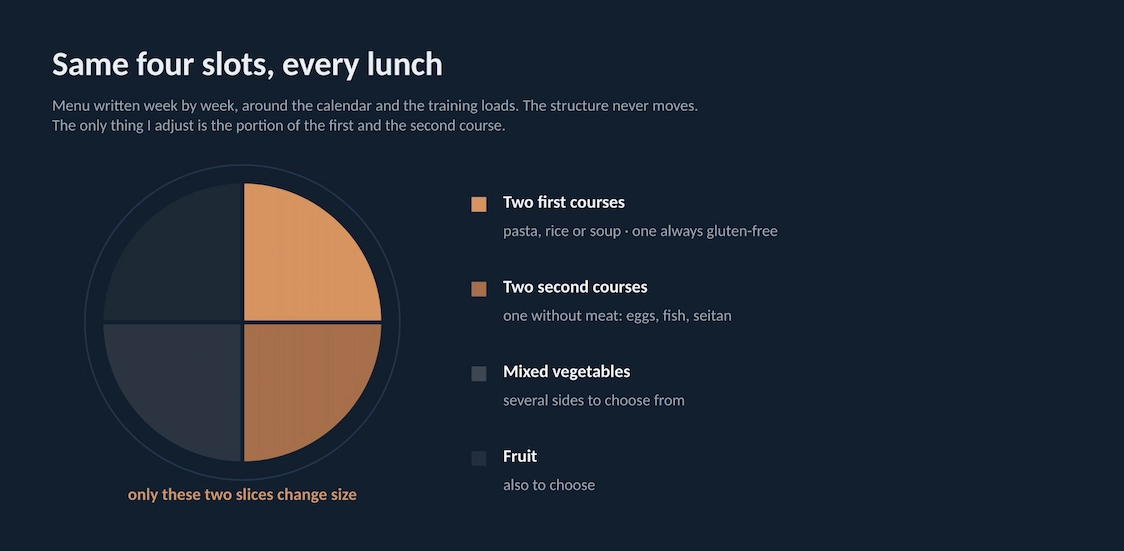
Every lunch has the same skeleton:
- Two primi (pasta, rice, soup), one of them always gluten-free
- Two secondi, one of them without meat (eggs, fish, vegan plates)
- Mixed vegetables as a side, with several options to choose from
- Dessert: fruit, also to choose
Same structure, different content. The players know what to expect, and I only adjust the portions of the primo and the secondo.
Working with the chef
I don’t work in the kitchen. I give the chef the guidelines, and he creates the recipes. We don’t have a fixed meeting: we talk all the time. The kitchen rules are simple. Nothing fried, no butter. Sauces only homemade, with a few exceptions like balsamic vinegar or sriracha.
Let them choose, the day before
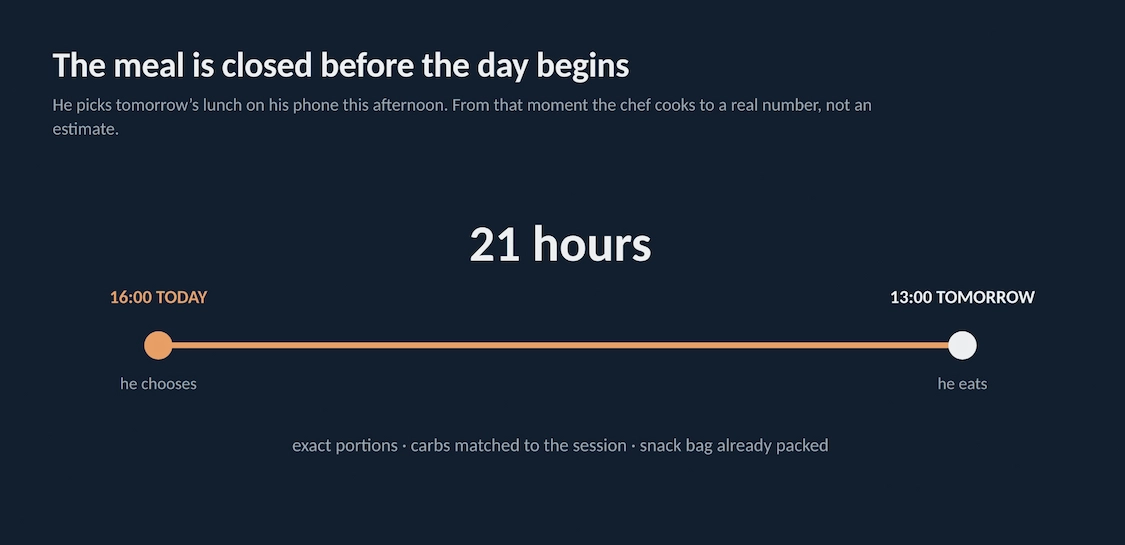
Every afternoon the players get a WhatsApp message with a link: “Choose your lunch for tomorrow.” They pick from the menu. This small habit made a big difference. The kitchen cooks the right quantities, we know who skipped what, and the player feels it’s his choice. Adherence goes up when people choose.
Periodize the plate around the microcycle
Carbs follow the work (Anderson et al., 2022). Protein stays stable every day (1.6–2.2 g/kg, 0.3–0.4 g/kg per meal) and fat fills the rest (Collins et al., 2021). This is what a one-match week looks like for me:
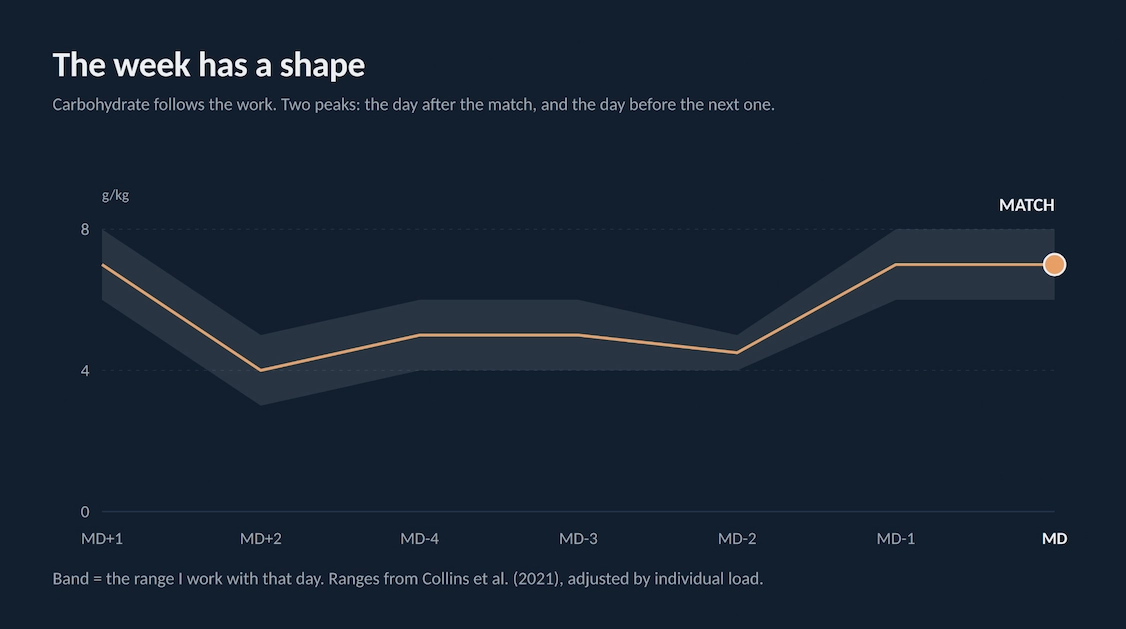
Two matches a week? Then MD+1 is also MD-2. There is no “normal” day: it’s refuel, refuel, refuel. I push carbs high from the final whistle and keep them high, because glycogen can still be low 48 hours after a match (Nédélec et al., 2012).
Toolbox 2: match day
Before
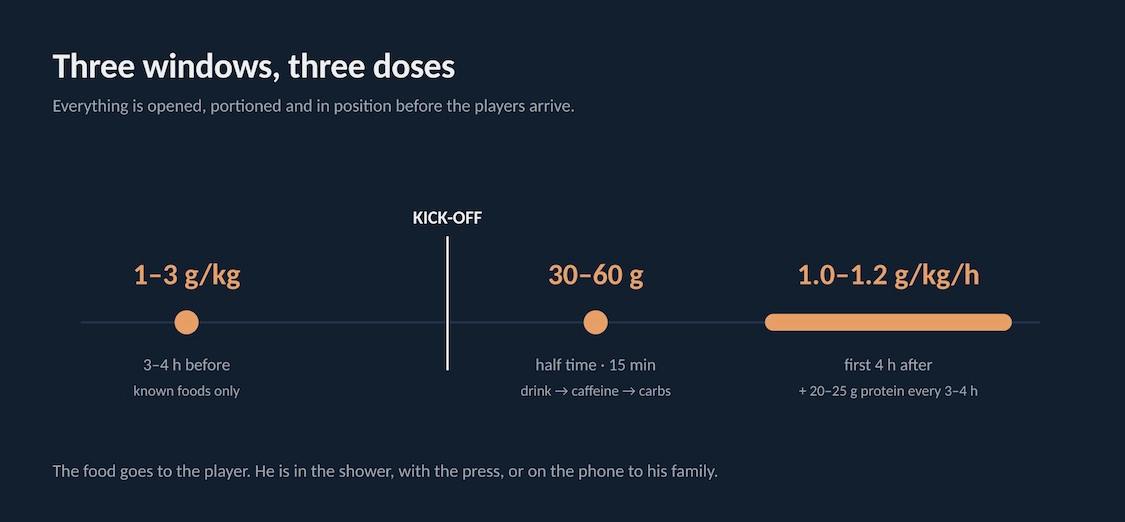
- Pre-match meal 3–4 h before kick-off, 1–3 g/kg of carbs. Known foods only. Match day is not the day to try the new granola.
- Hydration: 5–7 ml/kg in the 2–4 h before kick-off (Collins et al., 2021).
- Dressing room table: bananas, rice cakes, dried fruit, gummy sweets, gels, carb drinks, coffee machine. Ready before the players arrive.
Half time
Three things, in this order: drink, decide on caffeine for the players who use it (and who tested it in training), and keep blood glucose up with 30–60 g of carbohydrate (Burke et al., 2011; Collins et al., 2021). Fifteen minutes is nothing. Everything must be already open and in the right place.
After: the hour nobody owns
After the match the player wants to shower, talk to the press, call his family. Nobody thinks about eating. So the food must go to him. The target is 1.0–1.2 g/kg/h of carbohydrate for the first 4 hours, plus 20–25 g of protein every 3–4 hours (Collins et al., 2021; Thomas et al., 2016).
My trick: make recovery food tasty. In England they call it a performance chef: a cook who knows what athletes need, and why. Ours learned it by working with me. On the bus we serve pokè bowls, sushi, cannelloni, lasagne. Sometimes chicken kebab with homemade protein mayonnaise, chicken wings, burritos, falafel, burgers or fish burgers. Yes, really. But they are our chef’s healthy versions: we take out the less healthy part. A wrap, for example, is just chicken, lettuce, tomato, protein mayo and spices. A player who eats a 900 kcal burrito after the match recovers better than one who leaves a “perfect” salad untouched. With three matches a week I rotate even more, because variety is what keeps them eating.
Toolbox 3: away games
Every away trip, a chef and a maître travel with us, plus me. Before we leave, the hotel receives a written brief. This document saves you every time. Mine includes:
- Arrival: welcome table ready 25 min before check-in, at least four kinds of seasonal fruit, still and sparkling water.
- Room layout: one table for players, one for staff, a coffee station, a basket for phones. Players are served first, all within 15 minutes.
- Buffet by “corners”: carbs, protein, hydration, energy, vitamins. At breakfast the player walks the line and builds his plate without asking anyone.
- Always available: wholemeal pasta, basmati rice and wholegrain rice, even if they’re not on the menu.
- Evening snack on the players’ floor (22:15–24:00): milk, Greek yogurt, fruit, honey, nuts, bresaola.
Travel food
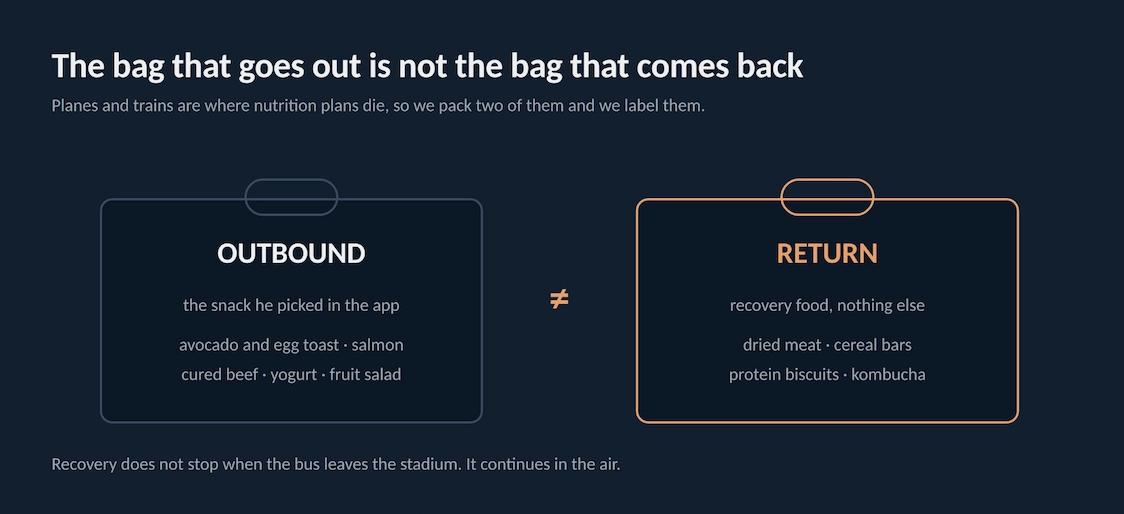
Planes and trains are where nutrition plans die. So we plan them too. The players choose their travel snack from the app before leaving: avocado and egg toast, salmon and cream cheese, bresaola and tomato, Greek yogurt, fruit salad. Nothing from the airline trolley.
We pack two bags, one marked “Outbound” and one marked “Return”. The return bag is recovery food: bresaola sticks, dried meat, veggie chips, baked crisps, cereal bars, protein biscuits, kombucha. Recovery doesn’t stop when the bus leaves the stadium. It continues in the following hours, including in the air.
Toolbox 4: education you can see
Lectures don’t work with footballers. Posters do, if you put them where players look. We have a urine colour chart in every toilet of the training centre. We also put infographics on the TVs of the training centre, for example an infographic on beer and rehydration, because players will drink after a match anyway, and it’s better they know what it does to their fluid balance.
On supplements, my rule is “food first, but not always food only” (Close et al., 2022). Vitamin D in winter, omega-3 for players who don’t eat fish, gels at half time because nobody wants a banana in the 47th minute. We decide case by case after screening: salivary cortisol and IgA and urine tests 48 h after the match, plus a microbiome test twice a season.
What I’d tell myself ten years ago
- Plan 24 hours ahead. If you decide the menu in the morning, you’re already late.
- Same skeleton every meal. Change the content and the portions, not the structure.
- Let players choose. Choice drives adherence.
- The hotel brief is your best friend away from home.
- Post-match food must be tasty. An eaten burger beats an uneaten salad.
- Measure. Skinfolds every month tell you if the system works.
None of this is new. The science is there. What makes the difference is the system you build around it, and the people who cook, serve and pack the bags with you.
References
Anderson, L., Drust, B., Close, G. L., & Morton, J. P. (2022). Physical loading in professional soccer players: Implications for contemporary guidelines to encompass carbohydrate periodization. Journal of Sports Sciences, 40(9), 1000–1019. https://doi.org/10.1080/02640414.2022.2044135
Anderson, L., Orme, P., Naughton, R. J., Close, G. L., Milsom, J., Rydings, D., O’Boyle, A., Di Michele, R., Louis, J., Hambly, C., Speakman, J. R., Morgans, R., Drust, B., & Morton, J. P. (2017). Energy intake and expenditure of professional soccer players of the English Premier League: Evidence of carbohydrate periodization. International Journal of Sport Nutrition and Exercise Metabolism, 27(3), 228–238. https://doi.org/10.1123/ijsnem.2016-0259
Burke, L. M., Hawley, J. A., Wong, S. H. S., & Jeukendrup, A. E. (2011). Carbohydrates for training and competition. Journal of Sports Sciences, 29(Suppl. 1), S17–S27. https://doi.org/10.1080/02640414.2011.585473
Close, G. L., Kasper, A. M., Walsh, N. P., & Maughan, R. J. (2022). “Food first but not always food only”: Recommendations for using dietary supplements in sport. International Journal of Sport Nutrition and Exercise Metabolism, 32(5), 371–386. https://doi.org/10.1123/ijsnem.2021-0335
Collins, J., Maughan, R. J., Gleeson, M., Bilsborough, J., Jeukendrup, A., Morton, J. P., Phillips, S. M., Armstrong, L., Burke, L. M., Close, G. L., Duffield, R., Larson-Meyer, E., Louis, J., Medina, D., Meyer, F., Rollo, I., Sundgot-Borgen, J., Wall, B. T., Boullosa, B., … McCall, A. (2021). UEFA expert group statement on nutrition in elite football. Current evidence to inform practical recommendations and guide future research. British Journal of Sports Medicine, 55(8), 416. https://doi.org/10.1136/bjsports-2019-101961
Nédélec, M., McCall, A., Carling, C., Legall, F., Berthoin, S., & Dupont, G. (2012). Recovery in soccer: Part I – Post-match fatigue and time course of recovery. Sports Medicine, 42(12), 997–1015. https://doi.org/10.2165/11635270-000000000-00000
Petri, C., Pengue, L., Bartolini, A., Pistolesi, D., & Suarez Arrones, L. (2024). Body composition changes in male and female elite soccer players: Effects of a nutritional program led by a sport nutritionist. Nutrients, 16(3), 334. https://doi.org/10.3390/nu16030334
Thomas, D. T., Erdman, K. A., & Burke, L. M. (2016). American College of Sports Medicine joint position statement. Nutrition and athletic performance. Medicine & Science in Sports & Exercise, 48(3), 543–568. https://doi.org/10.1249/MSS.0000000000000852
Powered by Froala Editor