What are force plates and what do they measure?
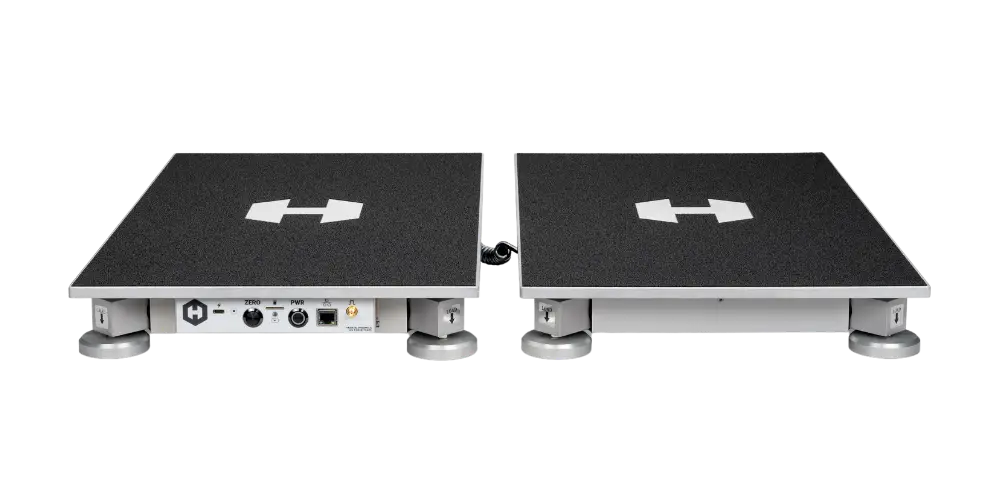
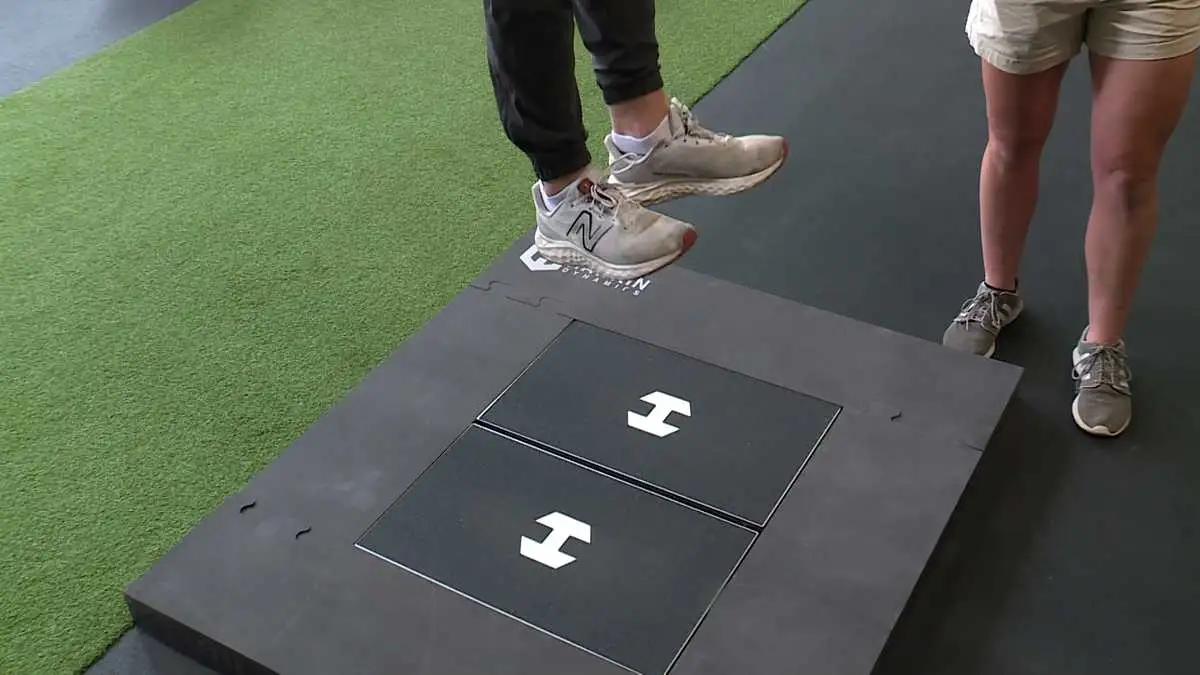
Force plates are devices that record the force an athlete applies against the ground during actions such as jumps or isometric tests. Beyond a final number, they allow us to analyse how force is generated over time, which is key to understanding performance and the player’s neuromuscular status.
Force vs time in force plates
The key value of these tools lies in the force-time relationship. Two players may achieve the same result but with different profiles: one produces force quickly, while the other needs more time. That difference completely changes how performance should be interpreted.
Types of variables
Force plates allow us to analyse different expressions of force depending on the objective.
Maximal Force
It evaluates the athlete’s maximum force production potential. It is used in isometric tests and is linked to both performance and injury prevention.
Power
It measures the ability to apply force explosively. It is key in actions such as jumping, accelerating, or changing direction.
Rate of Force Development
Rate of Force Development indicates how quickly force is generated. In football, it is more relevant to produce force quickly rather than simply producing a large amount of force without time constraints.
Contact Time
It analyses how long the athlete remains in contact with the ground during reactive actions.
How to choose what to measure with force plates
Choosing what to measure with force plates is just as important as the test itself. The issue is not the tool, but how it is used and for what purpose. Before selecting metrics, it is essential to have a clear strategy.
Common mistake - measuring without a prior strategy
One of the most common mistakes when using force plates is replicating protocols without understanding what is actually being measured. In many professional settings, the following tends to happen:
- The same tests used by other clubs or practitioners are applied
- Too many variables are collected without a clear objective
- Data is analysed without considering the player’s context
The problem is not a lack of data, but quite the opposite: too much information without direction. As Soriano points out, the first step is not choosing the test, but defining which capacity we want to measure. Force is not a single quality, but something that can be expressed in different ways depending on the context.
Framework for measurement
To simplify decision-making, the use of force plates can be structured around three main objectives:
- 1. Performance assessment (profiling)
Analyse the athlete’s potential and their ability to produce force in different contexts.
- 2. Fatigue monitoring
Detect changes in neuromuscular status without the need to perform maximal tests.
- 3. Rehabilitation and return to play
Track recovery after injury and ensure a safe return to competition.
Each of these objectives requires different tests and metrics. For that reason, effective use of force plates is not about measuring more variables, but about selecting the right ones according to the context.
Performance assessment with force plates
The goal of profiling is to understand how an athlete produces force and what their potential is in different contexts. To do this, one single test is not enough. It is necessary to combine tests that assess maximal force, explosive capacity, and movement efficiency.
Maximal force (IMTP)
Test: Isometric Mid-Thigh Pull
The Isometric Mid-Thigh Pull (IMTP) is one of the most commonly used tests to assess maximal force with force plates. It is performed in a position similar to a half squat, applying force against a fixed bar. Its main advantage is that it is a safe, simple, and highly reproducible test.
Key metrics
Peak Force
Peak force is the most direct indicator of an athlete’s maximum potential. It is a very stable and easy-to-interpret metric, which makes it a clear reference point in performance analysis.
RFD (>150 ms)
Rate of Force Development measures how quickly force is generated. In practice, it is advisable to analyse it in windows of 150 milliseconds and beyond, because:
- Early RFD (below 150 ms) tends to be highly variable
- Less variable measurements are more useful in applied settings
In this context, one key idea is clear: reproducibility is more important than sophistication.
Ballistic force (CMJ)
Test: Countermovement Jump
The Countermovement Jump (CMJ) is the most widely used test to assess the ability to apply force explosively. Beyond jump height, it allows us to analyse how that performance is generated from a mechanical perspective.
Metrics
Jump height
It is the best-known variable and represents the final outcome of the movement.
Mean force
It helps us understand the level of force applied during the propulsion phase.
Impulse
It links force and time, providing a more complete view of performance.
Power
It integrates force and velocity, making it especially useful in explosive football-specific actions.
Modified RSI (key in football)
What is modified RSI?
The modified Reactive Strength Index relates performance (jump height) to the time required to achieve it. It does not only measure how high a player jumps, but also how long it takes them to produce that performance.
Why it matters and how to apply it in a real environment
In football, the time available to apply force is limited. That is why modified RSI is a particularly relevant metric. It helps identify players who:
- Reach good performance in a short amount of time
- Need more time to produce the same result
This difference is key in real match actions, where execution speed makes all the difference.
J Momentum
The problem: body mass bias
Traditional metrics such as jump height can favour lighter players. This can lead to misleading interpretations in profiles such as centre-backs or strikers, who usually have greater body mass.
The solution: mass × velocity
J Momentum introduces a fairer solution: it combines mass and velocity to evaluate performance. In this way, it does not only assess how high a player jumps, but also how their mass influences that performance.
Real case: centre-backs vs wingers
An 80 kg player who jumps 40 cm may be producing performance equal to or even greater than that of a 60 kg player who jumps higher. J Momentum makes it possible to interpret these cases correctly, avoiding bias and providing a more realistic view of performance in professional football.

How to measure fatigue with force plates
Monitoring neuromuscular fatigue is one of the most valuable day-to-day uses of force plates. Unlike profiling, here it makes little sense to use maximal tests frequently. Instead, simple, quick, and repeatable tests such as the Countermovement Jump (CMJ) are used. The goal is not to measure maximum performance, but to detect changes in the athlete’s condition over time.
Fatigue indicators
One of the most common mistakes is to focus only on jump height. Fatigue does not always appear as a direct drop in performance. In fact, a player may maintain jump height and still be fatigued. The main indicators to consider are:
- Jump height does not always decrease
Similar performance does not guarantee an optimal state.
- Increase in time needed to apply force
The athlete needs more time to generate the same performance.
- Lengthening of the eccentric phase (breaking phase)
An increase in this phase usually indicates neuromuscular fatigue or accumulated muscle damage.
These changes reflect that the neuromuscular system is less efficient, even if the final result (the jump) remains the same.
Same jump ≠ same state
One of the most important ideas in force plate use is understanding that the same result does not imply the same physical condition. Two jumps with the same height may hide very different realities:
- An efficient jump, with rapid force production
- A slower jump, with greater time needed to apply force
In the second case, the player may be accumulating fatigue, increasing injury risk, or reducing their ability to perform in real game situations. That is why fatigue analysis must focus on how the movement is produced, not just on the final result.
Use of force plates in injury rehabilitation
Force plates are a key tool in return to play processes, as they make it possible to objectively track the athlete’s progress during recovery. In this context, the goal is not to measure overall performance, but to analyse precisely how the affected musculature responds and how it evolves over time.
Muscle-specific tests
Unlike general profiling, rehabilitation requires the use of more analytical and specific tests. This makes it possible to focus the assessment on specific structures such as:
- Hamstrings
- Quadriceps
- Other muscle groups involved in the injury
The goal is to isolate, as much as possible, the affected musculature in order to obtain more precise and useful data for decision-making.
Within-subject comparison
In rehabilitation processes, the main reference is not another player, but the athlete themselves. That is why the analysis must focus on within-subject comparison:
- Progress compared to their previous values
- Differences between the injured and non-injured side
- Changes throughout the recovery process
This approach allows practitioners to assess more reliably whether the player is regaining functional capacity.
Progression: from force to rapid force
One of the most important aspects of rehabilitation is understanding that recovery is not limited to maximal force. The process must follow a clear progression:
- Force
Recover the ability to produce force under controlled conditions.
- Rapid force
Reintroduce the ability to generate force quickly, in a way that is closer to the real demands of the game.
Force plates make it possible to monitor both phases, ensuring that the athlete not only regains strength, but also the ability to apply it efficiently in real contexts.
Drop Jump vs Rebound Jump (which one to use)
In reactive strength assessment, one of the most important decisions is choosing the right type of jump. Although the Drop Jump has traditionally been the most widely used, there are more reliable alternatives in applied settings.
Problems with the Drop Jump
The main drawback of the Drop Jump is its low reproducibility in real environments. This is due to variability in execution:
- Variability in the drop
The athlete may let themselves fall differently in each repetition, for example from the toes or with more or less flexion.
- Low reproducibility
It is not always guaranteed that the actual drop height is the same, which introduces noise into the data.
These differences make reliable long-term tracking of performance more difficult.
Advantages of the Rebound Jump
The Rebound Jump (or Countermovement Rebound Jump) offers a more consistent alternative. In this case, the athlete performs a maximal CMJ and, after landing, executes an immediate rebound.
- Natural drop from the CMJ
The drop height is determined by the athlete’s own jump, reducing variability between repetitions.
- Better longitudinal tracking
It allows the athlete to be compared with themselves more reliably over time.
Although there is still some between-subject variability, this approach is more useful in real contexts where the aim is to monitor individual progress.
Common mistakes when using force plates
Using force plates does not automatically guarantee better decision-making. In fact, many mistakes come not from the tool itself, but from how the information is interpreted. Avoiding these errors is key to making the most of their potential in high-performance settings.
Copying protocols from other clubs
One of the most common mistakes is replicating tests or metrics without understanding their purpose. Every context is different, and what works in another team may not be valid in yours. The key is to adapt measurement to the objective and the player’s profile, rather than copying external models.
Using too many metrics
Force plates can generate a huge amount of data, but more is not always better.
- Too many variables make interpretation more difficult
- Noise in decision-making increases
- Focus is lost on what really matters
A more effective approach is to select fewer metrics, but better chosen according to the objective.
Ignoring player context
Data has no value if it is not interpreted within the right context. Factors such as:
- Position on the pitch
- Body mass
- Injury history
- Moment in the season
can completely change the meaning of a metric.
Obsessing over jump height
Jump height is one of the most commonly used metrics, but also one of the most misunderstood. Focusing only on this value can hide key information about:
- How the movement is produced
- Neuromuscular efficiency
- The player’s fatigue status
In many cases, two jumps with the same height can represent completely different situations.

Conclusion: how to really use force plates
Force plates are not just a measurement tool, but a way of making better decisions in high-performance environments. Their value does not lie in the data they generate, but in how that data is interpreted within the athlete’s context.
Three key tips for proper use in high performance
- It is not just a tool → it is a decision-making system
- Fewer metrics, better selected
- Context > data
Additional resources
To learn more about force plate protocols and metrics: