Eccentric training has become one of the most important pillars of modern physical preparation in football. However, although many professionals talk about performance, strength, or injury prevention, it is rarely explained what actually happens inside the muscle when this type of stimulus is applied.
In this episode of FSI Talk, Alberto Filter, coordinator of FSI Lab and podcast host, speaks with professor and researcher Martino Franchi about the muscular adaptations produced by eccentric training and its impact on performance, rehabilitation, and injury prevention in football.
Who is Martino Franchi?
Martino Franchi is an Associate Professor of Human Physiology at the Università degli Studi di Padova (Italy) and one of the leading researchers in skeletal muscle physiology and neuromuscular adaptations to training.
His scientific work focuses on:
- Muscle and tendon adaptations to training
- Eccentric and plyometric training
- Injury prevention
- Sports performance
- Rehabilitation and return to play
- Applied physiology in football
In addition, he collaborates with Universitätsklinik Balgrist and actively participates in FSI Training master’s programs related to strength & conditioning, return to play, and injury prevention.
What is eccentric training really?
One of the most interesting points of the conversation is the clarification around the term “eccentric training.”
It is often used as a general concept, but Franchi explains that not all eccentric work produces the same adaptations.
The eccentric contraction
An eccentric contraction occurs when the muscle produces force while lengthening.
For example:
- Descending into a squat
- Decelerating after an acceleration
- Changing direction
- Absorbing impact during running or jumping
In football, these actions are constant.
Eccentric overload: beyond conventional training
What is the difference compared to traditional training?
In conventional training, the load used during the concentric and eccentric phases is usually the same.
For example:
- You lift 100 kg
- You lower those same 100 kg
The problem is that the body can generate more force during the eccentric phase than during the concentric phase. This means that the lowering phase is “understimulated.”
Eccentric overload aims precisely to solve this:
- Specifically overload the eccentric phase
- Generate greater mechanical tension
- Stimulate greater structural adaptations
Martino Franchi’s study on eccentric overload
During the episode, Franchi explains one of his most recent studies published in the American Journal of Physiology - Cell Physiology.
The study compared:
- Conventional training
- Eccentric overload training
Although the study was conducted in rats, the findings help explain physiological mechanisms that are difficult to measure directly in humans.
Main findings
1. Greater sarcomerogenesis
Eccentric overload training produced a greater increase in the number of sarcomeres in series.
This is important because sarcomeres are the functional units of muscle.
More sarcomeres in series imply:
- Longer muscle fascicles
- Greater force production capacity
- Better tolerance to stretching
- Improved mechanical efficiency
2. Different adaptations with the same strength improvement
One of the most interesting findings was that both groups improved maximal strength similarly.
However:
- The conventional group developed one set of adaptations
- The eccentric group developed completely different structural adaptations
This demonstrates that it is not only important how much an athlete improves, but also how muscle tissue adapts internally.
Why is this important in football?
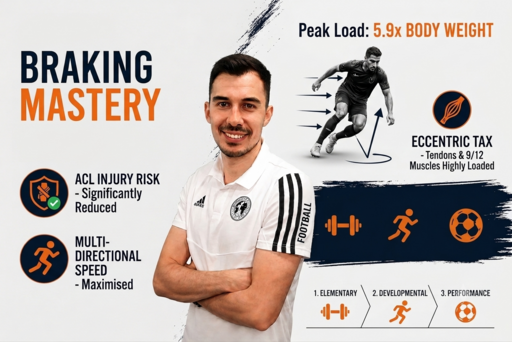
In football, many injuries occur during eccentric actions:
- Sprinting
- Decelerations
- Changes of direction
- Jumps and landings
- Braking actions
Therefore, improving the muscle’s ability to tolerate tension during lengthening may be key to:
- Reducing muscle injuries
- Improving force production
- Optimizing performance
- Increasing player resilience
Does eccentric training cause more muscle damage?
Yes, and this was another of the central topics of the episode.
Franchi explains that eccentric training usually causes:
- More fatigue
- More muscle damage
- More DOMS (delayed onset muscle soreness)
But this does not mean it is negative.
The key lies in proper dosage.
How to integrate eccentric overload into football
According to Martino Franchi, eccentric training should be treated as a high-intensity tool.
Main recommendations
1. Introduce it progressively
A high volume should not be applied from the beginning.
Ideally:
- Start with microdoses
- Increase progressively
- Allow tissue adaptation
2. Prioritize the preseason
Preseason is the best time to develop deep structural adaptations.
Then, during the season:
- The stimulus is maintained
- Volume is adjusted
- Interference with competitive performance is avoided
3. Monitor volume and velocity
One of the most interesting aspects of the conversation is the importance of monitoring:
- Execution velocity
- Volume
- Intensity
- Accumulated fatigue
Especially in work involving:
- Flywheel training
- Eccentric overload
- Velocity-based training
Flywheel training and eccentric overload
Flywheel training appears as one of the most interesting tools for generating eccentric overload.
Why?
Because the energy generated during the concentric phase returns during the eccentric phase through inertia.
This allows for:
- Greater eccentric tension
- Greater neuromuscular recruitment
- More specific stimuli
Muscle adaptations and injury prevention
One of the most important concepts explained by Franchi is that structural adaptations can expand the muscle’s ability to produce force at different muscle lengths.
This could help to:
- Improve tolerance to rapid stretching
- Reduce injury risk
- Improve efficiency during sprinting and changes of direction
In sports such as football, where mechanical demands are extremely high, these adaptations have enormous practical value.
Science and practice: the philosophy of FSI
The conversation also leaves a very clear message: the need to connect science and practice.
Martino Franchi highlights that one of the greatest values of FSI Training is precisely connecting:
- Researchers
- Strength and conditioning coaches
- Rehabilitation specialists
- Scientists
- Football coaches
With the objective of transferring scientific knowledge directly to the field, more scientific content can be explored within the FSI Lab.
Key takeaways from the episode
The most important insights from this conversation
- Eccentric training produces unique adaptations
- Eccentric overload may generate greater structural changes
- More strength does not always mean the same internal adaptations
- Proper dosage is key to avoiding excessive fatigue
- Flywheel training is a highly useful tool in football
- Muscle adaptations may help with injury prevention
- Applied science must be transferred to the real context of football
Listen to the full FSI Talk episode
If you work in:
- professional football
- physical preparation
- rehabilitation
- sports performance
- injury prevention
This episode provides an in-depth perspective on how to truly adapt muscle tissue through eccentric training.
You can discover more content and specialized education at FSI Training.