What is integral periodization? The synergy between gym and pitch
In elite football, there is no "Holy Grail" of training; everything depends on context. However, the integral periodization proposed by José Jiménez and Miguel Ángel Campos moves away from rigid models to focus on one fundamental idea: harmony.
Unlike traditional physical preparation, where the gym and the pitch often seem to speak different languages, this model integrates both worlds under the same technical-tactical objective. The key is not to "do more," but to compensate.
The pillars of the integral model:
Avoiding iatrogenesis: The main objective of gym work is to compensate for the demands of the pitch. If tactical training has overloaded the posterior chain, the strength session should not "hit" the same area, but instead readjust tensions to avoid injuries caused by the training itself.
Individual metric analysis: internal and external load (via GPS) are monitored to predict the mechanical profile of the session. If today's training includes high volumes of sprints and accelerations, the movement curriculum in the gym adapts in real time.
The pitch as the cornerstone: The design of football tasks drives the process. The strength and conditioning coach is no longer an isolated figure, but an architect who builds the physical foundation based on what the coach seeks tactically.
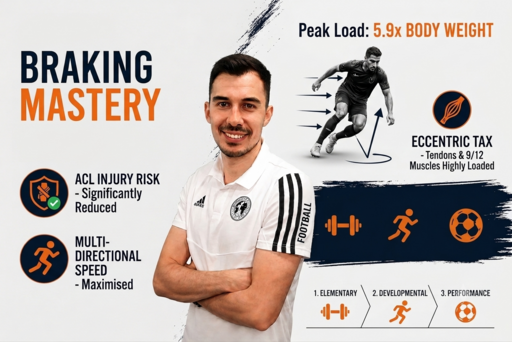
Key insight: Integral periodization aims to train based on high-intensity actions (acceleration, deceleration and changes of direction), turning the gym into a laboratory for direct transfer to the game.
The microcycle: variability within stability
One of the most common mistakes in high performance environments is maintaining a linear load that eventually leads to a steady state or performance plateau. José Jiménez proposes a disruptive strategy: variability within stability.
Instead of repeating the same structure every week, the training plan is organised into 6-week blocks. The goal is to micro-accentuate different stimuli without understimulating the others.
The rotation of GPS metrics in professional football
To optimise sport performance, mechanical priorities are rotated within the microcycle:
| Block (weeks) | High priority | "Fallow" state (maintenance) |
|---|---|---|
| Weeks 1–2 | Game pace | Speed and acceleration (stable) |
| Weeks 3–4 | High speed (sprints) | Pace (low level) and acceleration (moderate) |
| Weeks 5–6 | Acceleration / deceleration | Sprint (maintenance) |
This load management approach avoids monotony and drastically reduces the risk of muscle injuries. By "stimulating" the neuromuscular system with different emphases, the player remains in a constant state of adaptation, always within a healthy range monitored through GPS metrics.
Expert note: The aim is not to eliminate sprinting in week 1, but to adjust the volume. It is an intelligent "micro-stimulation" that ensures the player reaches match day in peak condition.
Microdosing and individualisation: the "secret" of scientific success
In the video, José Jiménez challenges the myth of long gym sessions. Integral periodization is based on the concept of microdoses: short training bouts of 15 to 20 minutes (or even less) performed daily before pitch training. As he says himself: "You should always knock on the door, but never bang on it or break it down."
For these doses to work, player individualisation relies on three parameters that José explains in detail:
- Player profile: Age, experience and metric status.
- Global microcycle: The accumulated and planned load.
- Position and game model: The specific high-intensity demands the player faces according to their tactical role.
"Striking" results: the Cádiz CF study
One of the most impactful moments of the talk is when José mentions his research published in Biology of Sport. After a 9-month study with the Cádiz CF academy, comparing integral periodization with a traditional approach, the results were clear:
- Significant improvement in high-intensity actions (10 m and 30 m sprints, CMJ jumps and changes of direction).
- 50 percent reduction in non-contact muscle injuries, a crucial metric for any professional coaching staff.
Beyond muscle: cognitive strength
The episode concludes with a disruptive perspective: strength training is not only a tissue adaptation, but also a central adaptation. Integrating strength training into the perception–action cycle allows the player not only to be stronger, but also to make better decisions under fatigue.
Conclusion: from the laboratory to the elite stadium
The FSI Talk #18 is not just an interview; it is a roadmap for professionals seeking excellence. José Jiménez’s transition from being an FSI student to leading the strength department at Bayer Leverkusen demonstrates that evidence-based education is the fastest path to elite football.
Do you want to take the next step in your career? Do not stop at this summary. Access José Jiménez’s full classes at FSI Training and master the methodology that is transforming European football.