Dr Thomas Dos'Santos
In multidirectional sports, acceleration and top-end linear speed have traditionally dominated both research and training paradigms. However, competitive football match data reveal a different reality: elite footballers perform significantly more high-intensity deceleration (DEC) actions than accelerations during match play (Harper et al., 2019). Despite this prevalence, horizontal braking and deceleration remain overlooked locomotor skills, despite their fundamental importance for multidirectional performance and the prevention of non-contact injuries.
The Extreme Biomechanical Impact
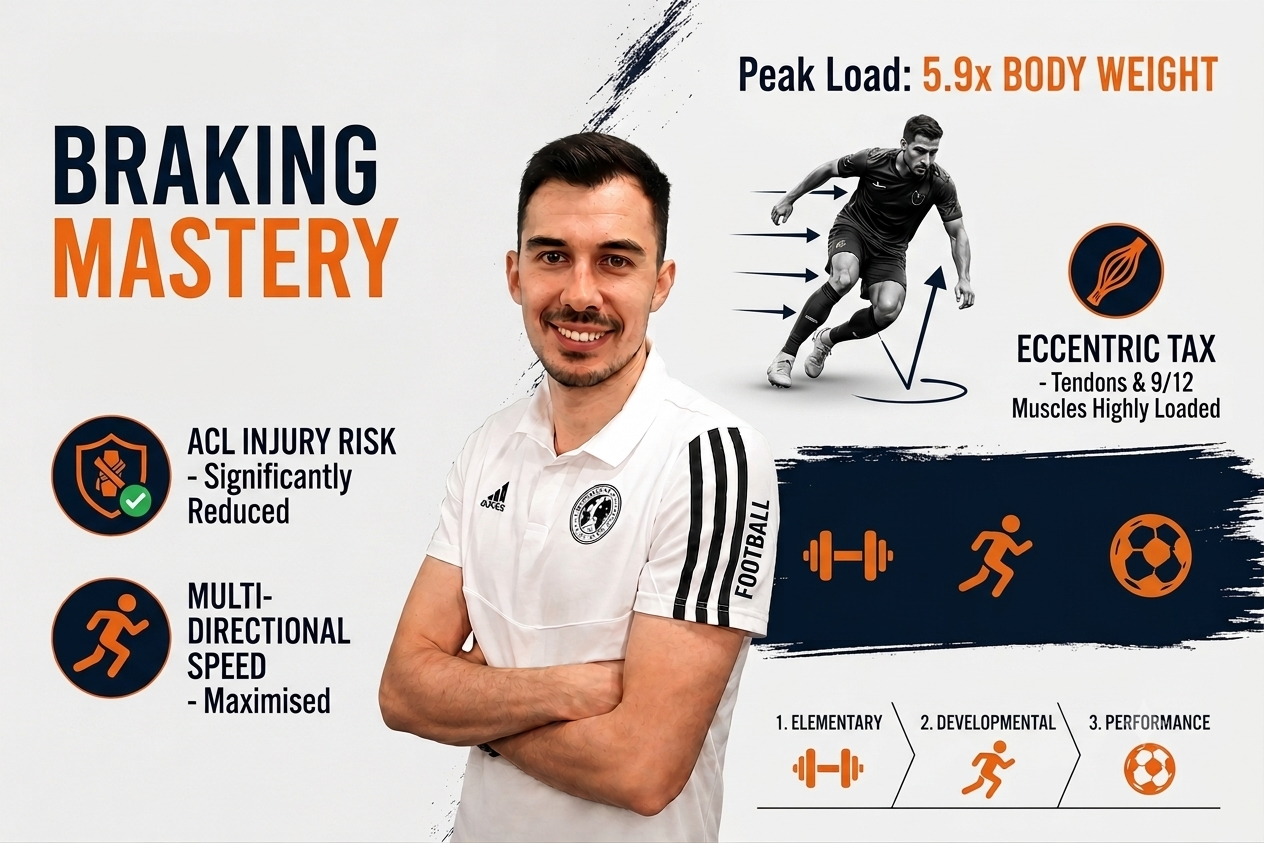
Executing a rapid change of direction (COD) or a sudden stop while sprinting exposes athletes to unique and substantial mechanical demands. Whereas peak acceleration forces increase progressively, maximal deceleration generates an immediate and highly aggressive ground reaction force (GRF) profile, reaching peaks of up to 5.9 times body weight (BW) with exceptionally high loading rates.
This external stress translates into significant internal tissue loading:
- Tendon force demands: Recent musculoskeletal modelling (Verheul et al., 2024) demonstrates extremely high peak forces in both the patellar tendon and Achilles tendon during the first braking step.
- Neuromuscular requirements: Nine of the twelve major lower-limb muscles perform intense eccentric contractions to attenuate impact forces and absorb kinetic energy through negative work. The gluteus maximus and gluteus medius generate the highest eccentric forces during the first 45–55% of ground contact to stabilise the pelvis and hip (Verheul et al., 2024).
When these loading cycles are repetitive or poorly managed, they contribute to neuromuscular fatigue and tissue damage, potentially leading to mechanical fatigue failure.
Of particular concern is that rapid decelerations performed with poor movement mechanics generate substantial multiplanar knee loading, increasing anterior tibial shear forces and knee abduction moments. This is especially relevant because video analyses have shown that rapid decelerations during defensive pressing actions are involved in approximately 58–66% of non-contact anterior cruciate ligament (ACL) injuries (Lucarno et al., 2021; Della Villa et al., 2020).

Profiling True Braking Capacity
To effectively manage these demands, practitioners must first be able to accurately quantify deceleration performance. Traditional timing gates cannot capture the progressive loss of velocity and momentum that characterises braking.
Instead, deceleration performance should be assessed using technologies capable of measuring instantaneous velocity, such as radar, laser, or LIDAR systems. Using dedicated Acceleration-Deceleration Ability (ADA) protocols, sprint-to-stop tests, and rapid change-of-direction assessments such as the 505 test, practitioners can obtain key metrics including:
- Distance-to-Stop (DTS)
- Time-to-Stop (TTS)
- Mean deceleration relative to entry velocity (Harper et al., 2026)
Technical Blueprint and the Braking Performance Framework
Developing a robust and adaptable athlete requires exposure to a structured progression of braking training while simultaneously refining specific technical adaptations.
1. Technical Mechanics: "Brake Hard Early"
Whenever possible, athletes should learn to distribute negative work across multiple braking steps rather than relying on a single aggressive stopping action.
Key technical coaching points include:
- Lower the centre of mass (COM) by flexing the hips ("sit back") to maximise dynamic stability.
- Place the foot well ahead of the COM with a negative tibial angle, directing the ground reaction force vector backwards.
- Maintain an upright or slightly backward-leaning trunk at ground contact to reduce hamstring strain and prevent excessive forward trunk collapse.
2. Systematic Training Progression
Following the Braking Performance Framework (Harper et al., 2024), physical preparation should progressively develop the force–velocity continuum through three distinct phases.
| Phase | Training Methods | Primary Adaptations |
|---|---|---|
| Braking Elementary | General structural strengthening through resisted eccentric exercises (e.g., Nordic hamstring curls, hamstring slides), yielding eccentric isometrics, and landing control drills. | Increased maximal eccentric strength, enhanced connective tissue capacity, and improved ability to attenuate braking forces. |
| Braking Developmental | Fast eccentric training using planned deceleration drills, snap-downs, drop catches, overcoming and oscillatory isometrics, and plyometric landing exercises. | Improved rate of force development (RFD), enhanced muscle pre-activation, faster postural adjustments, and increased musculotendinous stiffness. |
| Braking Performance | Highly sport-specific applications in open environments, including unanticipated decelerations, agility drills, and small-sided games. | Enhanced technical execution under neurocognitive demands, faster decision-making, and improved sport-specific coordination. |
By following a systematic progression—from developing tissue capacity to performing chaotic and unpredictable deceleration tasks—strength and conditioning coaches can build a true "physical vaccine", expanding an athlete's deceleration reserve, reducing injury risk, and enhancing multidirectional performance (McBurnie et al., 2022).
References
- Della Villa, F., Buckthorpe, M., Grassi, A., Nabiuzzi, A., Tosarelli, F., Zaffagnini, S., & Della Villa, S. (2020). Systematic video analysis of ACL injuries in professional male football (soccer): injury mechanisms, situational patterns and biomechanics study on 134 consecutive cases. British Journal of Sports Medicine, 54(23), 1423–1432.
- Harper, D., Cervantes, C., Van Dyke, M., Evans, M., McBurnie, A., Dos' Santos, T., et al. (2024). The Braking Performance Framework: Practical Recommendations and Guidelines to Enhance Horizontal Deceleration Ability in Multi-Directional Sports. International Journal of Strength and Conditioning, 4(1).
- Harper, D. J., Carling, C., & Kiely, J. (2019). High-Intensity Acceleration and Deceleration Demands in Elite Team Sports Competitive Match Play: A Systematic Review and Meta-Analysis of Observational Studies. Sports Medicine, 49(12), 1923–1947.
- Harper, D. J., Philipp, N. M., Eriksrud, O., Jones, P. A., Graham-Smith, P., & Dos' Santos, T. (2026). Assessing Deceleration Performance: Methodological and Practical Considerations. Sports Medicine, 56(1), 1–22.
- Lucarno, S., Zago, M., Buckthorpe, M., Grassi, A., Tosarelli, F., Smith, R., & Della Villa, F. (2021). Systematic Video Analysis of Anterior Cruciate Ligament Injuries in Professional Female Soccer Players. The American Journal of Sports Medicine, 49(7), 1794–1802.
- McBurnie, A. J., Harper, D. J., Jones, P. A., & Dos' Santos, T. (2022). Deceleration Training in Team Sports: Another Potential "Vaccine" for Sports-Related Injury?. Sports Medicine.
- Verheul, J., Harper, D., & Robinson, M. A. (2024). Forces Experienced at Different Levels of the Musculoskeletal System During Horizontal Decelerations. Journal of Sports Sciences, 42(23), 2242–2253.
Article written by Thomas Dos'Santos
Reader in Strength and Conditioning & Sports Biomechanics at Manchester Metropolitan University, with research focused on the biomechanics of change of direction, sports performance, and injury prevention. He has authored more than 120 peer-reviewed scientific publications.