

How can you improve speed in football? The answer goes far beyond running fast in a straight line. Football players need to accelerate over short distances, change direction, react to opponents, and reach high speeds when the game demands it.
In this article, you'll discover 5 football speed drills designed to develop these abilities, with practical training recommendations and references to scientific research involving Irineu Loturco, Bernardo Requena, and Alberto Fílter, researchers and performance specialists associated with FSI Training.
Speed is not a single physical ability
Acceleration, maximum sprint speed, curved sprinting, change of direction, and reactive agility involve different physical and perceptual demands. A comprehensive training program should address each of these abilities according to the individual needs of the player.
How to improve football speed according to science
Speed plays an important role in decisive attacking and defensive situations: winning a loose ball, attacking open space, recovering defensively, or beating an opponent.
However, not all high-speed actions require the same physical qualities. A 5-meter acceleration, a 30-meter sprint, and a 90-degree change of direction involve different combinations of force production, technique, and movement control.
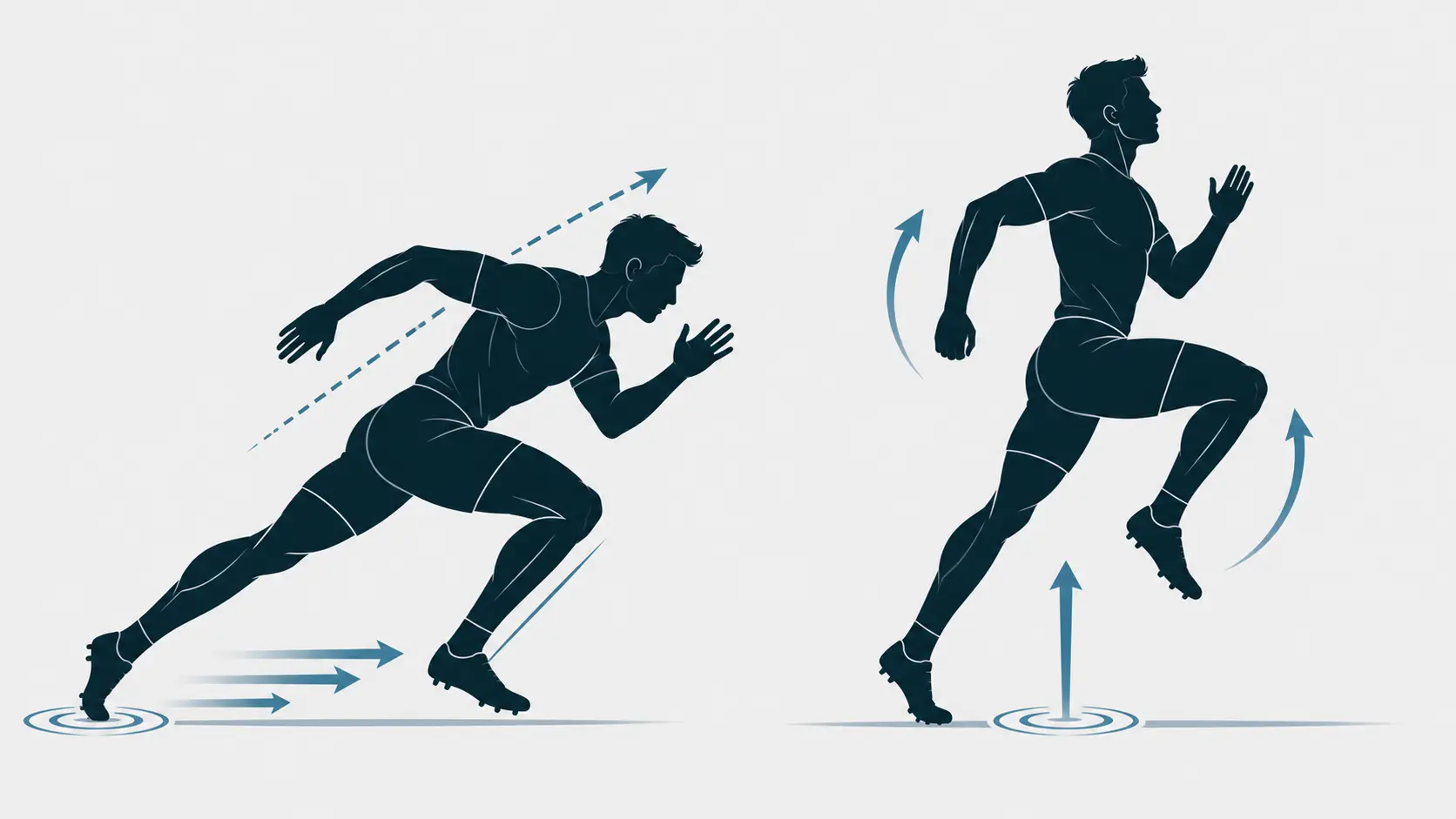
In 2026, Irineu Loturco, Bernardo Requena, and colleagues analyzed data from 248 professional football players across 11 training interventions. The average improvements observed were 0.52% over 10 meters and 0.90% over 20 meters.
These findings suggest that improving sprint performance in highly trained football players is possible, although adaptations are often relatively small and should be interpreted according to the distance assessed and the athlete's competitive level.
Source: Loturco et al. (2026), Journal of Strength and Conditioning Research.
What types of speed should football players train?
| Physical ability | What it involves | Application in football |
|---|---|---|
| Acceleration | Rapidly increasing running speed | Winning a duel over the first few meters |
| Maximum sprint speed | Reaching high running velocities | Longer runs into open space |
| Change of direction | Decelerating, redirecting movement, and accelerating again | Off-the-ball movements and defensive adjustments |
| Curved sprinting | Running at high speed along a curved path | Curved runs and pressing actions |
| Reactive agility | Perceiving a stimulus, making a decision, and adjusting movement | Responding to an opponent's dribble or movement |
5 football speed drills to improve performance
The following exercises target different aspects of speed performance. The suggested distances, repetitions, and recovery periods are practical examples, not universally validated training protocols for every football player.
1. 5- to 20-meter sprints to improve acceleration
Acceleration allows players to reach high running speeds over very short distances. In football, it is particularly important during explosive starts, attacking runs, pressing actions, and transitions.
Short-distance sprints performed with maximal intent are a simple and specific way to develop this ability.
How to perform the drill
- Mark distances of 5, 10, and 20 meters.
- Start from a stable position, alternating between static and dynamic starts.
- Accelerate with maximal intent throughout the distance.
- Perform 2 to 4 repetitions per distance, depending on the player's training level.
- Allow sufficient recovery to maintain sprint quality, for example, 1 to 3 minutes depending on the distance and intensity.
Training objective: improve the ability to accelerate and generate running speed over short distances.
To progress the exercise, coaches can introduce different starting positions or movements that resemble specific actions within the game.
Sprint quality matters more than accumulating distance
When the objective is to improve acceleration or maximum sprint speed, accumulated fatigue can reduce the quality of the training stimulus. Prioritizing high-speed execution and sufficient recovery is generally more appropriate than performing progressively slower repetitions.
To explore complementary strength training methods, read our article on strength exercises to improve acceleration in football, based on the teachings of researcher Irineu Loturco.
2. Change-of-direction sprints to improve deceleration and reacceleration
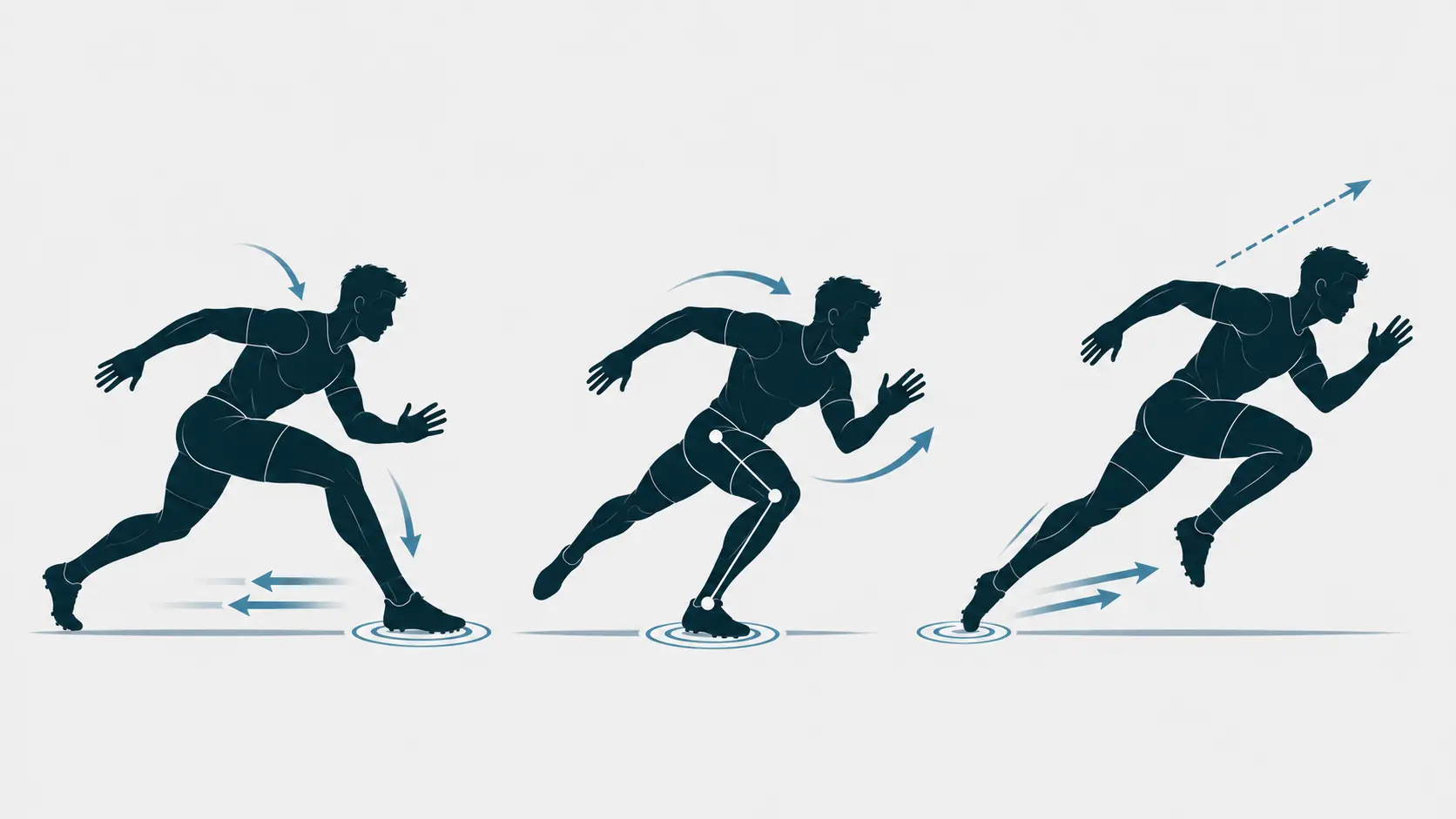
Changing direction in football requires players to control their approach speed, decelerate, and generate a new impulse in the intended direction.
Therefore, change-of-direction training should consider not only total completion time but also braking mechanics and the ability to accelerate again after redirecting movement.
How to perform the drill
- Position three cones to create a route involving directional changes of approximately 45 to 90 degrees.
- Establish running segments of 3 to 5 meters.
- Accelerate toward the first cone and reduce speed in a controlled manner before changing direction.
- Accelerate toward the next point, alternating turns to both sides.
- Perform 3 to 5 high-quality repetitions per direction, adjusting the recovery periods as needed.
Training objective: develop deceleration control, body repositioning, and the ability to accelerate after changing direction.
A 2021 study by Fílter, Requena, Loturco, and colleagues compared linear sprinting, curved sprinting, and change-of-direction performance in 33 football players. Although relationships were identified between these abilities, the researchers observed that curved sprinting and change-of-direction performance demonstrated relatively independent characteristics.
Therefore, training a single running pattern does not guarantee improvements across every form of multidirectional speed.
Source: Fílter et al. (2021), Journal of Human Kinetics.
For a deeper understanding of how movement angles and approach speed influence change-of-direction performance, explore our article on the relationship between change-of-direction angle, speed, and movement efficiency in football.
3. Curved sprints to develop speed along game-specific running paths
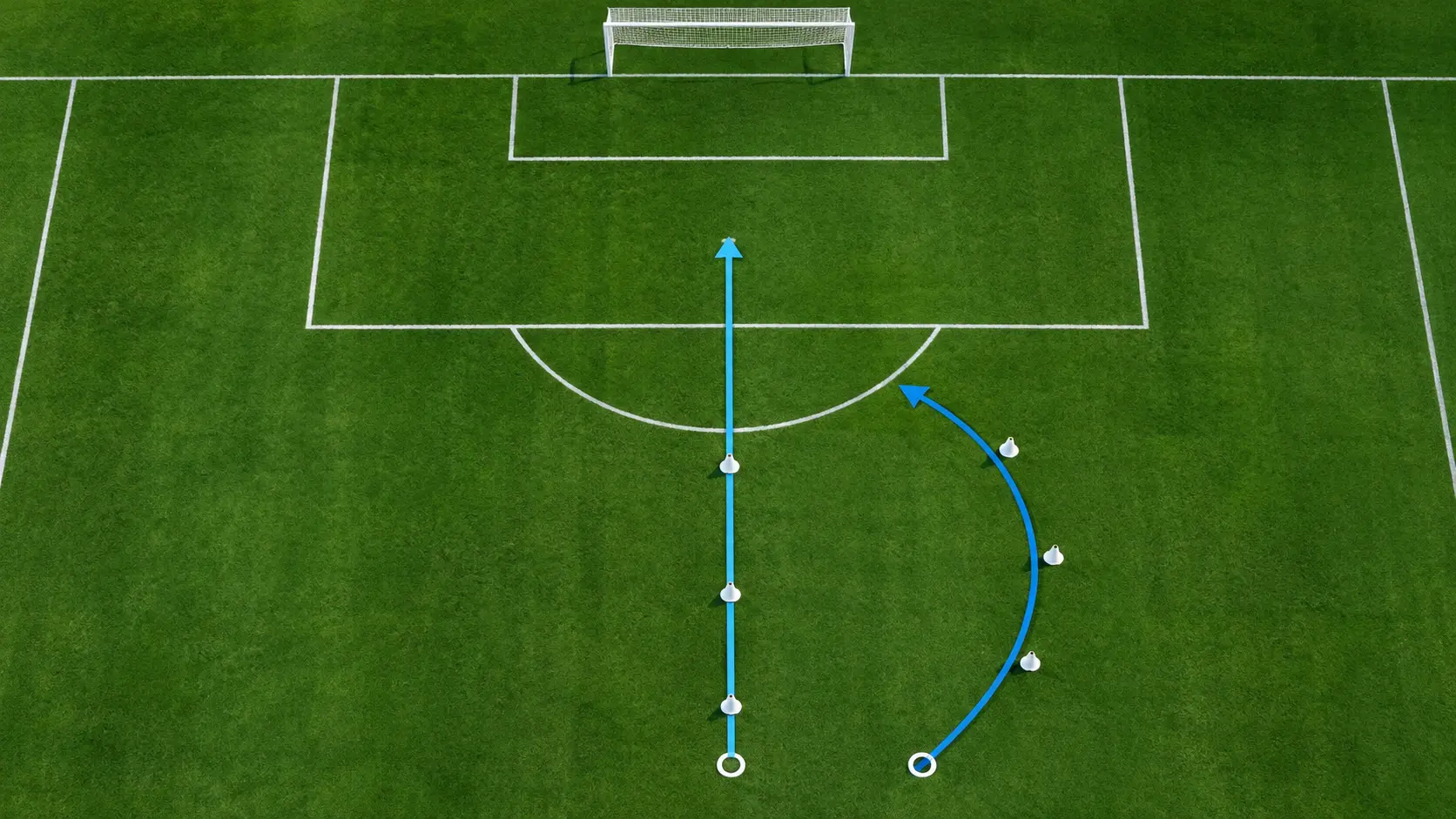
Football players do not always sprint in straight lines. Many attacking runs, defensive pursuits, and pressing movements require curved running paths.
Curved sprinting is particularly interesting because it combines running speed with the ability to maintain a nonlinear trajectory.
How to perform the drill
- Arrange several cones to create a smooth curved route approximately 15 to 20 meters long.
- Sprint along the marked trajectory without making abrupt directional changes.
- Repeat the drill following curves to both the right and left.
- Record sprint times in both directions when reliable timing equipment is available.
- Start with 3 to 4 repetitions per direction, allowing full recovery between efforts.
Training objective: improve the execution of high-speed curved runs and identify potential performance differences between running directions.
Applied research involving FSI Training experts
Loturco, Fílter, Requena, and colleagues studied 28 under-20 football players and identified meaningful relationships between linear sprint speed and curved sprint performance.
Their findings suggest that assessing curved running performance in both directions can be valuable. However, because this was an observational study, the results do not establish that improving linear sprint speed automatically leads to better curved sprint performance.
Source: Loturco et al. (2020), Biology of Sport.
A subsequent investigation by Loturco, Requena, and colleagues (2026), involving 51 elite female football players, also identified associations between linear sprint speed, curved sprinting, change-of-direction ability, and muscular power. These findings support the value of assessing these physical qualities together.
Source: Loturco et al. (2026), Journal of Strength and Conditioning Research.
For a practical example of curved sprint assessment, explore our article on the Penalty Arc 17-0-5 curved sprint test, related to the work of researcher Alberto Fílter.
4. Reactive sprint drills using visual stimuli and decision-making
Agility in football involves more than simply changing direction quickly. Players must also perceive information from their surroundings, interpret it, and produce an appropriate movement response.
As a result, a preplanned cone drill and a reactive movement task involving an opponent do not assess exactly the same ability.
How to perform the drill
- Mark out an area measuring approximately 10 × 10 meters.
- Position one player opposite a teammate who will act as the attacker.
- The attacker initiates a movement toward either side.
- The defender must react, adjust their footwork, and follow the movement.
- Perform short efforts lasting approximately 2 to 4 seconds, with sufficient recovery between repetitions.
Training objective: integrate perception, decision-making, and movement responses in a more football-specific environment.
A simple visual stimulus, such as a colored signal, can also be used. However, a stimulus generated by a teammate or opponent may better represent the information players must interpret during competitive situations.
In a 2025 study involving 87 under-15 football players, agility tests using specific stimuli were better at distinguishing competitive levels than preplanned change-of-direction tests.
This finding highlights the importance of assessing responses to stimuli, although it does not demonstrate that any particular drill directly improves competitive performance.
Source: Menezes et al. (2025), Journal of Strength and Conditioning Research.
5. Resisted sprints to develop acceleration
Resisted sprint training introduces an external load during running. Its purpose is to modify the mechanical demands of sprinting, particularly during acceleration.
One of the most commonly used tools is a weighted sled, which allows coaches to adjust the resistance. Resistance bands and uphill sprints are also possible alternatives, although they do not necessarily produce identical training stimuli.
How to perform the drill
- Use a sprint sled on a suitable training surface.
- Select a resistance that allows the player to maintain controlled sprint mechanics.
- Perform resisted sprints over distances of 10 to 20 meters.
- Complete 4 to 6 repetitions, adjusting the volume according to the player's training level.
- Rest for approximately 2 to 3 minutes, or as long as necessary to maintain sprint quality.
- When appropriate, combine resisted and unresisted sprint training.
Training objective: improve the ability to apply force during acceleration while accounting for individual player characteristics.
Sled loads should not be prescribed exclusively as a fixed percentage of body mass. Effective resistance also depends on surface friction, equipment, and individual athlete characteristics.
Does more resistance lead to better results?
Not necessarily. Heavier loads alter sprint mechanics and running velocity. Their usefulness depends on the training objective, individual tolerance, and how resisted sprinting is integrated with other speed and strength training methods.
In a study published in 2017, Loturco and colleagues investigated mixed training approaches combining power training with resisted sprints or plyometric exercises in professional football players. Both programs produced improvements in sprint and change-of-direction performance indicators during the intervention.
These findings support the use of combined training strategies without demonstrating that a single method is superior for every player.
Source: Loturco et al. (2017), Frontiers in Physiology.
How to organize football speed drills within a training session
It is not necessary to include all five exercises in the same training session. Exercise selection should depend on the physical qualities being developed, accumulated training load, age, training experience, and competitive schedule.
When speed development is the primary objective, high-intensity neuromuscular training should generally be performed after an appropriate warm-up and before substantial fatigue has accumulated.
Example of a football speed training session
| Exercise | Suggested volume | Training objective |
|---|---|---|
| Progressive warm-up | 10-15 min | Preparation for sprinting |
| Linear sprints | 4 × 10 m | Acceleration |
| Curved sprints | 2 × 15 m per direction | Nonlinear sprint performance |
| Change-of-direction drills | 3 repetitions per direction | Deceleration and reacceleration |
| Reactive agility drill | 3-4 short efforts | Perception and movement response |
This session is an illustrative example for football players with previous training experience. It has not been experimentally validated as a complete training protocol. Total volume and recovery periods should be adjusted to individual needs.
For further insights into distributing physical training tasks throughout the week, read our article on microcycle planning in youth football, based on the teachings of Alejandro Olivares.
Common mistakes when training speed in football
- Confusing speed development with repeated-sprint ability: performing repeated efforts with very short recovery periods changes the primary training stimulus.
- Training exclusively in straight lines: football also requires curved runs and changes of direction.
- Confusing agility with change-of-direction speed: reactive agility involves perception and decision-making.
- Always training under fatigue: accumulated fatigue can compromise high-speed movement quality.
- Using the same resisted sprint load for every player: identical loads do not necessarily produce equivalent demands across athletes.
- Failing to assess progress: monitoring sprint times over 5, 10, and 20 meters, alongside multidirectional tasks, helps coaches interpret training adaptations.
Frequently asked questions about football speed training
What are the best exercises to improve speed in football?
Useful exercises include short-distance sprints, high-speed running, change-of-direction drills, curved sprints, and resisted sprint training. The best choice depends on whether the objective is to improve acceleration, maximum sprint speed, or the ability to respond to game situations. No single exercise is superior for developing all these abilities.
How many times per week should football players train speed?
The appropriate frequency depends on competitive level, match schedule, and accumulated training load. One or two dedicated weekly speed exposures may serve as a planning reference in certain contexts, but there is no universally optimal frequency. Coaches must also consider sprinting and other high-speed actions performed during team training sessions and matches.
Can football players improve speed through ball drills alone?
Ball-based exercises can integrate technical, tactical, and perceptual components, but they do not guarantee sufficient exposure to maximum sprint speed or high-quality acceleration efforts. Combining football-specific tasks with targeted physical training can provide a more comprehensive approach.
What is the difference between acceleration and maximum sprint speed?
Acceleration refers to the ability to increase running velocity. Maximum sprint speed is the highest running velocity a player can achieve. Although these abilities are related, they require training stimuli and strategies that are not exactly the same.
How can coaches measure improvements in football speed?
One approach is to periodically measure sprint times over distances such as 5, 10, and 20 meters. Change-of-direction performance and curved sprinting can also be assessed using consistent testing protocols. Improvements should be interpreted in relation to measurement error, testing conditions, and individual variability.
Learn to develop football speed like a professional strength and conditioning coach
Designing an effective speed training program requires understanding the physical demands of football, interpreting scientific evidence, and individualizing training loads.
Through the FSI Training Master's in Football Strength and Conditioning, you can deepen your understanding of strength development, speed training, and other physical qualities that influence performance, with education delivered by specialists and researchers working in professional football.
FSI Training also maintains a network of more than 55 partner clubs and offers access to voluntary internship opportunities, subject to the conditions and availability of each placement.
From scientific knowledge to professional football performance
Learn from professionals and researchers working in high-performance football.
Explore the Football Strength and Conditioning Master'sScientific references
The following studies support the scientific concepts discussed throughout this article. The suggested drills are practical training applications rather than direct reproductions of the experimental protocols used in each study.
- Loturco, I., et al. (2026). Sprint Speed Adaptations in Elite Soccer Players: Are Improvements Greater Over Longer Distances? Journal of Strength and Conditioning Research. DOI: 10.1519/JSC.0000000000005643.
- Loturco, I., et al. (2026). Interrelationships Among Linear Sprinting, Curve Sprinting, Change-of-Direction Ability, and Power Output in Elite Female Soccer Players. Journal of Strength and Conditioning Research, 40(6), 695-701. DOI: 10.1519/JSC.0000000000005398.
- Loturco, I., et al. (2020). Curve sprinting in soccer: relationship with linear sprints and vertical jump performance. Biology of Sport, 37(3), 277-283. DOI: 10.5114/biolsport.2020.96271.
- Fílter, A., et al. (2021). The Relationship Between Performance and Asymmetries in Different Multidirectional Sprint Tests in Soccer Players. Journal of Human Kinetics, 79, 155-164. DOI: 10.2478/hukin-2021-0069.
- Loturco, I., et al. (2017). Mixed Training Methods: Effects of Combining Resisted Sprints or Plyometrics with Optimum Power Loads on Sprint and Agility Performance in Professional Soccer Players. Frontiers in Physiology, 8, 1034. DOI: 10.3389/fphys.2017.01034.
- Menezes, G. B., et al. (2025). Agility and Not Change of Direction Speed Discriminates Competitive Level in Young Soccer Players. Journal of Strength and Conditioning Research, 39(10), e1169-e1177. DOI: 10.1519/JSC.0000000000005172.
Powered by Froala Editor