Fundamentals and benefits of strength training in football
Strength training in football is based on the development of neuromuscular capacities that improve movement efficiency, joint stability, and power output in key actions such as sprints, jumps, or changes of direction. Among its main benefits are injury risk reduction, improved physical and technical performance, and better running economy, all essential to maintain a high competitive level throughout the season.
Types of strength applied to football (max strength, power, strength-endurance and reactive strength)
In football strength training, it is essential to understand that there is not just one type of strength, but several manifestations that must be trained specifically.
Maximal strength: foundation of performance; improves the ability to apply more force in less time, essential for duels, jumps, and changes of pace.
Power strength: converts strength into speed; key for accelerations, shooting, and vertical jumps.
Strength-endurance: allows maintaining intensity throughout the match, delaying muscular fatigue.
Reactive strength: improves the efficiency of the stretch-shortening cycle, enhancing explosive and repeated actions.
Combining these strength types ensures a faster, more resilient player with a lower risk of injury.
Periodization: preseason, in-season and transition (micro, meso and macrocycles)
Proper periodization of strength training in football helps structure training loads to optimize performance and prevent overtraining.
- Preseason: focuses on building a general strength base and structural adaptation, progressively increasing load.
- In-season: aims to maintain strength and maximize specific transfer to match performance through short, intense sessions.
- Transition: oriented toward active recovery and prevention of muscular imbalances.
Within this planning, microcycles (weekly), mesocycles (monthly), and macrocycles (yearly) allow individualized control of physical and technical progress.

Programs and key exercises in football strength training
Strength training in football must be adapted not only to competitive level, but also to playing position, age, and training environment. In youth categories, the goal is to build a solid motor foundation through global exercises and postural control. In later stages, emphasis is placed on lifting technique, intermuscular coordination, and progressive overload.
Defenders: eccentric strength, duels, aerial play and decelerations
Defenders require high levels of eccentric strength to stop explosive actions, win physical duels, and maintain stability under contact. Training should include eccentric squats, Nordic curls, loaded split squats, and controlled landing jumps. In addition, pulling strength exercises (such as pull-ups or rows) improve aerial ability and ball protection. Deceleration and change-of-direction drills enhance real-game transfer.
Midfielders: COD/agility, core and repeated sprint ability
Midfielders are the players who perform the most high-intensity intermittent efforts. Therefore, they must combine reactive strength and strength-endurance work, focusing on agility (COD – Change of Direction) and core stability. Exercises such as multidirectional lunges, band rotations, isometric core work, and repeated sprints with incomplete rest are essential. This improves metabolic efficiency and the ability to sustain performance for 90 minutes.
Forwards: jumping power, 0–10 m acceleration and finishing
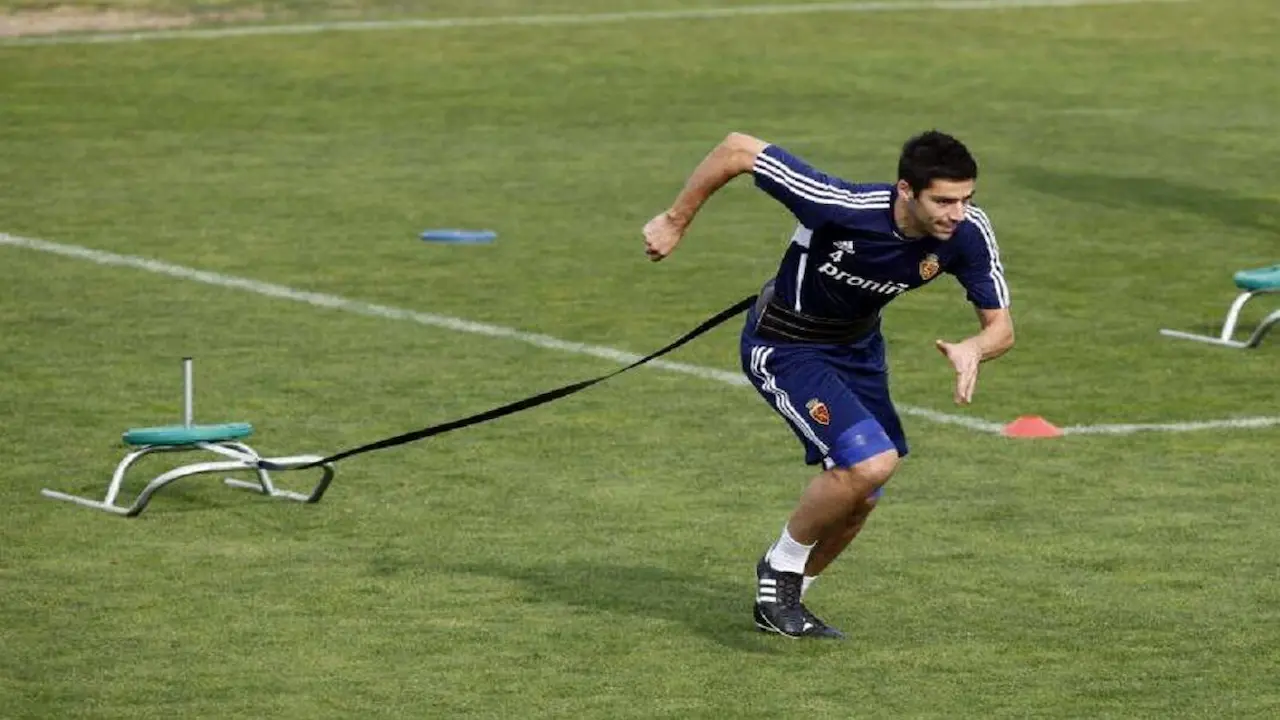
Forwards need maximum explosiveness and reaction speed. Power training should focus on plyometric jumps, short accelerations, and ballistic exercises (such as cleans or medicine ball throws). On-field work like resisted sprints, changes of pace with the ball, and finishing drills after effort helps transfer power into real performance. The goal is to turn every strength action into a competitive advantage.
Goalkeepers: vertical impulse, plyometrics and safe landings
Goalkeepers must develop vertical power, reaction speed, and safe landing mechanics. Exercises such as countermovement jumps, lateral plyometrics, medicine ball slams, and elastic band shoulder stability work are essential. The priority is improving take-off speed and impact absorption, reducing injury risk and enhancing dominance in goal.
Specialize with the FSI Training Coach Master’s Program
If you want to take your knowledge of physical preparation and performance to the next level, the FSI Training Coach Master’s Program offers a complete, practical, and up-to-date education. You will learn from active professionals with a science-based approach to movement and real application in football teams across different levels. It is your opportunity to design effective programs, enhance player performance, and advance your career in coaching and performance training.