
We explored this topic in depth in one of our FSI Talks. Santiago Zabaloy, in conversation with Alberto Fílter, shares the key insights. Zabaloy is a postdoctoral researcher at the Federal University of São Paulo, author of one of the most recent reviews on sprint training (2025), and an active strength and conditioning coach in Argentine rugby. These are the key takeaways.
Can sprint performance be improved in trained footballers?
It depends on who you are training. In young or less experienced athletes, there is considerable room for improvement due to the principle of diminishing returns. The real challenge lies with adult players who already have years of training behind them.
Zabaloy has observed this in his own studies with sprinters and rugby players: when assessed at different points throughout the season, their speed performance changes very little. That is why, before choosing a method, it is worth asking a more specific question: which part of the sprint do I want to improve?
The 3 goals of speed training
Acceleration ability.
This is where adding external resistance, such as a sled, makes sense. The overload stimulates horizontal force production.
Maximum speed.
In short sprints, you do not reach your peak speed. You need longer distances, either unloaded or with light resistance.
Resistance to speed loss.
Reaching peak speed is good; maintaining it is even better. In footballers, peak speed is usually reached between 20 and 30 metres, so sprints of 30 to 50 metres train the ability to sustain it.
A note on horizontal force.
It is high during the first few steps and falls rapidly as speed increases, while vertical forces become greater. Without added resistance, horizontal force never exceeds vertical force, not even at the start. In addition, many sprints in football begin from a moving position rather than from a standstill. Horizontal force is important, but not decisive on its own.
Sled training: heavy or light loads?
This is one of the most heated debates in speed training. Zabaloy's position is clear: there is currently no evidence that very heavy loads are superior to light or moderate loads.
Very heavy loads are those that reduce sprint speed by more than 50%, typically around 80% of body mass. The pioneering study often cited to justify them in footballers has several important limitations:
- It used a statistical method, magnitude-based inference, that is no longer accepted in the scientific literature.
- It did not find clear differences compared with the group that trained without resistance.
- In fact, 40% of the training volume performed by the "heavy" group consisted of unresisted sprinting.
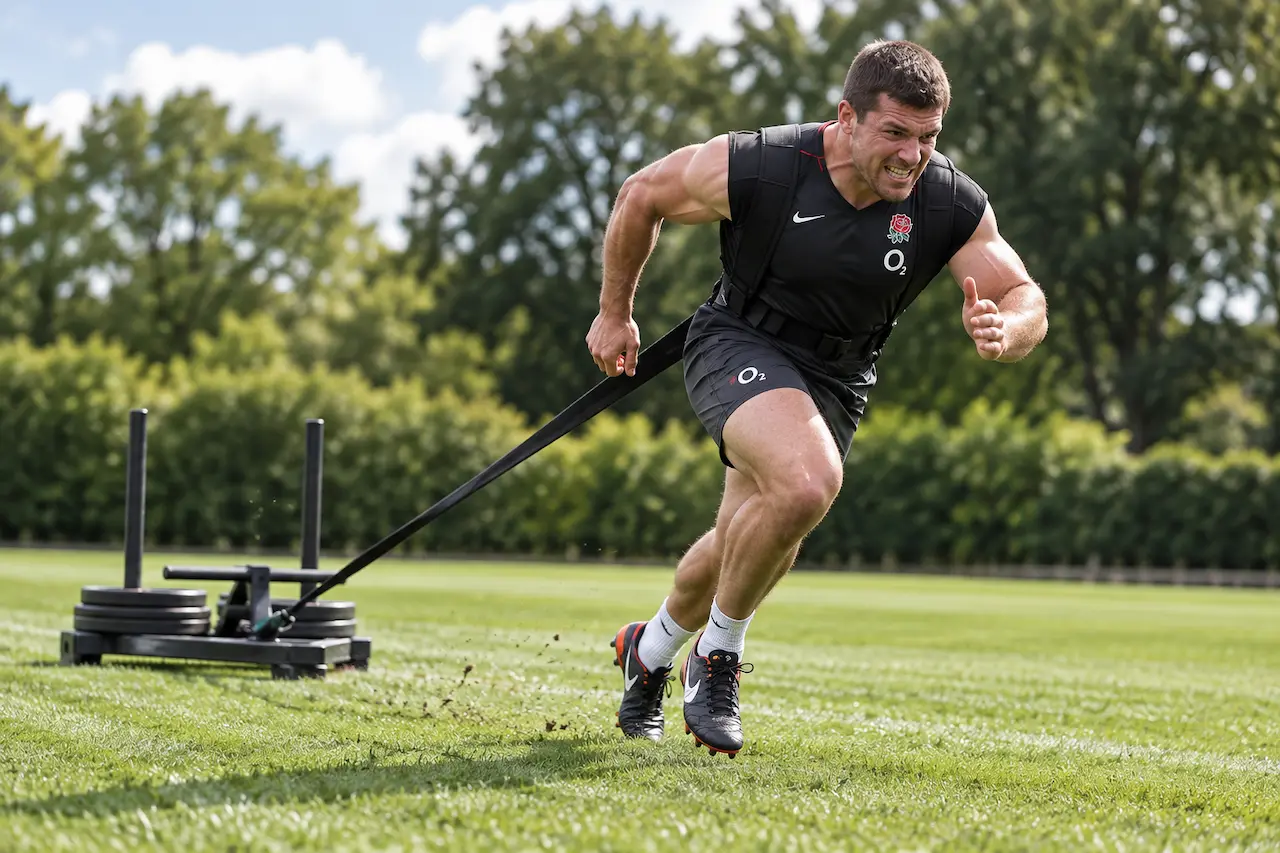
In addition, training in football is concurrent: speed, strength and technical-tactical work all coexist within the same week, and often on the same day. Very heavy loads generate mechanical and metabolic fatigue that can compromise everything that comes afterwards. "If there is no superiority, I choose the option that improves me just as much while creating less fatigue," Zabaloy summarises.
Two practical observations reinforce this point. In a survey of coaches working with some of Brazil's top sprinters, none used loads of this magnitude; most train maximum speed with traditional sprinting and acceleration with light or moderate resistance. Zabaloy's own research group also had to stop two studies using loads above 50% of body mass: after two weeks, the players could no longer tolerate the fatigue.
His most recent research points in the same direction. In a study involving under-19 rugby players, both unresisted sprinting and resisted sprinting at 50% of body mass maintained performance during the season, while only the unresisted sprint group improved 30-metre sprint speed.
What about sprint technique?
In the short term, heavy loads do alter sprint mechanics. As load increases, hamstring activation decreases while quadriceps activation increases. These changes appear with loads that reduce speed by around 30% (≈50% of body mass) and become more pronounced above 50% speed loss (≈80% of body mass).
In the long term, only two studies have examined this, and both have limitations. There is not enough evidence to conclude that technique deteriorates. The argument against very heavy loads is fatigue, not proven long-term technical damage.
How to prescribe sled load
For years, the standard reference was percentage of body mass. Today, the literature proposes a more precise metric: the percentage of velocity loss caused by the load. If a player runs at 10 m/s without resistance and at 5 m/s while pulling the sled, that load causes a 50% reduction in speed.
The drawback is practical: it requires testing every player individually, and with squads of 25 or 30 footballers this is not always feasible. The pragmatic alternative is to prescribe load as a percentage of body mass, bearing in mind that the heavier the load, the more individual responses vary. With light and moderate loads, the response tends to be more consistent between players.
| Load (% body mass) | Approx. velocity loss | Practical interpretation |
|---|---|---|
| Light-moderate (<50%) | <30% | Recommended option in a concurrent training context |
| ≈50% | ≈30% | Threshold from which sprint mechanics begin to change |
| ≈80% | ≈50% | Much greater fatigue, with no proven advantage |
Strength training: beyond "verticalism"
Alberto Fílter raises the question of whether there is too much "verticalism": exercises based on vertical force vectors in a sport that is predominantly horizontal. Zabaloy agrees and adds three key ideas.
- Strength training is a good tool for maintaining speed, but it is difficult to improve speed through strength training alone.
- Football is multidirectional and depends on the opponent, teammates and the ball. A programme limited to hip, knee and ankle flexion-extension neglects the frontal and transverse planes.
- Jumps, plyometrics and ballistic exercises with light loads can help maintain or improve sprint performance.
Maximum loads are not necessary to maintain strength either: 1RM can be maintained or improved with light and moderate loads. "If I only think about the squat when trying to improve speed, I am falling short."
Practical takeaways
- Define the goal before choosing the method: acceleration, maximum speed or resistance to speed loss.
- For maximum speed and the ability to maintain it, use longer distances of 30 to 50 metres.
- When using the sled, favour light to moderate loads: they can produce similar improvements with less fatigue.
- If you cannot measure velocity loss, prescribe by body mass and use sound judgement.
- Train strength in all three planes and include plyometrics and ballistic exercises.
- Keep it simple. Motorised devices can be useful, but with 30 players you need several units for the session to flow properly. A light sled or weighted vest is enough for an excellent session; a vest also allows you to train change of direction, agility and deceleration.
Frequently asked questions
What sled load should you use with footballers?
Light to moderate loads, approximately below 50% of body mass. There is no evidence that very heavy loads improve sprint performance more, and they create substantially more fatigue. In a concurrent training context, that fatigue can compromise subsequent strength and technical-tactical work.
How far should you sprint to improve maximum speed?
In footballers, peak speed is usually reached between 20 and 30 metres. To improve maximum speed and the ability to maintain it, 30 to 50 metre sprints at maximum intensity are recommended, either without resistance or with light resistance.
Is a heavy sled better for improving acceleration?
There is no evidence that it is superior to lighter loads. Studies suggesting otherwise have methodological limitations, such as combining heavy resisted sprinting with unresisted sprinting. When results are similar, the light or moderate option is preferable because it generates less fatigue.
Does heavy sled training worsen sprint technique?
In the short term, it does alter mechanics: hamstring activation decreases while quadriceps activation increases. In the long term, however, the evidence is insufficient to conclude that technique deteriorates permanently.
Can sprint performance be improved through strength training alone?
It is difficult. Strength training is particularly effective for maintaining speed. To improve sprint performance, jumps, plyometrics and ballistic exercises with light loads can help, especially when training across all three planes of movement.
Learn how to apply performance science in football
Knowing what sled load to use is only the beginning. The real challenge is integrating speed work into a genuine concurrent training plan, week after week. In the FSI Training Master's in Football Strength & Conditioning, you will explore these and many other topics in depth with more than 30 FSI Training lecturers and researchers.
Discover the Master's programme
Powered by Froala Editor