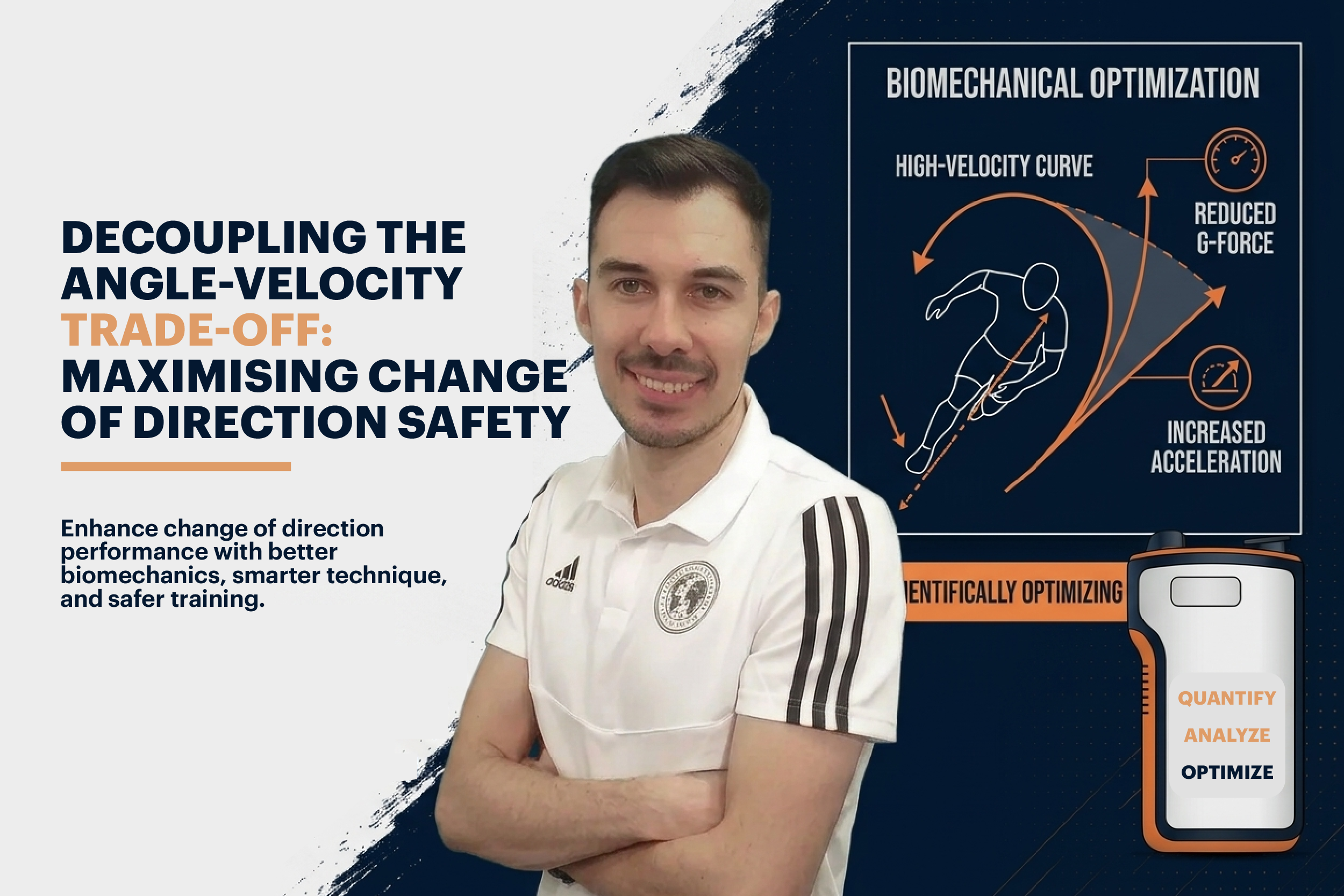
In modern elite football, an athlete's multi-directional speed profile determines their competitive edge. Match-play data reveals that footballers frequently execute hundreds of changes of direction (CODs) per match, displaying a high density of actions across a complex spectrum of angles and approach velocities. Mechanically, a COD is defined as a reorientation and change in the path of travel of the whole-body centre of mass (COM) towards a new intended direction. However, this critical performance attribute highlights an inherent mechanical compromise: the angle-velocity trade-off.
As the sharp-turn and angle demand expands, a transition occurs along a continuum from centripetal acceleration (velocity maintenance) to tangential deceleration (substantial braking). For practitioners, managing this continuum is critical: rapid multiplanar cutting actions are a primary catalyst for non-contact musculoskeletal tissue damage, such as non-contact knee ligament injuries, lateral ankle sprains and adductor injuries.
Biomechanical Regulators of COD Performance
To enhance exit velocity while minimising injury risk, practitioners must evaluate the entire multi-step COD sequence, which comprises preliminary deceleration, postural adjustment, execution (the plant phase), and follow-through re-acceleration (Figure 1).
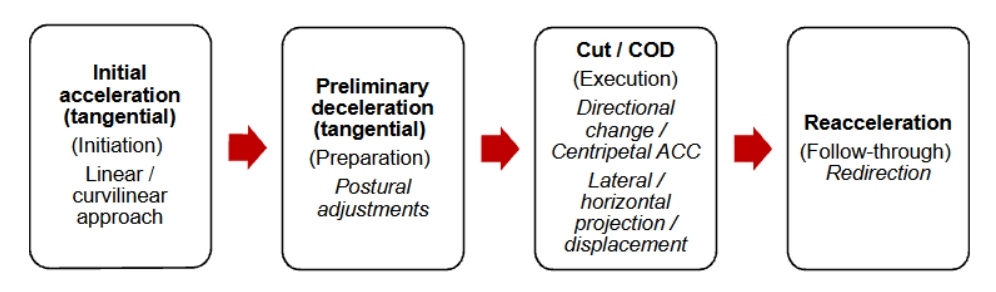
Figure 1. COD phases
A common mistake is to focus entirely on the final foot contact (FFC). In side-step cutting manoeuvres (30–90 degrees) and sharp turns >90 degrees, performance is heavily governed by the preparatory adjustments made during the penultimate foot contact (PFC) and potentially steps prior. The PFC serves as the primary regulator of momentum. Generating a greater sagittal plane braking impulse during the PFC alters kinetic energy efficiently, shifting the mechanical burden away from the turning limb. Because acute ACL ruptures occur within the first 50 milliseconds of touchdown—a window too brief for neuromuscular feed-forward or feedback corrections—reducing velocity prior to the final plant step is a critical strategy for joint unloading and facilitating faster exit performance.
Conversely, executing cuts via "high-risk" mechanical strategies severely exacerbates multiplanar knee joint loads. High knee abduction moments (KAMs) and ACL strain are directly driven by specific postural deficits:
- An excessively wide lateral foot-plant relative to the pelvic midline.
- Extended knee postures coupled with limited hip flexion at touchdown.
- Pronounced lateral trunk flexion and rotation away from the center of mass.
- Aberrant knee valgus, internal hip rotation, and external foot rotation.
The Three-Phase COD Development Framework
To modify these deficits without compromising performance, the Four Pillars of COD Mediation - Perceptual-Cognitive Ability, Periodisation/Monitoring, Technique/Variability, and Physical Capacity—must be advanced via a structured, progressive framework (Figure 2).
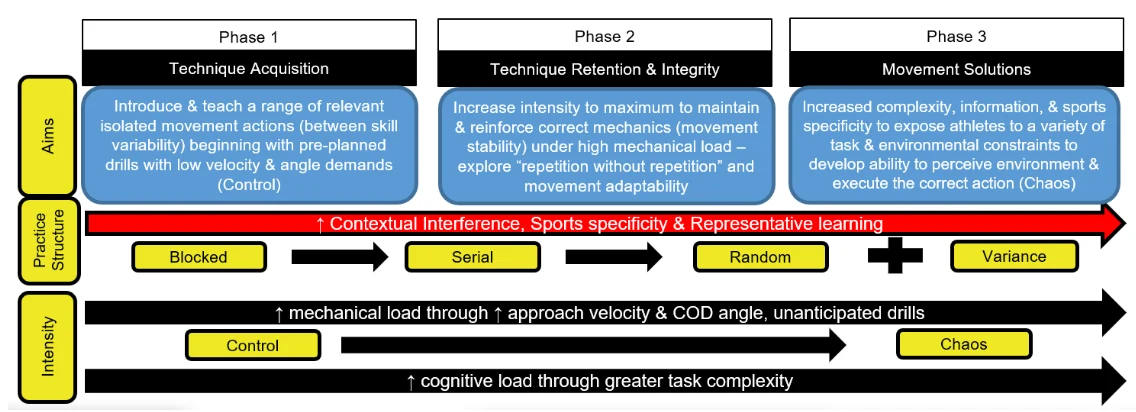
Figure 2. COD framework
Phase 1: Technique Acquisition
Aims:
Introduce isolated movement mechanics, optimise perception-action coupling, and address leg-dominance deficits within closed, pre-planned conditions. Approach velocities are kept low, and angles are highly regulated (45–135 degrees).
Coaching Methodology:
Direct explicit instruction and video biofeedback are deployed to establish fundamental literacy. External verbal cues should target body orientation and braking mechanics:
"Sit and drop the hips early to slam on the brakes, then punch the ground away."
Phase 2: Technique Retention and Integrity
Aims:
Maximise approach velocity and increase COD angles to reinforce mechanical stability under heavy eccentric and multiplanar loads.
Coaching Methodology:
Transition from blocked to serial and random practice structures. Practitioners should introduce within-skill variability (the "Goldilocks effect"), encouraging subtle adjustments in stride length, lower-limb co-flexion, and foot placement to build tissue robustness against mechanical fatigue.
Phase 3: Movement Solutions
Aims:
Expose the athlete to representative, open-loop environmental constraints to cultivate rapid visual scanning, pattern recognition, and perceptual-cognitive speed.
Coaching Methodology:
Utilise task-oriented constraints and small-sided games (SSGs) where players must continuously read and react to defenders.
Practitioner Note on SSGs
While excellent for metabolic conditioning, SSGs can make it difficult to strictly regulate the volume of high-intensity multi-directional actions. Athletes frequently default to their preferred leg-plant or movement strategy. Therefore, micro-dosed pitch-based multidirectional speed "top-ups" (e.g., 20–40 controlled cuts across 230–480 total meters, spaced at least 48 hours apart) must be maintained within pitch warm-ups to preserve tissue homeostasis and ensure symmetrical bilateral robustness.
Article written by Thomas Dos'Santos
Reader in Strength and Conditioning & Sports Biomechanics at Manchester Metropolitan University, researcher specializing in change of direction biomechanics, sports performance, and injury prevention, with more than 120 peer-reviewed scientific publications.