Realistic roadmap to become a football tactical analyst
Start with a foundation in data analysis (even outside football)
The starting point should not be football itself, but a solid foundation in data analysis. Modern tactical analysis requires the ability to interpret quantitative information and turn it into decisions.
Programs in data analysis or data science help develop skills such as data management, pattern recognition, and visualization. Certificates like the Google Data Analytics Professional Certificate or the IBM Data Analyst Professional Certificate are accessible and valuable introductions.
The initial objective is not sports specialization, but building an analytical mindset that can later be applied to football, where data and video are combined to understand performance.
This helps to understand the role of the football tactical analyst within a coaching staff and how their work is structured in a professional environment. Specialized education helps connect theory and practice.
Afterwards, it is necessary to broaden the perspective toward global concepts of the game: tactical systems, phases of play, and coaching staff structure. The goal is to understand how analysis fits into the overall functioning of the team.
Develop key tools
Once you have an analytical foundation and football education, the next step is to master tools that transform analysis into real work.
Excel or Google Sheets are essential for organizing and working with data at a basic level. From there, Python and SQL allow analysts to move toward deeper analysis, although understanding their logic is enough at the beginning.
Python in football tactical analysis
Python is a general-purpose programming language that, thanks to its clear syntax and broad ecosystem of scientific libraries, has become the reference tool for data analysis in professional sports. In football, its use goes far beyond basic statistics: it allows analysts to process large volumes of event and tracking data, build performance models, and generate complex tactical visualizations with relatively little code.
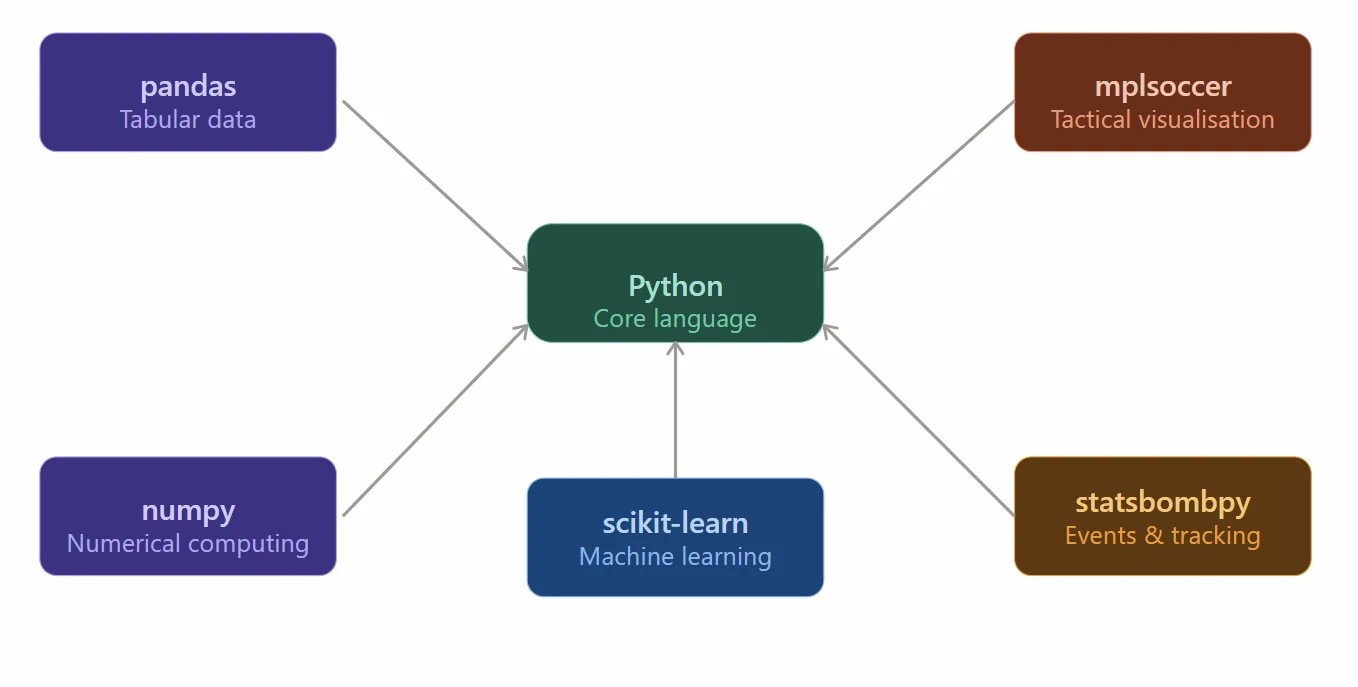
Analysts usually work with a set of specialized libraries. pandas and numpy handle data manipulation and numerical calculations on raw data —positions, passes, pressures, xG—, while mplsoccer allows analysts to draw directly on football pitch representations to visualize heat maps, passing networks, or pressing zones. To access high-quality data, statsbombpy provides detailed professional match events —including open data from competitions such as the Champions League or the Euros—, while libraries like scikit-learn open the door to machine learning: from classifying playing styles to predicting the expected outcome of a specific tactical action.
SQL in football tactical analysis
SQL (Structured Query Language) is the standard language for querying and managing relational databases. In the context of professional football, it is the layer on which virtually all quantitative analysis is built: match data —positions, passes, pressures, shots, duels— are stored in structured tables, and SQL allows analysts to cross-reference, filter, and aggregate them accurately and reproducibly.
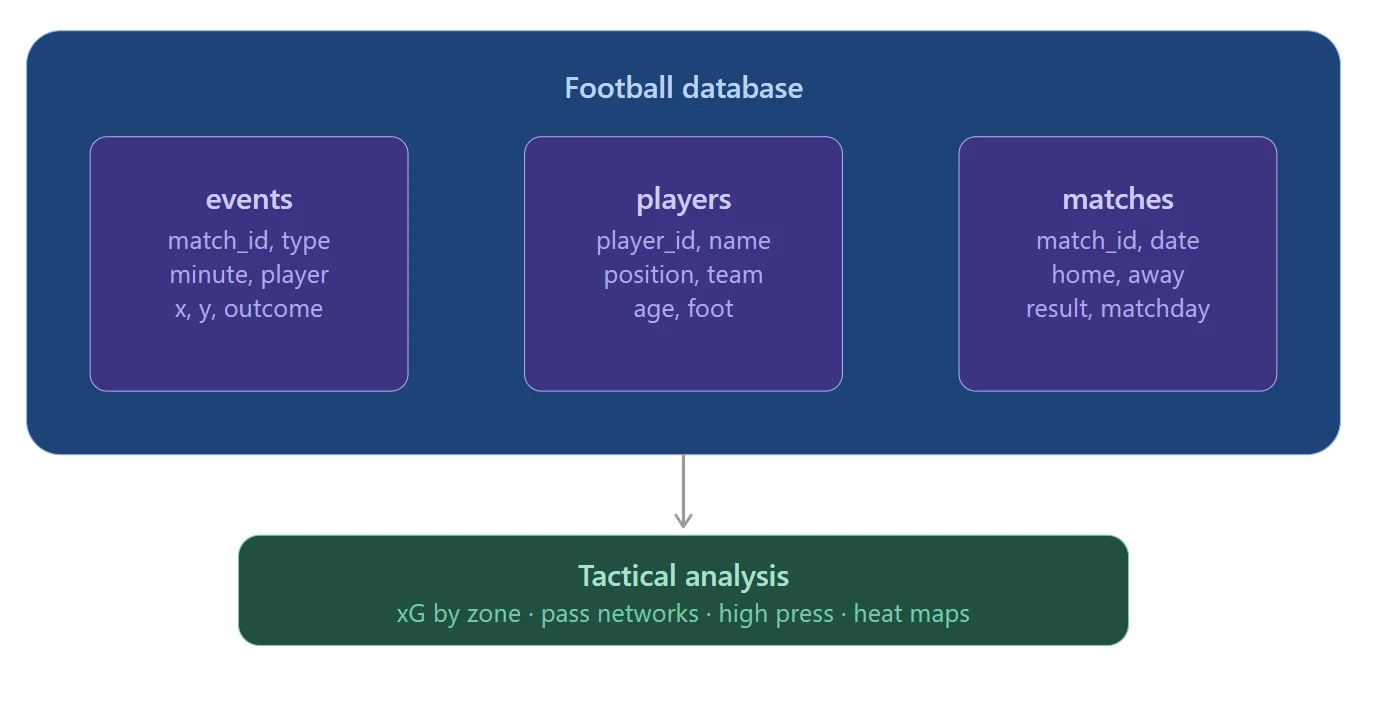
An analyst can use a single query to calculate a striker’s accumulated xG in fast transitions over the last ten matches, or to compare ball recovery rates in the opposition half between two different tactical systems. Tools such as BigQuery, PostgreSQL, or DuckDB are commonly used to store these datasets, while operations such as JOIN, GROUP BY, or WINDOW FUNCTIONS are part of the daily vocabulary of any modern analysis department. SQL does not replace Python; instead, it works alongside it: queries extract and prepare the data that scientific libraries later visualize or model.
AI as support for the football tactical analyst
Artificial intelligence is also a key tool in modern analysis, useful for interpreting data, generating ideas, and optimizing processes.
Finally, tools such as Tableau, Power BI, or video analysis software make it possible to transform information into clear reports that can be applied to the team context.
Practice independently (before working professionally)
Before entering a professional environment, it is essential to develop practical experience on an individual basis.
This involves analyzing full matches, not just isolated actions, and focusing on identifying collective patterns rather than individual plays. The goal is to connect tactical understanding with quantitative analysis: what is observed on video and what can be measured or justified.
It is also important to begin generating clear and structured conclusions that go beyond simply describing the game.
Sharing analysis on platforms such as LinkedIn or Instagram can be a useful way to build visibility and begin developing a differentiated professional profile.
Learn how to communicate analysis
The value of analysis is not only in the ability to interpret it, but also in the way it is communicated.
It is essential to learn how to synthesize information and transform it into clear and useful messages for a coaching staff. This includes creating reports with logical structure and visual support when necessary.
The key concept at this stage is storytelling applied to data: turning complex information into understandable decisions. A good analyst does not present numbers; they present arguments. They select what to show and in what order, build a narrative that takes the coach from the problem to the solution, and choose the format —a chart, a sequence of frames, a comparative table— depending on who will read it and when. Data without context does not convince; well-communicated data changes decisions.
The ultimate goal is for analysis not to remain descriptive, but to translate into concrete actions within team performance.
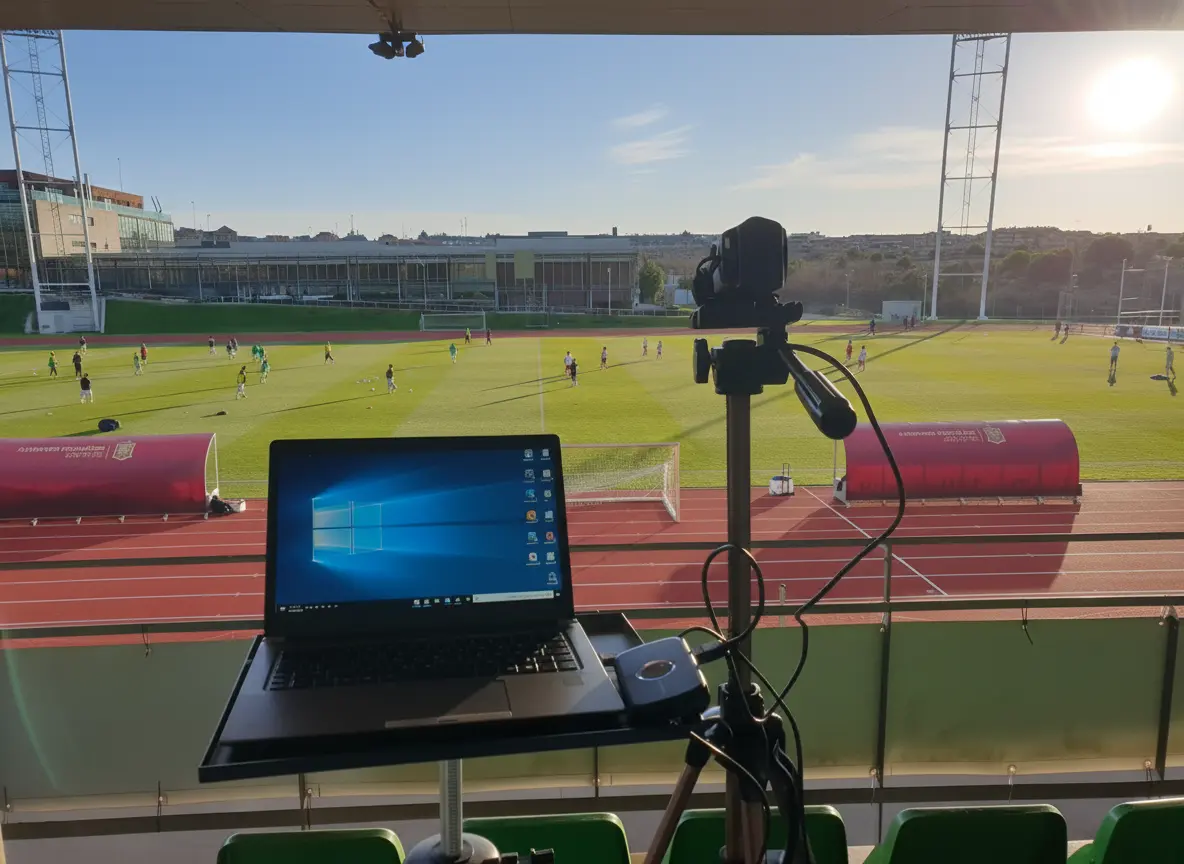
Seek real experience as early as possible
Once you have technical foundations and analytical skills, the next step is to gain exposure to real working environments.
This can happen through internships, collaborations with clubs, or analysis projects. At this stage, the priority is not the conditions, but gaining experience in a professional environment.
To become a professional tactical analyst, it is essential to acquire the knowledge and skills demanded by the most competitive clubs. For that reason, a Football Tactical Analyst Master is a fundamental step toward developing yourself and adapting to such a competitive market.
Maximize opportunities (a key differentiator)
Tactical analysis is a career path with high work flexibility, especially in digital environments.
For that reason, it is important not to limit yourself geographically when looking for opportunities. There are remote work options, international collaborations, and long-distance projects available.
Taking advantage of this flexibility significantly increases the chances of entering the professional sector.
Growth in this field largely depends on the ability to adapt to different contexts and take advantage of opportunities beyond the local environment.
Build your professional profile progressively
The final step of the process is consolidating everything learned into a coherent and competitive professional profile.
This is built through accumulated practical experience, the creation of an analysis portfolio, and the development of a CV focused on professional football.
Beyond education, what truly differentiates an analyst is their ability to demonstrate real work: reports, match analysis, and participation in projects.
The ultimate goal is to position yourself as a professional capable of adding value within a coaching staff by combining analytical foundations, tactical knowledge, and applied experience.
Discover more about the Football Tactical Analyst Master.