Live Football Tactical Analysis: Methods, Tools and Decision-Making
Live tactical analysis in football is playing an increasingly important role in the work of coaching staffs during matches. Although there are now numerous tools and sources of information available, the real challenge lies in knowing what to analyse, how to interpret it and, above all, how to communicate it at the right moment.
During a match, the analyst does not have the same amount of time or the same conditions as in post-match analysis. The game is constantly changing, the coaching staff are working under pressure and many decisions need to be made within seconds.
For this reason, real-time football analysis should be brief, precise and focused on information that can have a practical application during the match.
What Is Live Tactical Analysis in Football?
Live tactical analysis is the process of observing, recording and interpreting what happens during a match in real time. Its objective is to provide the coaching staff with relevant information that can support their analysis and decision-making.
However, there is no single way to analyse a match. Every coach has their own methodology, playing principles and priorities. Therefore, the analyst needs to understand how the coaching staff work and adapt their analysis to their needs.
The fundamental idea is simple: do not analyse something simply because it can be analysed. Before recording an action or creating a report, the analyst should ask what question they want to answer and what conclusion can be drawn from that information.
Why Is Real-Time Analysis Important?
During a match, coaches have to process a large amount of information. They observe the game, communicate with players, assess possible tactical adjustments and manage the pressure of competition.
For this reason, the way information is communicated is particularly important.
The live analyst should not overwhelm the coach with dozens of statistics or observations. Their role is to identify the information that can help the team improve its performance or support a specific decision.
For this reason, live analysis can be summarised in two principles: brief and precise.
The analyst should put themselves in the coach's position and ask:
- What information would I need at this moment?
- What is relevant to the current situation?
- Can this information help support a decision?
- What conclusion can we draw?
From Observation to a Structured Analysis Process
Football can be interpreted in many different ways. Two coaches may have completely different ideas about how a match should be played, meaning that the aspects an analyst considers important may also vary.
Therefore, having a structured process is essential.
The analyst must determine which aspects of the game are relevant based on the coach's methodology, the team's playing principles, the stage of the season and the priorities of the match.
This does not mean following a rigid system. It means developing different analytical approaches and knowing when each one may be useful.
Think before you act is one of the fundamental principles of effective live analysis.
Tools Used in Live Football Analysis
Before developing a live analysis process, the analyst needs to have the right technical tools. Two elements are particularly important: the video feed and coding software.
The Tactical Camera
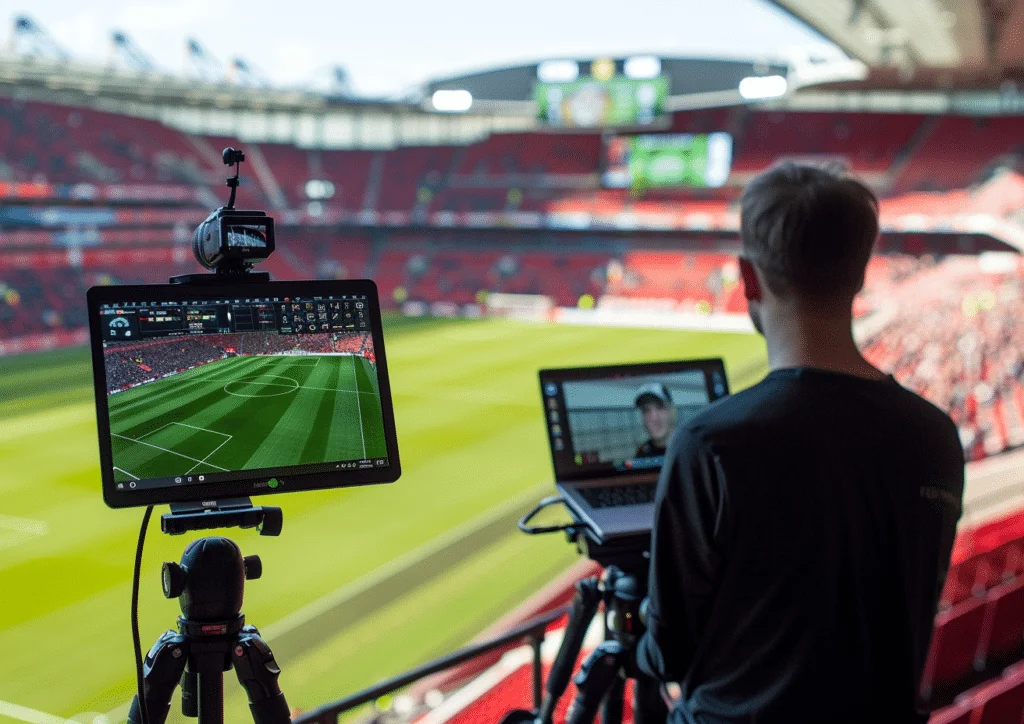
The tactical camera provides a wider view of the pitch than a conventional television broadcast. This makes it easier to observe the positioning and movements of the entire team and better understand collective behaviours.
The television feed can also be useful, particularly for reviewing situations such as refereeing decisions, offside calls, goals or disciplinary actions. Slow-motion replays can provide additional information that may not always be available from the tactical camera.
Using different video perspectives therefore allows the analyst to complement their analysis and gain a more complete view of what is happening during the match.
Coding Software
Coding software allows analysts to organise match actions, create sequences, configure visualisations and generate reports adapted to the needs of the coaching staff.
One of the advantages of flexible software is that analysts can build their own workflow based on the coach's principles and the questions they want to answer.
However, having many technical possibilities can also create a problem: too much information can make the process less effective. The objective is to use the tools to answer relevant questions rather than recording everything simply because it is possible to do so.
Four Methods for Live Football Analysis
One of the main aspects of live analysis is that different methods can be used depending on the objective. Four approaches can be used, ranging from simple tactical coding to more detailed collective and individual statistical analysis.
Method A: Simplified Coding
The first method focuses on identifying the opportunities created and conceded by the team.
The question it aims to answer is simple:
How are we creating danger, and how is the opposition creating danger against us?
This is a technically simple method that allows analysts to isolate the key actions that occur during the match.
Its value lies in the possibility of reviewing the sequences afterwards and identifying details that may not have been detected by the coaching staff during the match. These details may be related to positioning, transitions, pressing or other tactical situations.
Because of its simplicity, it can also be a good starting point for developing the skills required for live analysis.
Method B: Advanced Coding
Advanced coding expands on the previous method by incorporating more detailed information about patterns of play, transitions and attacking and defensive set-piece situations.
Instead of only identifying dangerous situations, the analyst can study situations that help identify opportunities for improvement.
For example, if the opposition uses a specific pressing structure that prevents the team from progressing with the ball, the analyst can study the situation and identify possible solutions.
Another interesting approach is to compare positive and negative actions. A midfielder who does not create movements between the lines may limit the team's ability to progress. When the same player finds space behind the opposition and receives the ball, the sequence can have a completely different outcome.
This type of comparison can help present tactical behaviours to coaches and players in a clear and practical way.
Method C: Collective Coding
Collective coding aims to build a more detailed statistical picture of team performance.
The analyst may record information such as:
- Number of shots.
- Shots on target.
- Shot locations.
- Areas where possession is lost.
- Consequences of possession losses.
- Direction of attacks.
- Speed of attacking sequences.
- How attacking actions end.
This approach allows the coaching staff to receive data that complements the observations made during the match.
For example, instead of simply stating that the opposition is creating too much danger down one side of the pitch, the analyst can provide information about what proportion of attacks are developing through that area.
The main difficulty is that this method requires a high level of concentration and accuracy. Because the analyst is continuously coding, they have less time to stop and study each action in depth.
Method D: Collective and Individual Coding
The final method incorporates individual statistics into the collective information.
Depending on the criteria established by the analyst, this may include:
- Possessions won and lost.
- Interceptions.
- Completed and unsuccessful passes.
- Shots.
- Crosses.
- Individual involvement in the different phases of the game.
The analyst can also establish specific definitions and criteria for each action. For example, it may be necessary to determine what counts as a possession recovery or how to classify a defensive action that stops a counterattack.
This method provides a detailed statistical view of the match and individual performance. However, it is also the most demanding approach, as it requires maintaining concentration and accuracy throughout the entire match.
How to Train Live Tactical Analysis Skills
Developing the skills required for live analysis requires progressive practice.
A good starting point is to begin with the simplest method and simulate match conditions. An entire match can be watched without pausing while focusing on a single aspect, such as defensive situations.
Once this process becomes comfortable, the analyst can incorporate additional elements, such as attacking opportunities, transitions or other tactical situations.
The process should be gradual. Trying to record everything from the beginning can make it more difficult to learn the software and understand the demands of analysing a match in real time.
It is also important to remember that practising from home is not exactly the same as working in a stadium. A real match involves pressure, noise, interruptions and an environment that is constantly changing.
Adapting Analysis to the Coaching Staff
One of the most important skills for a football analyst is understanding the coach's perspective.
The analyst needs to understand the team's playing principles, know what the coach considers important and determine what information can genuinely support their work.
This means that the same analysis may be useful for one coach and less relevant to another.
Therefore, the objective is not to create a universal method, but to develop the knowledge and technical flexibility required to adapt analysis to different situations.
From Live analysis to decision-making
Effective live analysis is not about generating as much information as possible. It is about transforming what happens on the pitch into information that can be understood and used by the coaching staff.
The process can be summarised as follows:
- Identify the question.
- Determine what needs to be analysed.
- Choose the appropriate method.
- Collect and organise the information.
- Interpret the situation.
- Communicate the most relevant conclusion.
This approach allows the analyst to move beyond simply observing the match and provide information with a practical purpose.
The role of the football analyst during a match
Live tactical analysis requires technical knowledge, tactical understanding, concentration and the ability to adapt quickly.
There is no single perfect method. Simplified tactical coding, advanced coding, collective statistics and individual analysis can each provide different types of information.
The important thing is to understand what each method can contribute and know when it is appropriate to use it.
Ultimately, effective live analysis helps the coaching staff understand what is happening, identify relevant patterns and make informed decisions during the match.
Brief. Precise. Purposeful.
This content is based on knowledge and materials developed by Romain Brottes, a professional football tactical analyst.
To become an expert in football tactical analysis, enrol in the FSI Master's in Football Tactical Analysis.