There is a widespread belief in amateur football and also in youth categories: the more protein, the more muscle and the better the performance. However, scientific evidence on sports nutrition paints a much more nuanced picture: there is no magic number, but rather a range that depends on very specific variables.
In fact, a recent meta-analysis on macronutrient intake in football players found that protein is already consumed above recommended levels in both youth and senior categories, while the nutrient that consistently falls short is carbohydrate. This changes the question: it is not so much about "how much more protein can I take", but about understanding what the actual optimal range is and how to distribute it properly throughout the day.
How Much Protein Does a Footballer Really Need?
Why the General Recommendation (0.8 g/kg) Is Not Enough for Football
The recommended daily allowance (RDA) for sedentary populations is 0.8 grams of protein per kilogram of body weight per day. This value is intended to cover basic maintenance needs, not to compensate for the demands of a high-intensity, intermittent sport such as football, which combines strength efforts, repeated sprints and prolonged training sessions.
A footballer needs more protein than a sedentary person for two main reasons: to repair muscle tissue damaged by training and competition, and to have sufficient amino acids available in response to the increased protein oxidation that occurs during prolonged exercise.
What Do Scientific Consensus Statements Say?
There is no single "official" number, but rather different ranges depending on the organization and when the recommendation was published:
- ACSM, Academy of Nutrition and Dietetics and Dietitians of Canada: between 1.2 and 2.0 g/kg/day, according to this review on nutrition in football.
- FIFA / F-MARC (2006): a maximum of 1.2 to 1.6 g/kg/day, although the report itself acknowledges that the evidence is "not clear or universal", as detailed in this study on protein intake in collegiate football players.
- UEFA (the more recent and sport-specific guideline): a higher range of 1.6 to 2.2 g/kg/day, according to the same study.
- Classic Kent State University study: one of the first studies to focus specifically on football, placing the range at 1.4–1.7 g/kg/day in its research on protein requirements in football.
If we consider all these ranges together, the practical consensus for most footballers falls between 1.2 and 2.0 g/kg/day, potentially increasing to 2.2 g/kg during periods of high training load or demanding competition.
How Much Protein Is Needed Depending on the Timing and Context?
According to Competitive Level
Actual protein intake varies considerably depending on the category. A study that analyzed the diets of football players before, during and after official matches found that top-division players consumed an average of 2.2 g/kg/day, compared with values between 1.7 and 1.9 g/kg/day in players from lower national leagues, according to this study on dietary intake according to competitive level. This suggests that the greater the physical demands and match density, the greater the need for (and actual consumption of) protein.
According to the Season Phase
Protein needs are not static throughout the year. During pre-season, with a higher volume of strength and endurance work, it is advisable to move towards the upper end of the range. During the regular competitive season, with weekly matches, the focus is on maintaining recovery between efforts. During injury recovery, especially when there is muscle mass loss due to immobilization, evidence suggests maintaining intake at the upper end of the range to minimize atrophy, even when training volume is lower.
Factors That Actually Determine Protein Needs
Beyond the general range, individual variables adjust the specific amount each player needs.
Body Weight and Composition
The calculation is always based on grams per kilogram of body weight, not absolute figures. This means that two players in the same position and with the same training load may have different total protein needs simply because of differences in body weight.
Training Intensity and Volume
The greater the volume of strength work or the higher the match density, the greater the muscle damage and, therefore, the need for protein for repair and adaptation.
Timing and Distribution Throughout the Day
It is not only about how much protein you consume, but also how you distribute it. Evidence suggests that consuming doses of 20 to 40 grams every 3–4 hours maintains a steady flow of amino acids that supports muscle protein synthesis, as explained in this review on nutrition in football. In relative terms, this is approximately equivalent to 0.25–0.40 g/kg per serving, according to this review on nutritional requirements in football players, which also points out that a slightly higher intake before bedtime, around 0.55 g/kg, may be beneficial.
Protein Quality: Animal, Plant-Based and the Role of Leucine
Not all protein has the same effect on muscle protein synthesis. Leucine, an essential amino acid found in higher proportions in animal sources (meat, fish, eggs and dairy), acts as the main trigger of the anabolic response after intake. This does not mean that plant-based sources are ineffective: legumes, tofu, soy or nuts can fully meet requirements when properly combined and when total intake is adjusted slightly upwards.
The Best Protein Sources for Footballers
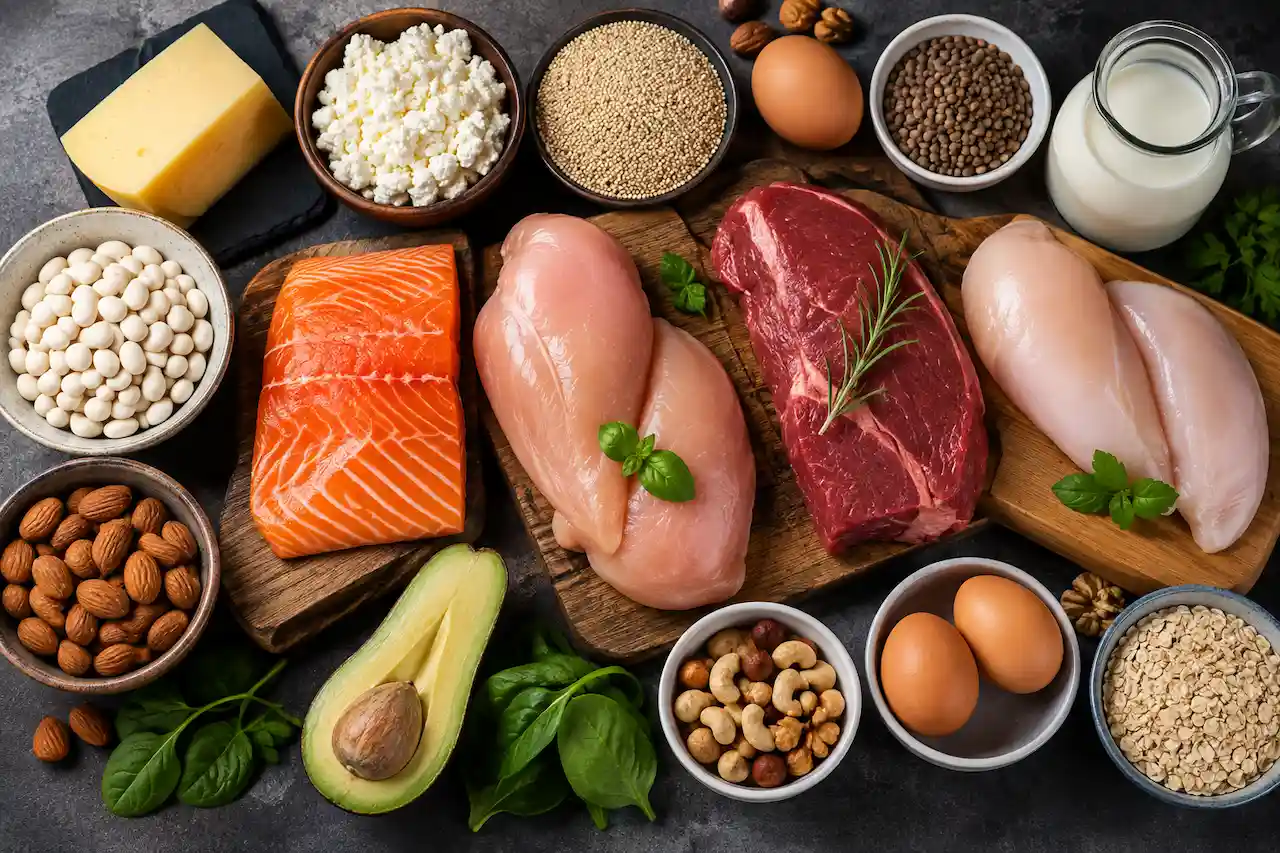
With the range and timing clear, the final step is to choose where that protein comes from. As a general rule, it is advisable to prioritize lean sources and avoid excessive saturated fat that accompanies some animal-based products.
Lean Animal Sources
- Chicken and turkey breast
- White and oily fish (hake, salmon, tuna)
- Whole eggs
- Low-fat dairy products (Greek yogurt, fresh cheese, milk)
Plant-Based Sources
- Legumes (lentils, chickpeas, beans)
- Tofu and textured soy
- Nuts and seeds
- Quinoa and other pseudocereals
Example of Protein Distribution on a Training Day
A 70 kg footballer aiming for around 1.8 g/kg/day would need approximately 126 grams of protein distributed across 4–5 servings throughout the day: breakfast, lunch, a pre- or post-training snack, dinner and, optionally, a serving before bed. If you want to learn more about how to fit these servings around training, you can read our article on the best foods for recovery after training or competing.
What to Look for Before Buying: Quality Certifications
An example of what a properly certified product should look like is Centenarian Road's Grass Fed Whey Protein, which has three external certifications:
- Informed Sport: certification guaranteeing that every batch is tested for more than 250 substances prohibited in sport, through laboratories accredited under the ISO 17025 standard. It is the standard used by federations and elite athletes to avoid inadvertent doping violations.
- Lab Guaranteed Composition: confirms, through testing in external laboratories, that the composition stated on the label matches what the product actually contains.
- Main Pollutants Free: certifies the absence of the main contaminants, also verified by independent laboratories.
In the specific case of this product, it is also a native whey isolate (extracted directly from the fresh milk of grass-fed cows through cold filtration, rather than the conventional process derived from cheese production), which results in a higher concentration of leucine and more comfortable digestion thanks to the DigeZyme® enzyme complex. Each serving provides 31.5 g of protein, fitting well within the 20–40 g per serving range mentioned above.
The general recommendation, beyond this particular brand, is simple: before choosing any protein supplement, check that it has batch-by-batch testing for prohibited substances and external verification of its composition. That is the difference between a trustworthy product and one that only appears trustworthy because of its packaging and marketing.
Conclusion
There is no single protein intake that is valid for all footballers, but rather a range of 1.2 to 2.2 g/kg/day that depends on competitive level, season phase and the individual characteristics of each player. What the evidence consistently supports is that distributing protein properly throughout the day, in doses of 20–40 grams every 3–4 hours, and prioritizing high-quality sources, matters just as much as the total amount.
The good news is that, in practice, most footballers are already close to or above these ranges without the need for aggressive supplementation. The real room for improvement is usually in timing and source quality, not in the raw quantity.
Keep Learning About Nutrition and Performance in Football
Protein is just one piece of the nutritional puzzle for a footballer. If you want to continue learning, we recommend these related articles:
- The best foods for recovery after training or competing
- Creatine and football: benefits, use and scientific evidence
If you want to learn how to develop a nutrition plan tailored to training load and goals for professional athletes, you can contact us via WhatsApp and we will provide information about our training programs.
Powered by Froala Editor