This article is based on one of the talks at a high-performance event organised by FSI, given by Jordan Troester, then Director of Performance and Sports Science at the University of Oregon. He previously worked as a strength and conditioning coach and sports scientist in professional rugby in Australia and in the NHL.
The problem: how does your player arrive on Monday?
Match on Saturday, day off on Sunday, session on Monday. It is one of the hardest decisions of the week: how hard can I push each player today? And a player who went the full 90 minutes is not the same as one who came on in the second half.
Troester used the usual tool: a countermovement jump (CMJ) on a force plate every Monday. It worked for almost everyone, except for one veteran who was never “mentally ready” to give a maximal effort.
His solution was to ask for something less demanding: a single-leg balance test on the same force plate. And that raised a question: what if postural control could actually be used to measure fatigue?
What postural control is and how it is measured
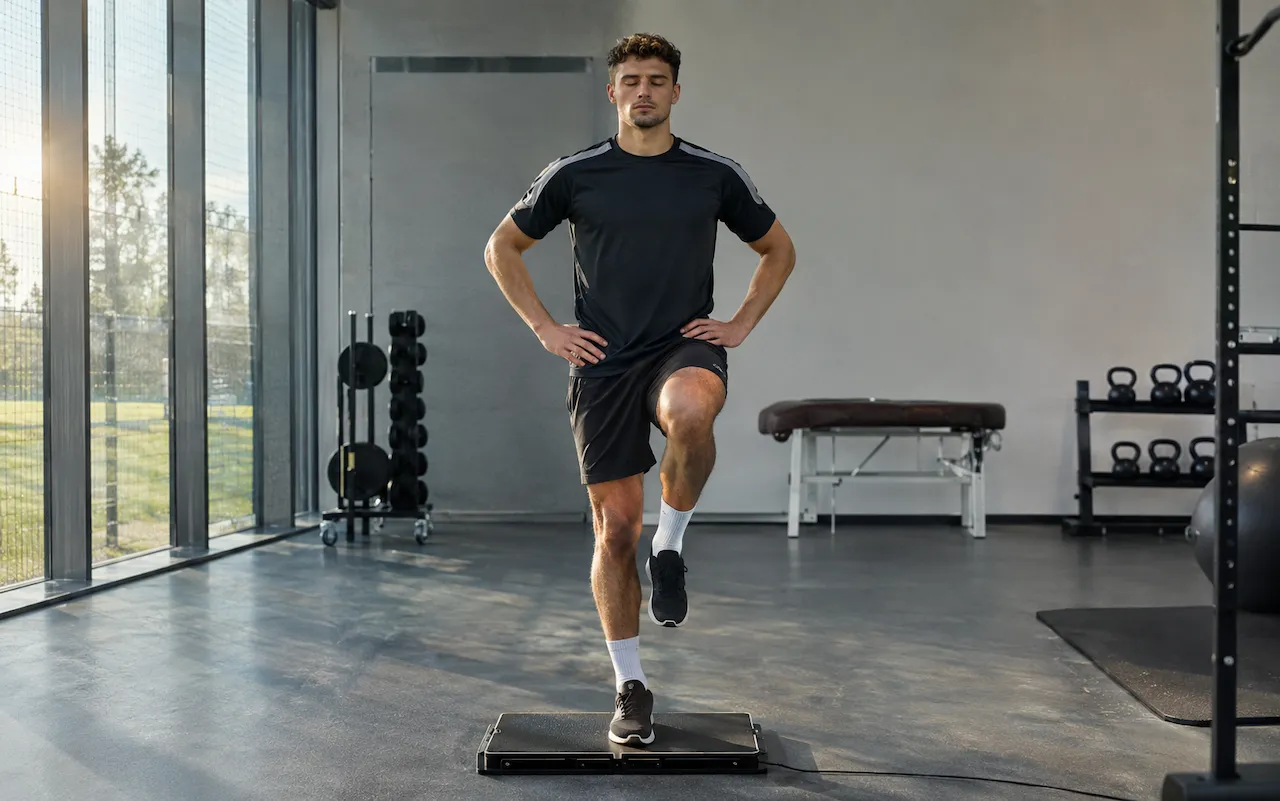
It is the ability to keep the centre of mass over the base of support. It integrates visual, vestibular, sensorimotor and neuromuscular information, so it is a complex and highly dynamic system.
On a force plate it is usually measured with two types of test:
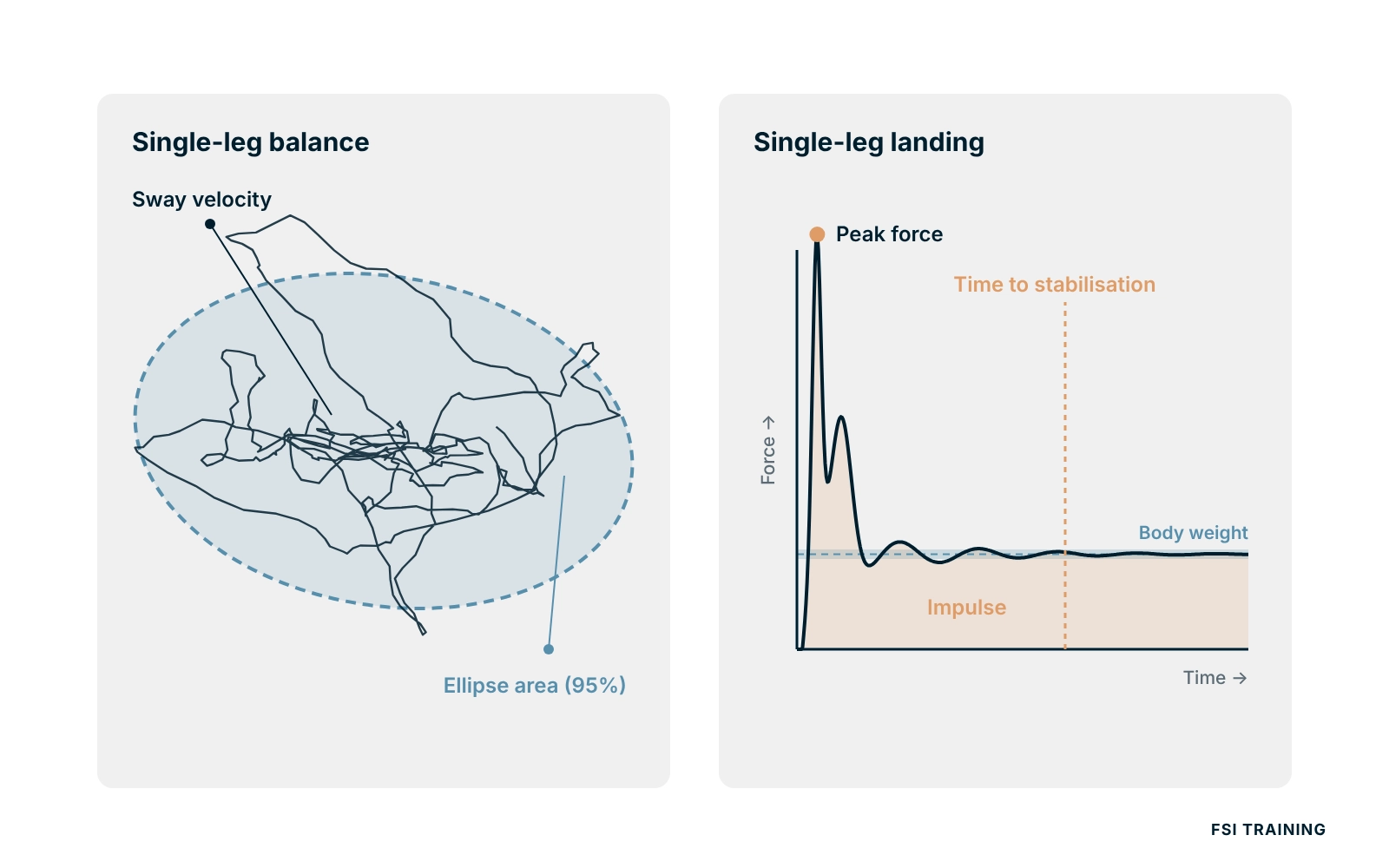
- Static single-leg balance. The main measures are sway velocity (how far the centre of pressure moves per second) and the area of the sway ellipse.
- Single-leg landing. The measures are peak force, impulse and time to stabilisation, which is the one most often used as a quality indicator.
Test conditions change the result a lot: eyes open or closed, a stable or unstable surface, or adding a secondary task.
The experiment that didn’t work
Troester designed a careful protocol. For balance: single-leg stance, hands on hips and eyes closed, two 20-second trials per leg. With eyes open the test was too easy and did not differentiate between players. For landing: three trials per leg, holding the position for 2–3 seconds.
The results, published in the Journal of Sports Science and Medicine (Troester et al., 2018), were as follows:
- Balance: acceptable reliability (ICC from 0.60 to 0.89), but with high variability, between 7% and 13%.
- Landing: peak force and impulse were acceptable, but time to stabilisation was not reliable. In the talk, Troester showed coefficients of variation of up to 29%.
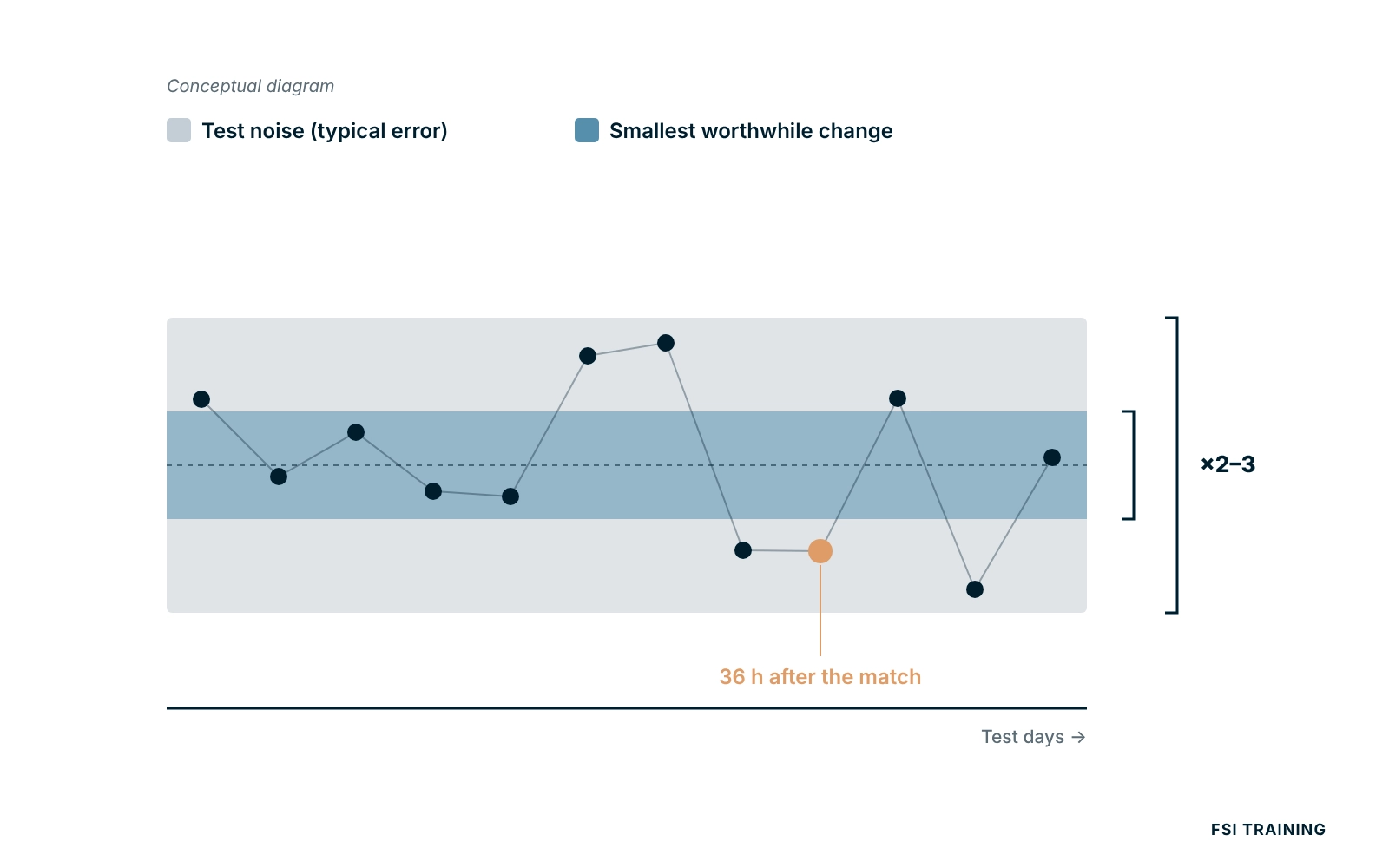
In practice: the normal “noise” of the balance test (its typical error) was 2–3 times larger than the smallest worthwhile change. In other words, for the test to detect fatigue, the player would have to get much worse from one day to the next.
The field study confirmed it. At 36 hours after the match, players’ postural control was practically the same as at rest. Only small signs of fatigue appeared in those who had accumulated more load (Troester & Duffield, 2019).
Troester’s conclusion: as a tool for monitoring post-match fatigue, it doesn’t work.
So, what should you use for fatigue?
His current recommendation:
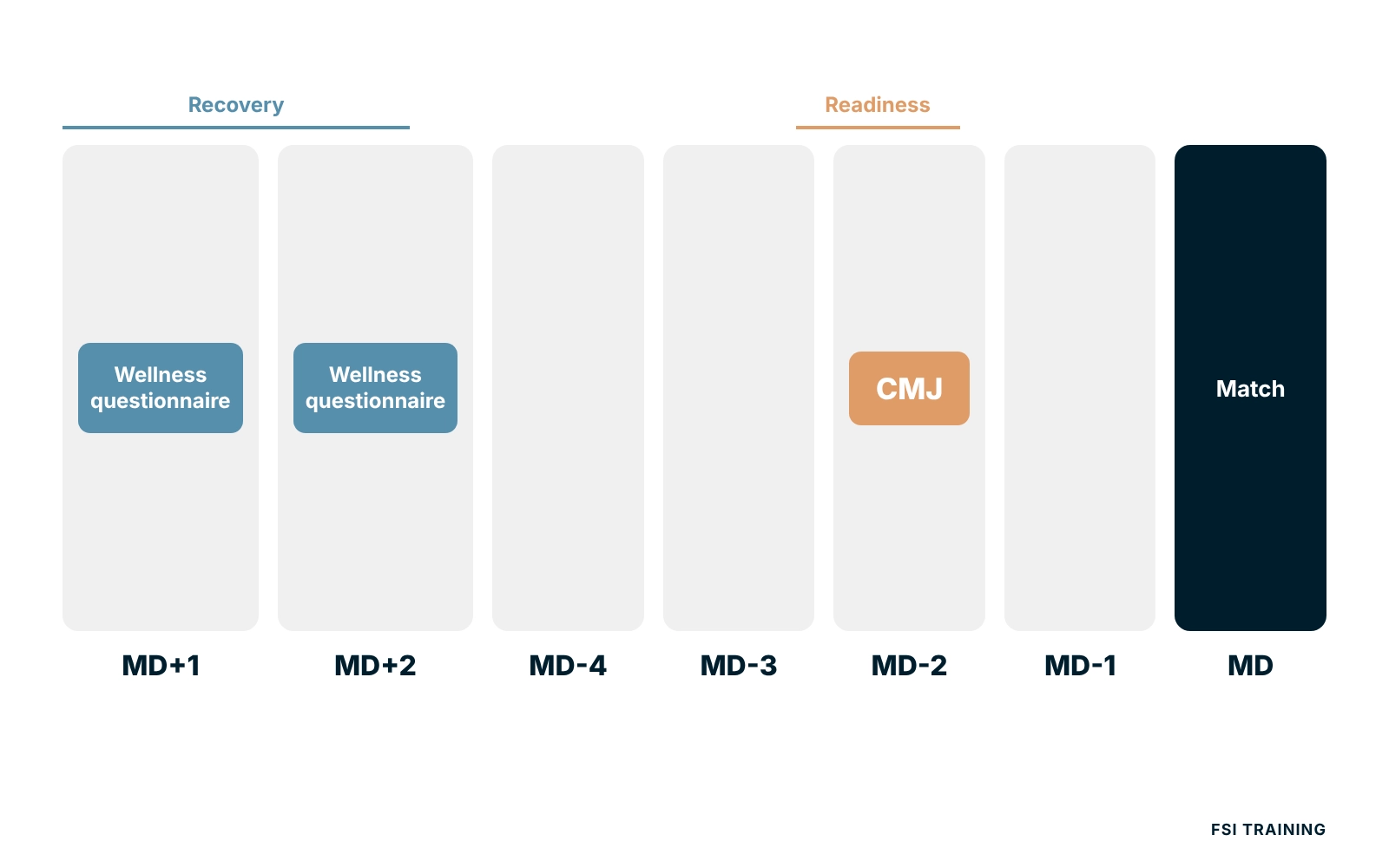
- Early in the week, subjective wellness questionnaires. A player who doesn’t feel able to give a maximal effort is already telling you a lot.
- The CMJ, better on MD-2. That way you use it as a match-readiness test rather than a recovery test, and you still have time to adjust. The CMJ is one of the most studied tools for monitoring neuromuscular status (Claudino et al., 2017).
Where the balance test does work
Years later, in a different environment, Troester brought the balance test back for two uses where it does add value.
1. Profiling players
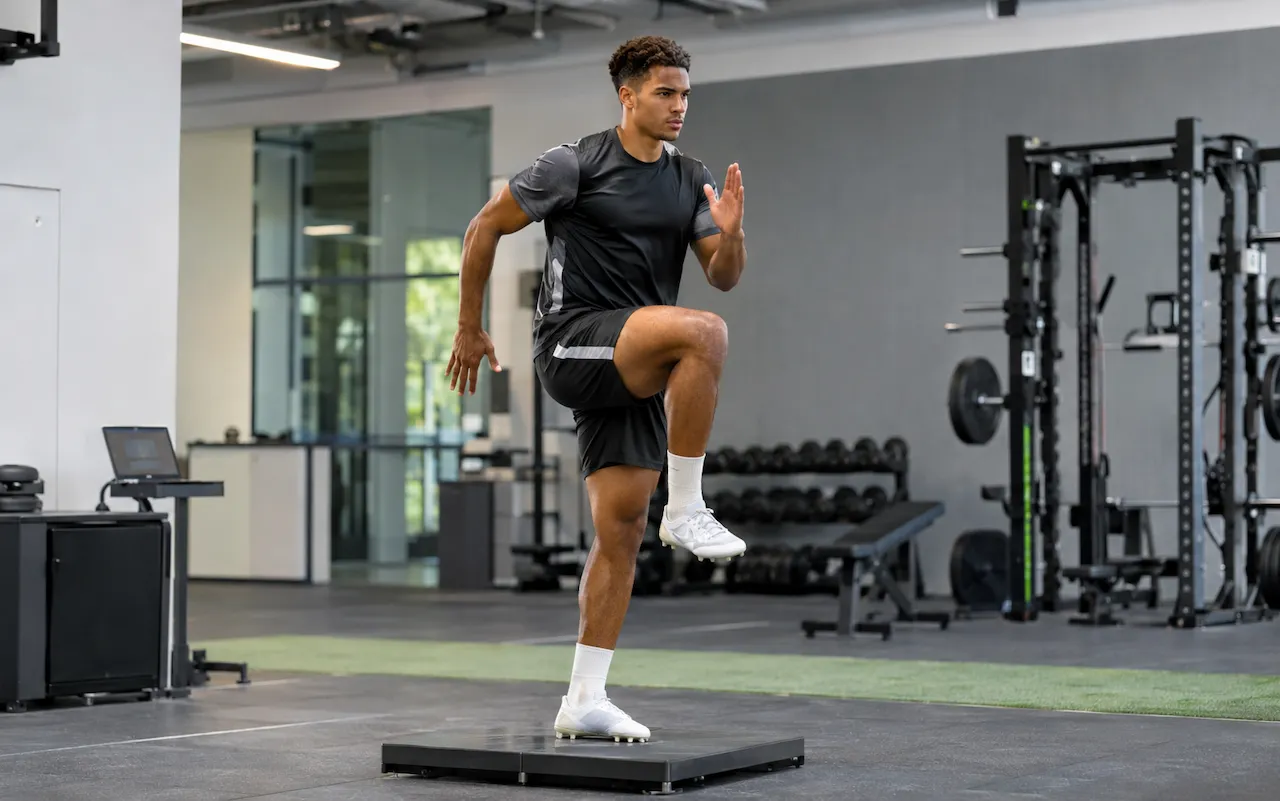
He changed the protocol: eyes open, but in a sprinter stance, with the hip of the free leg flexed. That position shifts the centre of mass and makes the test more demanding without losing visual information.
With enough data he built reference values by sport and position. This lets him identify players who fall below them and give them targeted work. A striking detail: many athletes can’t stay on one leg long enough even to set up a single-leg CMJ.
The two interventions that work best for him:
- Heavy loaded step-up. It trains postural control in positions similar to the ground contact of the sprint.
- Instrumented balance board (DELOS system), with biofeedback, which involves trunk control and the intrinsic foot muscles.
His approach is to combine both ends of the spectrum: loaded work and work on unstable surfaces.
2. Rehabilitation after injury
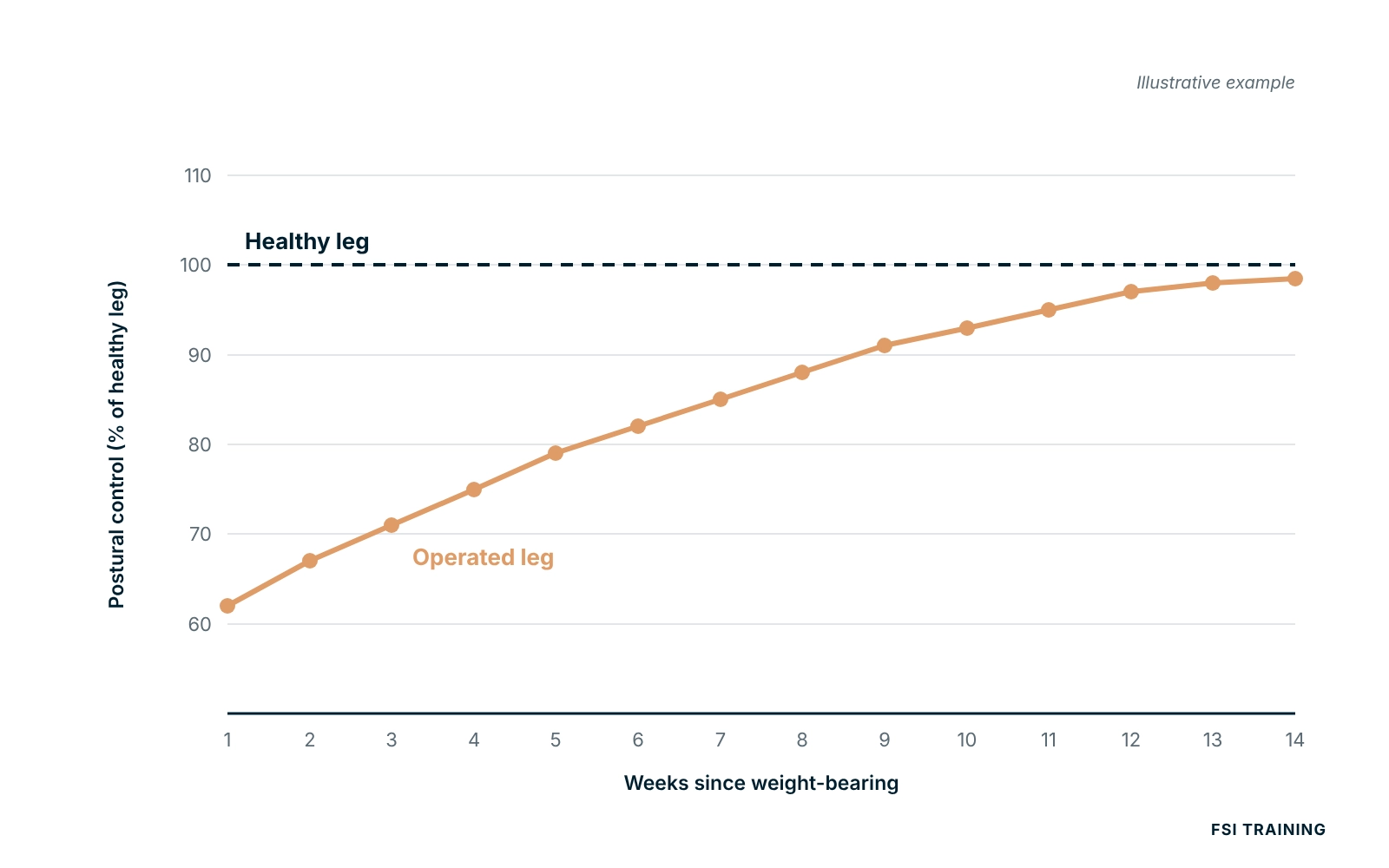
This is where the test shines. After ACL surgery, as soon as the player can bear weight, Troester has them do 20 seconds of single-leg stance on the force plate once a week. That allows him to:
- Compare the operated leg with the healthy one.
- Compare it with the player’s pre-injury value, if available.
- Track progress week by week. In the case he showed, improvement was steady for about three months, until it normalised.
It also motivates the player. In the early stages they can’t jump, and seeing measurable progress in something more dynamic than range of motion builds confidence. It fits as one more line in the rehabilitation plan, in the style of the Gantt chart proposed by Darcy Norman.
3 lessons for your day-to-day work
- Look for questions in your own environment. That player who doesn’t fit your protocol could open up a new line of work.
- Check the reliability of your tests with your own data. The literature is a starting point, but your population, technology and protocol change the results. If you don’t know a test’s sensitivity, you can’t make decisions with confidence.
- Don’t be afraid of failed experiments. What doesn’t work today may be useful in another context, as happened to Troester with the balance test.
If you want to learn how to assess, monitor and rehabilitate with this mindset, take a look at our Master’s programmes in Football Injury Prevention & Reconditioning and Football Strength & Conditioning.
References
- Claudino, J. G., Cronin, J., Mezêncio, B., McMaster, D. T., McGuigan, M., Tricoli, V., Amadio, A. C., & Serrão, J. C. (2017). The countermovement jump to monitor neuromuscular status: A meta-analysis. Journal of Science and Medicine in Sport, 20(4), 397–402. https://pubmed.ncbi.nlm.nih.gov/27663764/
- Troester, J. C., & Duffield, R. (2019). Monitoring residual 36 h post-match neuromuscular fatigue in rugby union; a role for postural control? European Journal of Sport Science, 19(10), 1312–1319. https://doi.org/10.1080/17461391.2019.1606941
- Troester, J. C., Jasmin, J. G., & Duffield, R. (2018). Reliability of single-leg balance and landing tests in rugby union; prospect of using postural control to monitor fatigue. Journal of Sports Science and Medicine, 17(2), 174–180. https://www.jssm.org/jssm-17-174.xml-abst
Powered by Froala Editor