During a training session or a football match, the body loses water and minerals through sweat. Among them are electrolytes, substances involved in essential processes such as fluid balance, muscle function and nerve transmission.
However, talking about electrolytes in football does not mean recommending a sports drink to every player. The hydration needs of footballers change depending on exercise intensity, environmental conditions, sweat rate and individual characteristics. Evidence from professional football shows precisely this variability, which is why knowing how much fluid and sodium is lost is the first step in designing an appropriate hydration and recovery strategy.
What are electrolytes and why are they important for footballers?
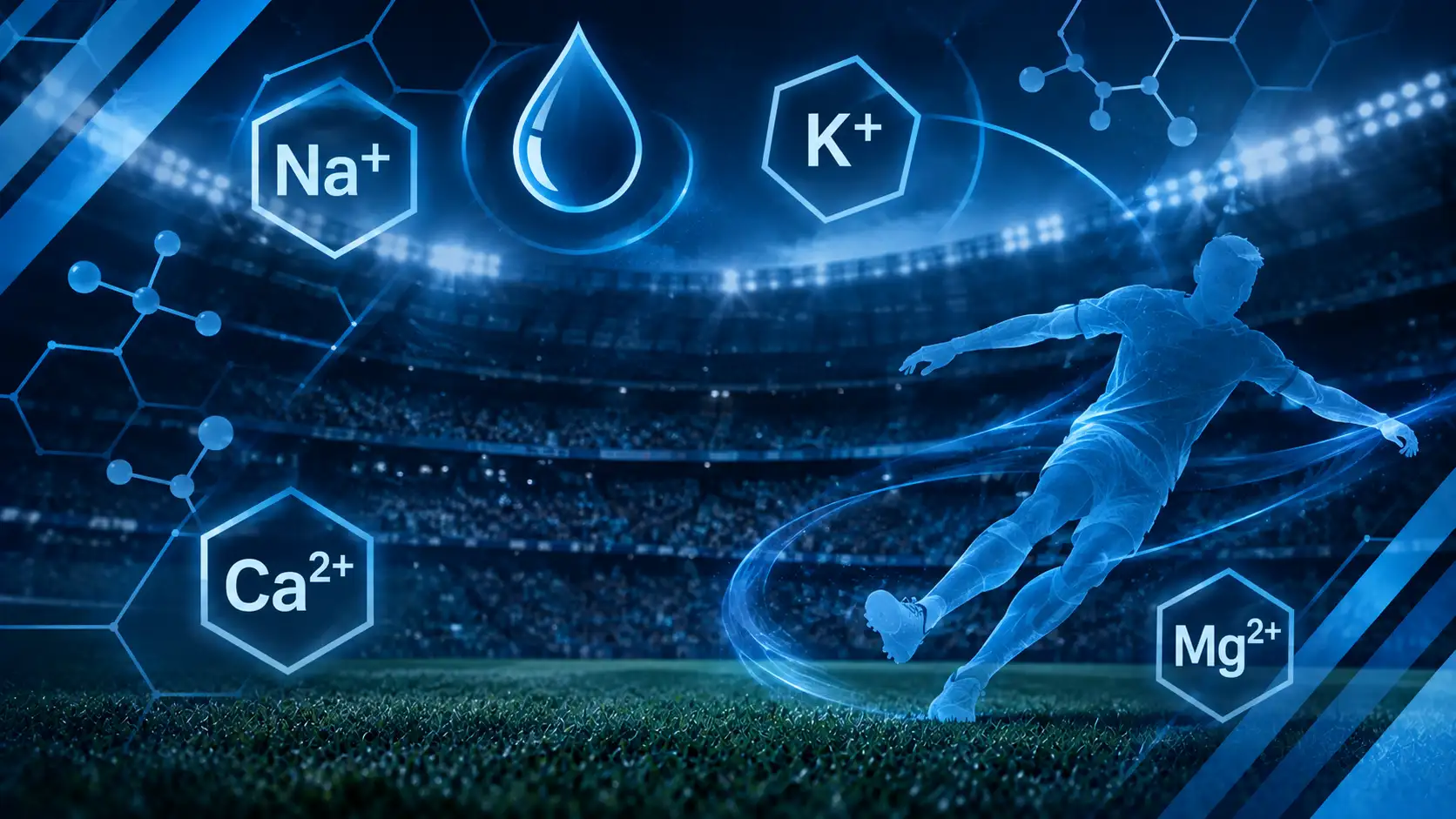
Electrolytes are minerals that carry an electrical charge when dissolved in body fluids. The main ones are sodium, chloride, potassium, calcium and magnesium.
They take part in physiological functions related to sporting performance, such as maintaining fluid balance, muscle contraction and the transmission of nerve signals. During exercise, some of them are lost through sweat, and in this context sodium is especially important: it is the main electrolyte in sweat and one of the most relevant when designing a fluid replacement strategy.
Which electrolytes are lost when sweating?
When sweating, the body mainly loses water, but also sodium, chloride and smaller amounts of potassium, calcium and magnesium.
The amount lost is not the same for every player. Two footballers doing exactly the same training session can have different sweat rates and sweat sodium concentrations. That is why there is no amount of electrolytes that can be considered optimal for all footballers alike.
How much do footballers sweat and how much sodium do they lose when training or playing a match?
The amount of fluid a footballer loses varies with exercise intensity, temperature, humidity, session duration and the player's individual response.
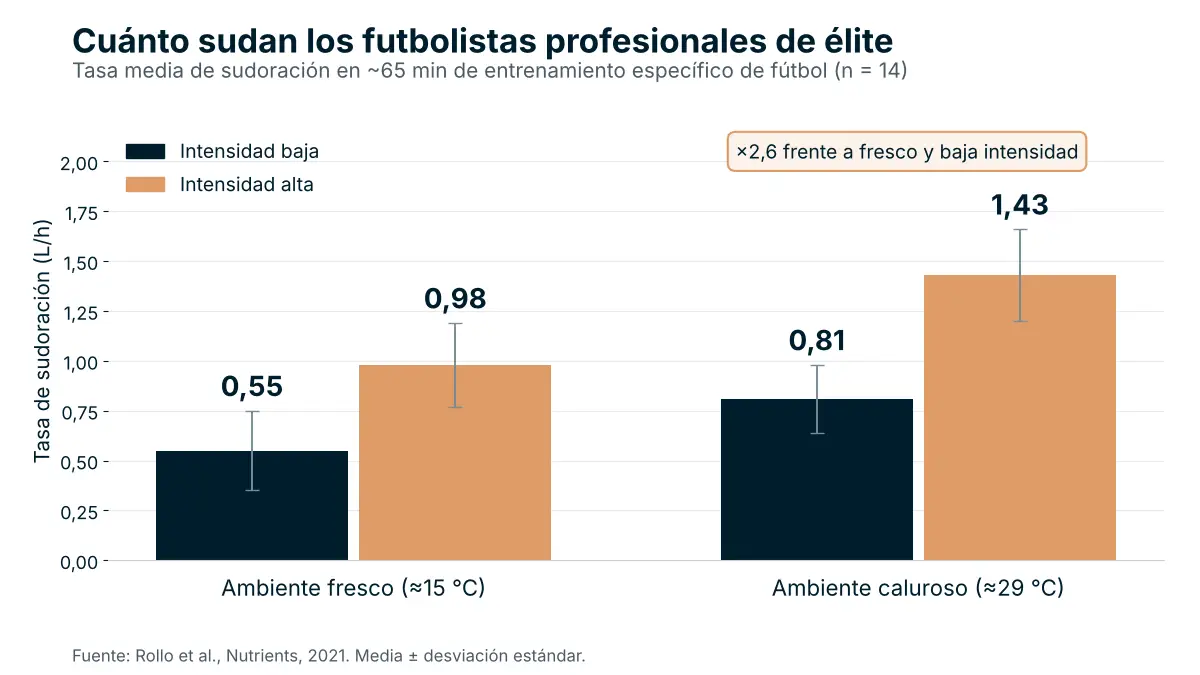
A study published in Nutrients (2021) with 14 elite professional footballers, in which Asker Jeukendrup, an FSI professor, took part, measured fluid balance and sodium losses in four situations: low- or high-intensity training, in a cool environment (around 15 °C and 66% relative humidity) or a hot one (around 29 °C and 52% relative humidity). Each session included around 65 minutes of football-specific training, with free access to water and carbohydrate drinks.
| Training condition | Mean sweat rate (L/h) | Sweat sodium (mmol/L) |
|---|---|---|
| Cool, low intensity | 0.55 ± 0.20 | 35 ± 9 |
| Cool, high intensity | 0.98 ± 0.21 | 38 ± 8 |
| Hot, low intensity | 0.81 ± 0.17 | 34 |
| Hot, high intensity | 1.43 ± 0.23 | 38 ± 8 |
Source: Rollo et al., Nutrients, 2021. Sodium was measured with patches on the thigh. Values expressed as mean ± standard deviation.
Key figure: ×2.6
The combination of heat and high intensity produced a sweat rate 2.6 times higher than that of light training in a cool environment (1.43 vs 0.55 L/h). Two sessions for the same player can have very different hydration needs.
The most relevant results of the study were:
- Intensity and environment significantly influenced sweat rate (p = 0.001): from light training in cool conditions to intense training in the heat, the mean rate was multiplied by 2.6.
- Sweat sodium concentration did not differ significantly between conditions (p = 0.475). Because the mean concentration remained stable, total sodium loss increased mainly because sweat volume increased.
- Fluid intake was associated with sweat rate (p = 0.019) and no player lost more than 2% of their body mass.
- Carbohydrate intake varied widely between players (from 0 to 38 g/h) and there were no differences between conditions.
Illustrative calculation example (not data from the study)
Using the means in the table: 1.43 L/h × 38 mmol/L × 23 mg/mmol ≈ 1,250 mg of sodium per hour in the most demanding condition, compared with around 440 mg per hour (0.55 × 35 × 23) in the mildest. These are group means: each player can be well above or below them.
Read the study on fluid balance and sodium losses in professional footballers.
Heat and intensity increase fluid loss
As intensity rises, the body generates more heat and increases sweating to regulate temperature. In the study, going from low to high intensity in a cool environment raised sweat rate from 0.55 to 0.98 L/h (approximately 1.8 times), and heat with low intensity put it at 0.81 L/h (approximately 1.5 times). The combination of both factors reached 1.43 L/h.
That is why the hydration strategy must be adapted above all in the hottest months. If you want to go deeper, read our guide on how to stay properly hydrated when playing football in summer.
How do you calculate a footballer's sweat rate?
A practical way to know your hydration needs is to calculate your sweat rate. In the study, players were weighed in minimal clothing before and after training. To estimate it, compare your body weight before and after the session, add the fluid you drank and subtract the urine produced:
Sweat rate formula
Sweat (L) ≈ body weight loss (kg) + fluid intake (L) − urine produced (L)
Then divide that amount by the number of hours of exercise. For example: a player who weighs 75.0 kg before and 74.0 kg after one hour of training, and drinks 0.5 L without urinating, has lost approximately 1.5 L of sweat (1.5 L/h) and 1.3% of their body mass (1.0 kg out of 75.0 kg).
This rate changes from day to day depending on the training and the environment, so it is worth measuring it under different conditions.
Sodium, hydration and performance: what happens when a footballer becomes dehydrated?
During exercise, sweating means a simultaneous loss of water and electrolytes. If these losses are high and are not adequately replaced, a progressive fluid deficit develops. Studies in football indicate that, despite having drinks available, players can end up with a net fluid deficit, and that hypohydration is associated with greater physiological strain and lower physical and technical performance, although not all research confirms this.
Controlling losses is especially important when playing in the heat, in prolonged sessions or when there is little recovery time between efforts. Sodium also plays a role in maintaining body fluid balance.
Does sweating more mean needing more electrolytes?
Sweating a lot means a greater total fluid loss, but not that all players who sweat a lot lose the same amount of sodium. To estimate total sodium loss you need to consider two factors: how much the player sweats and what sodium concentration that sweat has. One footballer can have a high sweat rate with a moderate sodium concentration, and another can show the opposite pattern.
For this reason, hydration and electrolyte recommendations should be adapted to the player and the context, rather than applying the same amount to the whole team.
When should you take electrolytes: before, during or after playing football?
The need to consume drinks with electrolytes depends on the type of exercise and the losses incurred. A short session in moderate conditions with little sweat loss has very different needs from an intense match played in the heat.
Electrolytes before a match
The goal beforehand is to start exercise in a good state of hydration. When large sweat losses are expected, sodium can be part of the pre-exercise strategy, always adapted to the player's context.
Electrolytes during a match or training session
During exercise, the need for water, electrolytes or a sports drink depends on duration, intensity, environment and the sweat lost. In short sessions or with small losses, water can cover needs; when effort is prolonged, sweating is high or conditions are demanding, a drink providing fluid and sodium can help cover part of the losses. In prolonged efforts, some drinks add carbohydrates to provide energy.
Electrolytes after playing: rehydration and recovery
After a match or intense training session, the goal is to gradually recover the fluids and nutrients used. Sodium replacement can contribute to rehydration, especially if sweat losses have been high. But recovering is not just drinking water or electrolytes: you also need to replenish carbohydrates, protein and other nutrients. Discover the best foods to recover after training or competing.
Water, isotonic drink or electrolyte drink: which is best for a footballer?
There is no single drink that is the best for all footballers in all situations. A review by Lawrence Baker and Asker Jeukendrup (Comprehensive Physiology, 2014) concludes that the optimal composition of a replacement drink depends on the source of the fluid loss (sweat, urine, breathing, diarrhoea or vomiting) and that the best drink is the one adapted to physiological needs, environmental conditions, desired benefits and the athlete's characteristics and preferences. That is why a sports drink should not be judged solely by the electrolytes it contains.
Read the scientific review on the composition of fluid replacement drinks.
Does more sodium or more carbohydrate mean better hydration?
Not necessarily. In a study by Jeukendrup and colleagues (Nutrition & Metabolism, 2009), 20 healthy men, fasted, drank different beverages with a deuterated water tracer to measure how much fluid was delivered to the body. The design compared drinks with 0, 3, 6 and 9% glucose (with 20 mmol/L of sodium) and drinks with 6% glucose and 0, 20, 40 or 60 mmol/L of sodium.
- Glucose: the 3% drink showed the greatest fluid delivery; the 0% drink outperformed the 6% and 9% drinks, and the 6% drink outperformed the 9% one. Once glucose went above 6%, fluid delivery decreased.
- Sodium: increasing sodium from 0 to 60 mmol/L in a drink with 6% glucose did not improve fluid delivery.
Key idea
This does not mean that sodium is unimportant for hydration: it means that adding more of one ingredient does not automatically make a drink better. In addition, the study measured fluid delivery at rest and in healthy people, not the performance of footballers in play.
Read the study on glucose, sodium and fluid delivery.
Carbohydrate and electrolyte drinks in football
In football, sports drinks can serve more than one function: in addition to fluids and electrolytes, some provide carbohydrates as energy. A study by Harper, Stevenson, Rollo and Russell (Journal of Science and Medicine in Sport, 2017), with Mark Russell, an FSI professor, as co-author, analysed a drink with 12% carbohydrate and electrolytes (60 g of carbohydrate and 205 mg of sodium in 500 mL) in 15 footballers during 90 minutes of football-specific exercise. Players drank 250 mL at the end of the warm-up and another 250 mL at half-time, and were compared with a placebo drink with electrolytes and with water.
- Compared with water and placebo, the carbohydrate drink increased accelerations above 1.5 m/s² during self-paced exercise (by more than 25%) and ball-dribbling speed from the 60th minute onwards (by more than 3%).
- Mean sprint speed improved by 2.7% compared with water.
- Carbohydrates did not attenuate the post-exercise reduction in cognitive function, and abdominal discomfort was similar between drinks.
How to interpret this result
The study evaluated a drink that combined carbohydrates and electrolytes, so it does not allow us to conclude that electrolytes alone caused the improvements. And it does not contradict the previous study, because they measure different things: fluid delivery at rest versus performance in a simulated match.
Read the study on carbohydrate and electrolyte drinks and football-specific performance.
How many electrolytes does a footballer need? Why hydration must be individual
There is no universal amount of water, sodium or electrolytes that all footballers should consume before, during or after playing. Even among elite professional players there are considerable differences in the sweat produced and in sodium losses. A hydration strategy should consider:
- The duration of the training session or match.
- Exercise intensity.
- Ambient temperature and humidity.
- The individual sweat rate.
- Sweat sodium concentration.
- Body weight before and after exercise.
- The amount of fluid drunk during the activity.
- The time available until the next training session or match.
This approach is consistent with the UEFA expert group statement on nutrition in elite football (Collins et al., British Journal of Sports Medicine, 2021), written by 32 experts and covering nine areas, including match-day and training-day nutrition and demanding environments. FSI professors Asker Jeukendrup, Graeme Close, Stuart Phillips and Tim Meyer took part in it, and its approach prioritises food (“food first”) over supplements.
Read the UEFA expert group statement on nutrition in elite football.
In short
A good hydration strategy in football does not consist of consuming as much water or electrolytes as possible, but of adapting fluid and sodium intake to the player's actual losses, the environment and the demands of training or competition.
Summary of the scientific evidence
| Study | Sample and design | Main result |
|---|---|---|
| Rollo et al., 2021 | 14 elite professional footballers; 4 conditions (low/high intensity, cool/hot) | Sweat rate of 0.55 to 1.43 L/h; sweat sodium of 34 to 38 mmol/L, with no differences between conditions |
| Baker and Jeukendrup, 2014 | Scientific review | The optimal drink depends on the source of the loss, the environment and the athlete's characteristics |
| Jeukendrup et al., 2009 | 20 healthy men; deuterated water tracer | More than 6% glucose reduces fluid delivery; more sodium (0-60 mmol/L) does not improve it |
| Harper et al., 2017 | 15 footballers; 90 min of football-specific exercise; 12% carbohydrate drink | More accelerations and faster dribbling speed compared with water and placebo |
| Collins et al., 2021 (UEFA) | Consensus of 32 experts; 9 areas of nutrition in elite football | Evidence-based, practice-oriented approach, prioritising food |
Frequently asked questions about electrolytes and hydration in football
Which electrolytes does a footballer lose when sweating?
Mainly sodium and chloride, and in smaller amounts potassium, calcium and magnesium. Sodium is the most abundant electrolyte in sweat and the most relevant when designing a hydration strategy, although the amount lost varies from player to player.
How much do footballers sweat?
It depends on intensity and climate. In elite professional footballers who trained for around 65 minutes, the mean sweat rate was 0.55 L/h in a light, cool session, 0.98 L/h in an intense, cool one, 0.81 L/h in a light session in the heat and 1.43 L/h in an intense session in the heat.
How much sodium is there in a footballer's sweat?
In that same study, the mean sweat sodium concentration was between 34 and 38 mmol/L depending on the condition, with no significant differences between conditions. Even so, there is variation between players, so an individual's figure may differ from the mean.
Do you need to take a drink with electrolytes in every training session?
Not necessarily. The need depends on duration, intensity, heat and the amount of sweat lost. In the study with elite footballers, with sessions of around 65 minutes and drinks available at will, no player lost more than 2% of their body mass. A long, intense or hot session may raise different needs.
Does more sodium in the drink hydrate faster?
Not according to a study of 20 healthy men using a deuterated water tracer: increasing sodium from 0 to 60 mmol/L in a drink with 6% glucose did not improve fluid delivery. This does not mean sodium is irrelevant for replacing sweat losses, but that adding more does not automatically make a drink better.
What carbohydrate concentration is best in a sports drink?
It depends on the goal. For fluid delivery, going above 6% glucose reduced it in the Jeukendrup study, and the 3% drink had the greatest delivery. For performance in a simulated match, another study used a 12% drink (60 g in 500 mL) split into two 250 mL servings, with improvements in accelerations and dribbling speed. They are different goals.
How do you calculate sweat rate?
Weigh yourself in minimal clothing before and after the session and apply: sweat (L) ≈ body weight loss (kg) + fluid intake (L) − urine (L). Divide the result by the hours of exercise to get litres per hour. Remember that it can vary with the climate and the intensity of each session.
When should you take electrolytes: before, during or after playing?
There is no single protocol. It depends on the expected sweat losses, the duration of the effort and the environmental conditions. Knowing your individual losses lets you adjust intake, and after the session rehydration should be part of a broader recovery strategy that includes carbohydrates and protein.
Scientific references
- Rollo I, Randell RK, Baker L, et al. Fluid Balance, Sweat Na+ Losses, and Carbohydrate Intake of Elite Male Soccer Players in Response to Low and High Training Intensities in Cool and Hot Environments. Nutrients. 2021;13(2):401. PubMed
- Baker LB, Jeukendrup AE. Optimal composition of fluid-replacement beverages. Comprehensive Physiology. 2014;4(2):575-620. PubMed
- Jeukendrup AE, Currell K, Clarke J, Cole J, Blannin AK. Effect of beverage glucose and sodium content on fluid delivery. Nutrition & Metabolism. 2009;6:9. PubMed
- Harper LD, Stevenson EJ, Rollo I, Russell M. The influence of a 12% carbohydrate-electrolyte beverage on self-paced soccer-specific exercise performance. Journal of Science and Medicine in Sport. 2017;20(12):1123-1129. PubMed
- Collins J, Maughan RJ, Gleeson M, et al. UEFA expert group statement on nutrition in elite football. British Journal of Sports Medicine. 2021;55(8):416-442. PubMed
This content is for information only and does not replace the advice of a healthcare professional or a sports nutritionist. If you have a medical condition, consult before changing your sodium or fluid intake.
Powered by Froala Editor