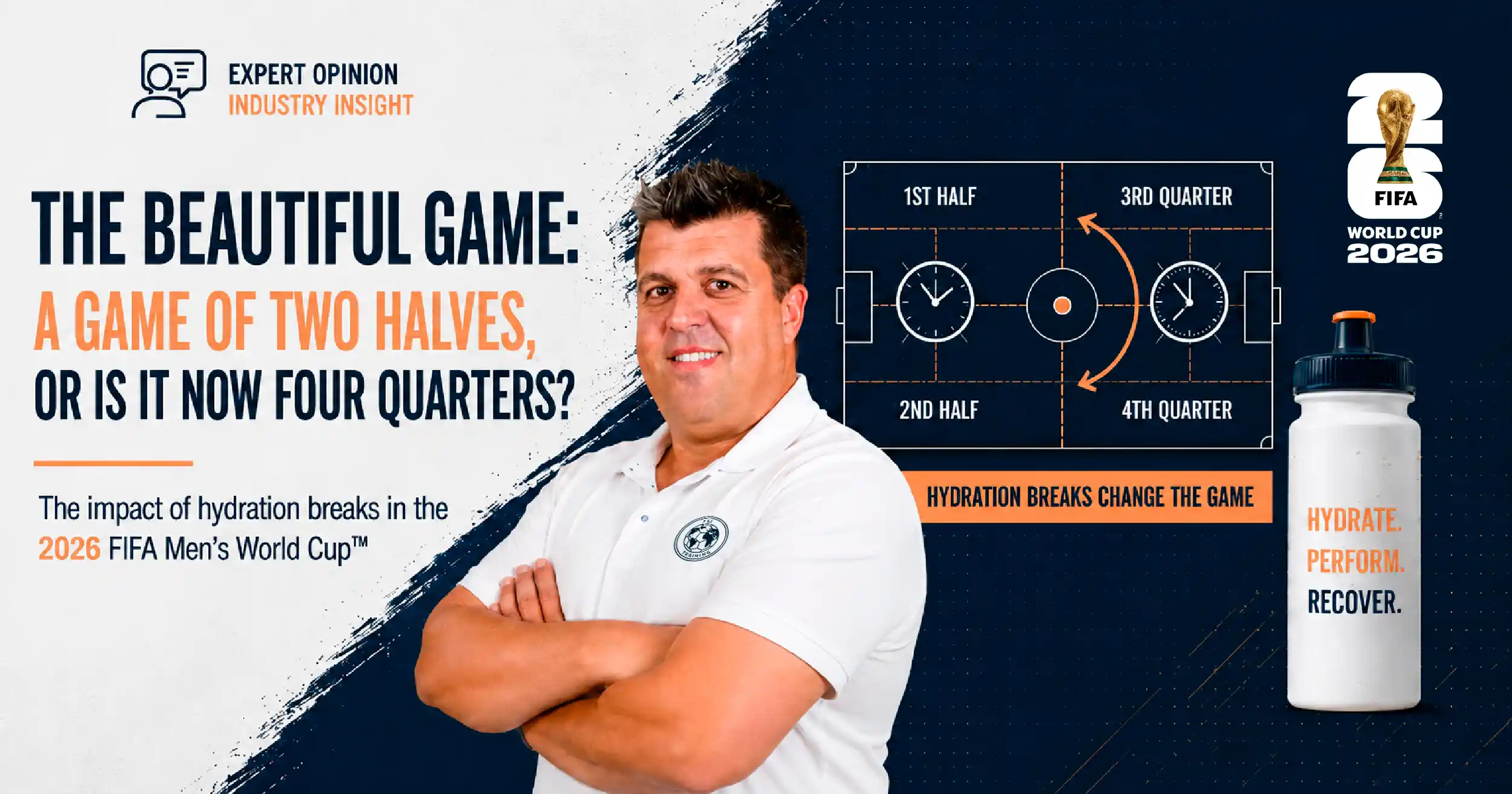
The 2026 FIFA Men’s World Cup sees the introduction of mandatory hydration breaks in both the first and second halves during all matches. The three minute pause in play at the mid-point of each half is nothing new as previous tournaments and major competitions have seen them used at the official’s discretion or if certain temperature thresholds were breached. However, for the 2026 men’s competition hosted by USA, Mexico and Canada, there will be no weather or temperature condition in place, meaning the breaks will take place in all games irrespective of weather conditions (i.e., in colder temperatures also), and/or if matches are played in stadia with closed roofs and/or possibly air conditioning.
Introduced with player welfare in mind, some argue that it may disrupt the flow and momentum of the game. Indeed, critics have included England manager Thomas Tuchel speaking after the match against Croatia and more recently Alan Shearer, former England captain, after the England v Ghana game. The FIFA president has also stepped in to the debate by re-iterating the purpose of the hydration breaks and the rationale behind ditching the case-by-case approach to their use.
Mark Russell, Professor of Performance Nutrition and Applied Exercise Physiology at Leeds Trinity University who is a World-leading expert in match-day strategies to enhance performance in team sports players commented that: ”Due to the way in which the body attempts to regulate it’s temperature during exercise (i.e., sweating), players can routinely experience significant fluid losses over the course of a match; losses which can have important performance, and in some cases, health, consequences if they’re not minimised. Given the limited opportunities outside of the warm-up, half-time and/or any prolonged breaks in play due to injury, players may not be able to rehydrate optimally once a match kicks off - especially in warmer and more humid conditions.”
“Given the rules were only made public in December, little direct research or evidence will exist about the actual effects of the mandatory three minute breaks 22 min into each half in this competition.” But, Prof Russell also highlights that all is not lost as using extra-time as a model, where the 5 min period preceding the extra 30 min is often used for hydration and energy provision, similar to the activities that will occur in the 2026 FIFA World Cup hydration breaks, does allow some insight to be gained. Indeed, extra-time research is an area of specialism for Prof Russell.
“The short 5 min break before extra-time is some of the closest comparable research we have to date regarding the possible responses to these mandatory hydration breaks.”
Prof Russell’s research highlights that when football-specific exercise stops for the period between the end of the 90 min and the onset of extra-time, a duration of ~5 min, then the body responds in specific ways – some of these responses persist after subsequent match-play has restarted. For example, while it may be beneficial to take fluids on board, both from hydration/energy provision and cooling perspectives, there is the chance that any performance-enhancing effects of the prior exercise, such as those explained by muscular performance, may drop outside of an optimal window for peak performance thereafter by temporarily stopping match-play. This may be more of a consideration in some of the games played in cooler conditions given that the hydration breaks are mandatory in all matches. If, it takes some time to recover these characteristics, and physical performance markers are impaired temporarily, then this could go some way to explaining a drop or a lull in intensity once matches restart – but this is yet to be confirmed with real world data and at this stage is merely one possible theory.”
While hydration breaks are nothing new, the increased frequency and prevalence in every men’s FIFA World Cup match, now begs the question whether the beautiful game is indeed still a match of two halves or is it actually four quarters?
Further information about Professor Mark Russell and the work of the Enhancing Human Performance Research theme at LTU is available via: Research in Sport and Exercise Science - Research - Leeds Trinity University.