
This article is based on the teachings of Alejandro Olivares, FSI lecturer. He is a strength and conditioning coach with a UEFA A licence and the NSCA’s CSCS certification, and has worked at Atlético de Madrid, at the FC Barcelona academy in Austin and at the Austin FC Academy.
Why plan week by week in youth football
In youth football, many teams don’t have a strength and conditioning coach. Planning the week usually falls to the head coach, who also has to fit in tactics, technique and the mental side.
Olivares starts from one idea: it’s not about separating physical work from tactical work, but about periodising everything together through the game. And there are three reasons to do it week by week:
- There’s competition every week. A track athlete aims to peak on a specific date. A football player has to be ready every weekend.
- Every week is different. The number of matches, the day you play, the opponent, the previous result or injuries all change.
- There are more than 20 players. Some play 80 minutes and others never leave the bench, so they don’t all arrive at Monday in the same state.
More isn’t better: train smart
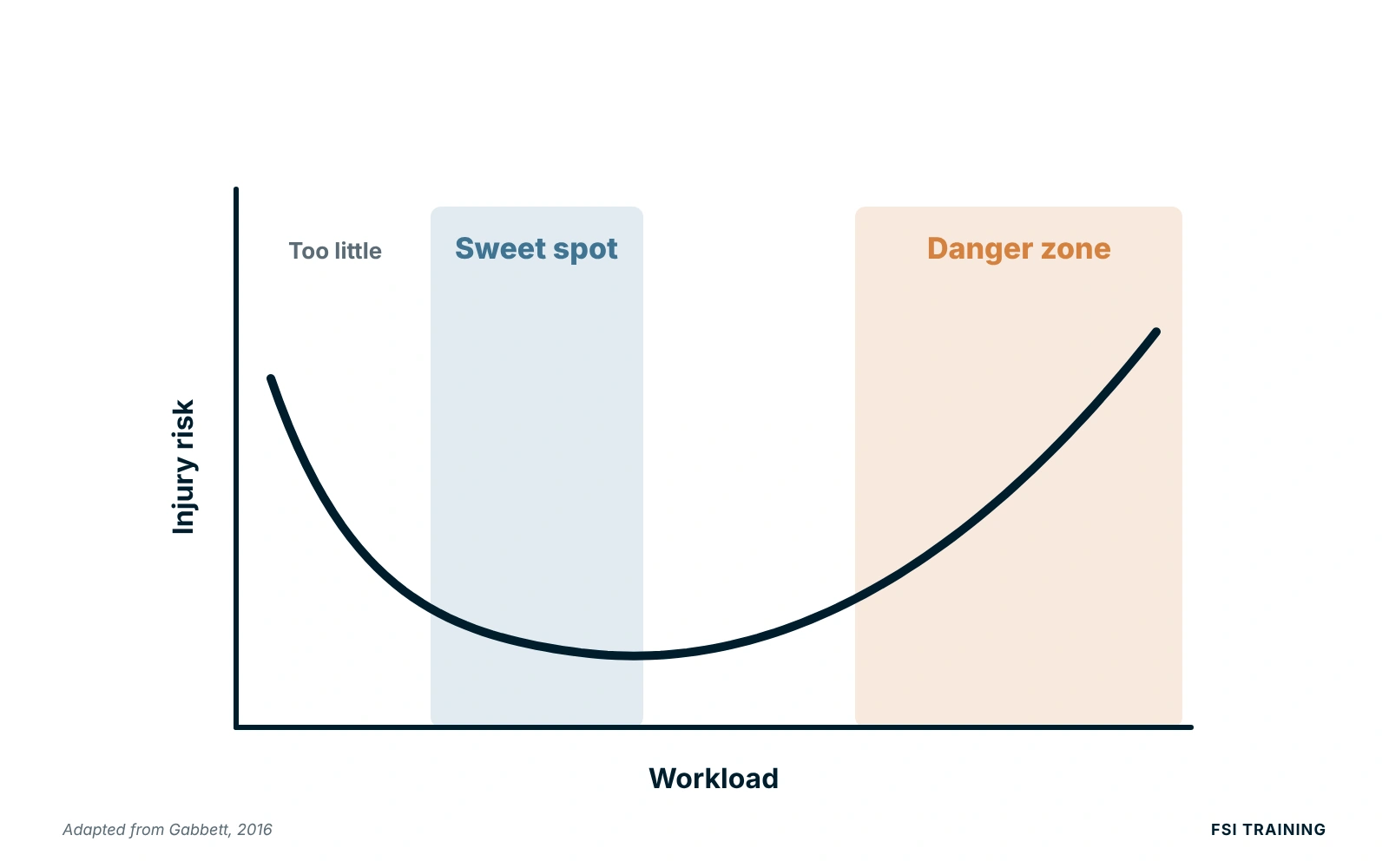
For Olivares, “no pain, no gain” is one of the worst sayings in sport. The relationship between load and injury is U-shaped: training too little also increases the risk, because the player isn’t prepared for what the match demands. Training too much pushes them into the danger zone (Gabbett, 2016).
The goal is to find the sweet spot: choosing which days to push and which days to let the player recover.
The 5 principles for planning a microcycle
- Load dynamics: decide which days are for recovery, loading and tapering based on the fixture schedule.
- Content periodisation: choose which types of session you will use.
- Sequencing: decide the order of those sessions.
- Weekly load: distribute high-speed running, sprinting, accelerations and changes of direction.
- Individualisation: add or remove load depending on minutes played.
How to distribute load across the week
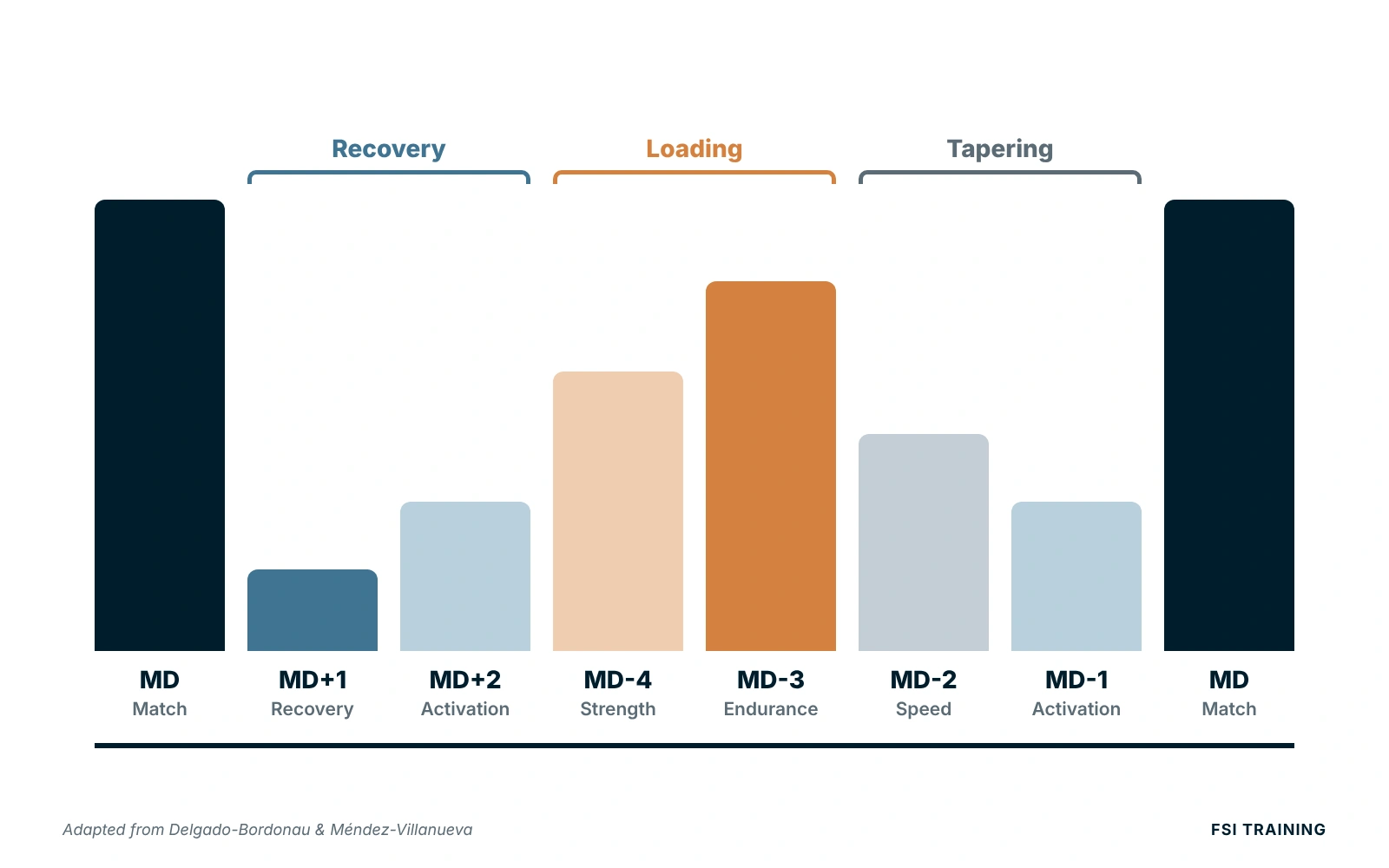
After a match, players need between 48 and 72 hours to recover (Silva et al., 2018). With that in mind, a week with a match every seven days is split into three blocks:
- Recovery (MD+1 and MD+2): a regeneration session or a day off, followed by a low-load session.
- Loading (MD-4 and MD-3): the two days furthest from the previous and the next match. This is where you push.
- Tapering (MD-2 and MD-1): medium and low load so players arrive fresh for the match.
To quantify it, Olivares uses a load scale from 0 to 4, expressed as a percentage of what the player does in a match: very low (0–10%), low (10–30%), medium (30–40%), high (40–50%) and very high (50–70%).
This pattern has been observed in the reserve team of a LaLiga club that worked with strength, endurance and speed sessions: load dropped clearly over the two days before the match, allowing players to arrive fresh without losing fitness across the season (Guridi et al., 2021).
The 4 types of session in the microcycle
Sessions are named after the physical demands of football. First, strength: changes of direction, accelerations, decelerations, jumps and duels. Second, linear and non-linear speed. And finally, endurance, which is the ability to repeat all of that for more than 90 minutes.
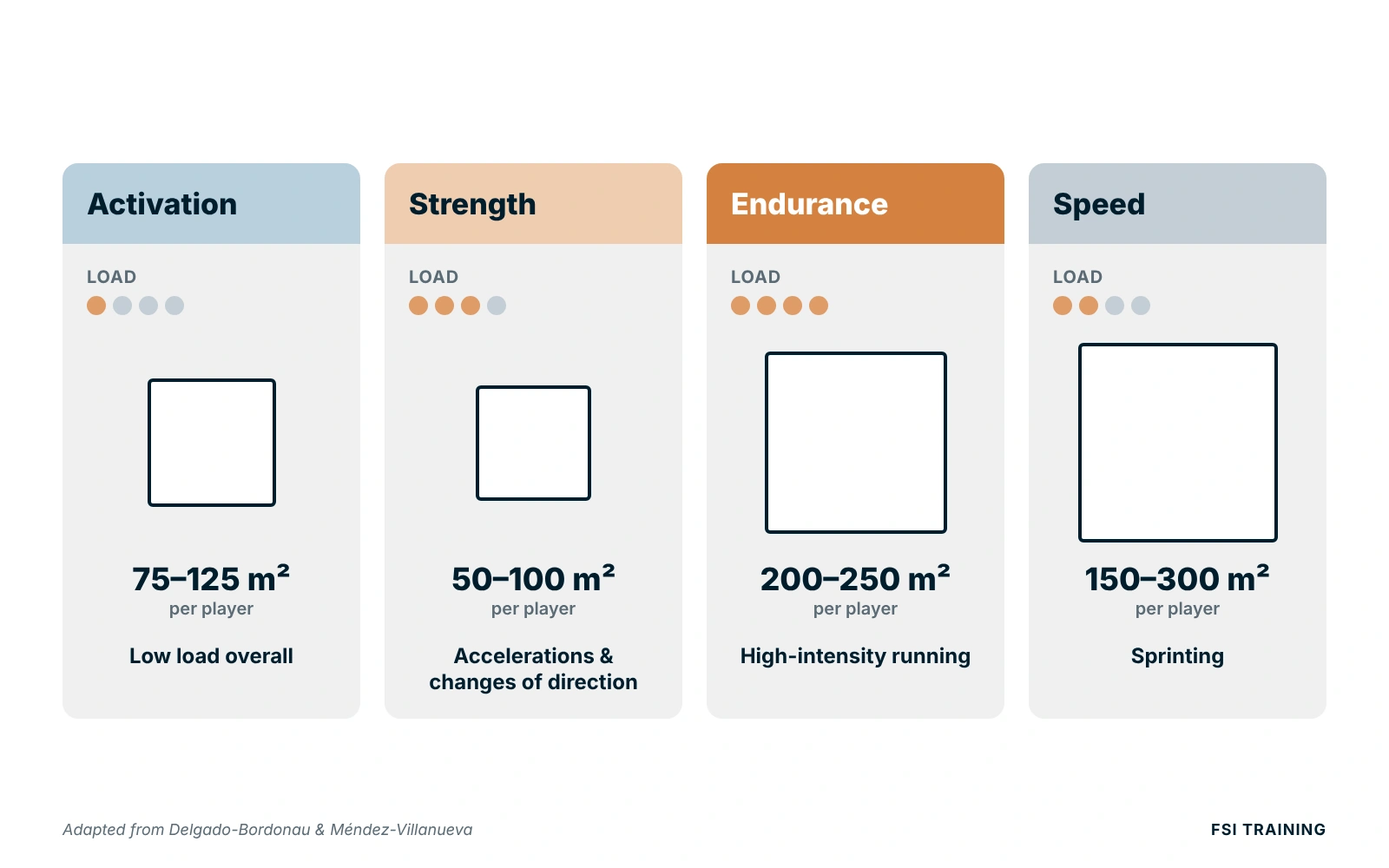
From there come four types of session, in a model adapted from Delgado-Bordonau and Méndez-Villanueva. The main lever to adjust them is space per player:
| Session | Space | Players per team | Sets and rest | Physical focus |
|---|---|---|---|---|
| Activation | 75–125 m²/player | 5–11 | 1–3 min, rest of half the set | Everything low |
| Strength | 50–100 m²/player | 3–6 | 1–3 min, rest of 20 s to 1 min | Accelerations and changes of direction |
| Endurance | 200–250 m²/player | 7–11 | Over 3 min, rest of a third of the set | High-intensity running |
| Speed | 150–300 m²/player | 3–11 | 5–30 s, rest of 2–3 times the set | Sprinting |
One factor that is often forgotten: the coach’s style also changes the load. The same drill doesn’t produce the same load with a coach who pushes and encourages as with one who watches with arms folded.
Activation: low load and plenty of success
This is the session at the start or end of the week. It uses reduced spaces with many players, so there’s high density and little movement. Sets are short, rest is long and the session lasts around 60 minutes.
A possession game with around 75 m² per player or a game with goals and goalkeepers with around 125 m² works well. Low cognitive load, positive feedback and tasks in which players experience success.
Strength: small spaces and high intensity
The aim is to accumulate accelerations, decelerations and changes of direction, without looking for sprints. To do that, play with few players in a small space, for example 50 m² per player in possession or 100 m² with goals. More on why braking matters in the deceleration vaccine.
Rest periods are short, a third of the set, so the coach only has between 20 seconds and a minute to give corrections. A practical tip from Olivares: this forces you to keep your message short. Here, feedback is more emotional than tactical and competitiveness is encouraged.
Endurance: the day most similar to a match
This is the highest-load session and it goes on the day furthest from both matches. It’s played in large spaces, with many players and long sets of 6 minutes or more. The focus is high-intensity distance, that is, running fast without reaching a sprint.
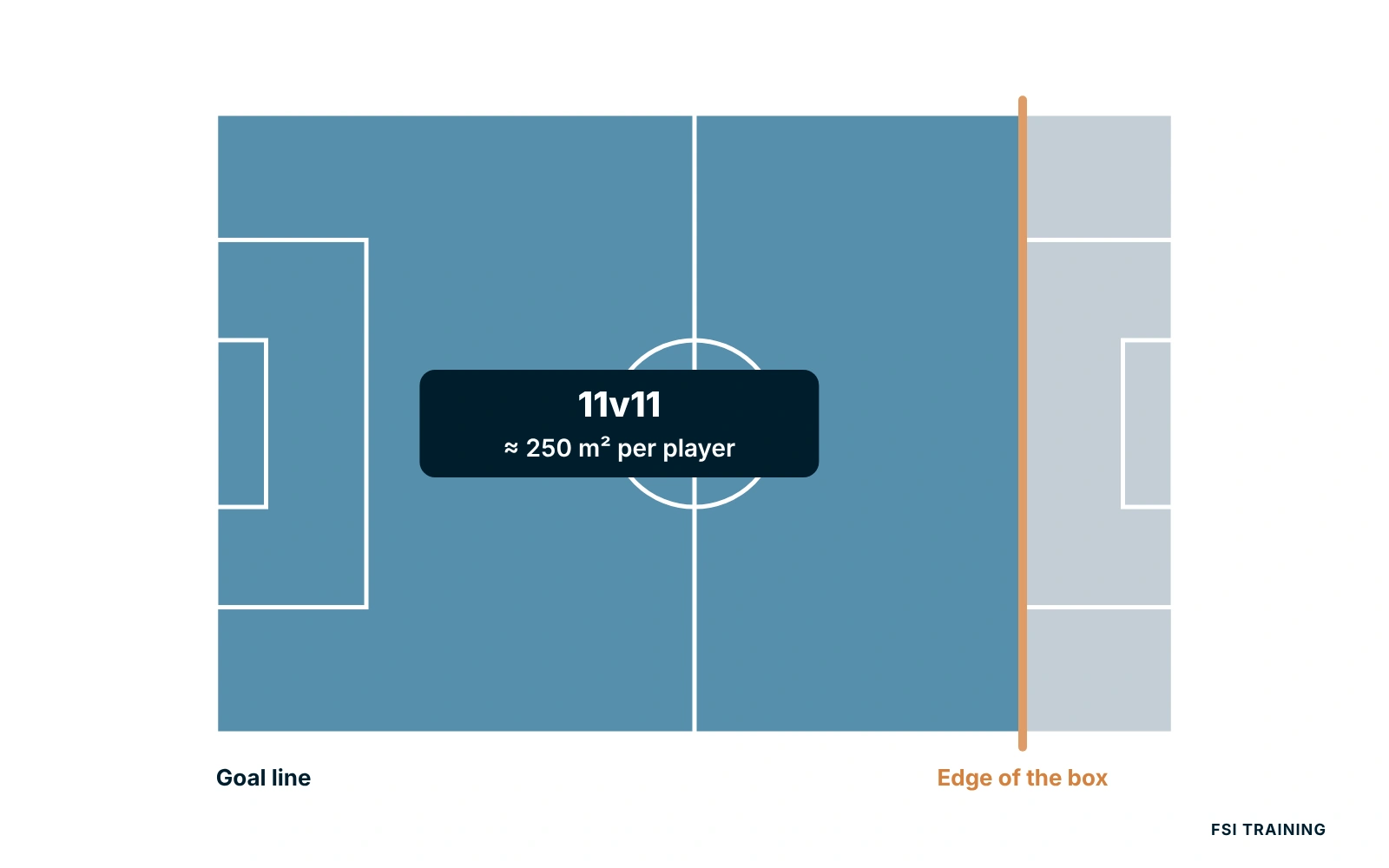
The trick to keep sprinting in check is to shorten the pitch. An 11v11 with around 250 m² per player covers from one goal line to the edge of the opposite box: you remove one penalty area and reduce the space for sprinting.
Because rest periods are longer, there’s time for more tactical feedback. Olivares recommends a guided discovery approach instead of giving direct instructions: players have to make decisions on heavy legs.
Speed: high intensity, low volume
These are 100% efforts lasting 5 to 30 seconds, with long rests. The typical example is a 3v2 counter-attack: the action lasts about 15 seconds and the player walks back to position before the next one. For a 3v3 or 4v4, that means using half the pitch with the width of the box.
Another option is an 11v11 on half a pitch, restarting with a corner or a free kick every 30–45 seconds. That makes the game intermittent and, at the same time, lets you work on set pieces.
The most common mistake: the session gets out of hand. There’s a lot of finishing, players and staff get excited and the load ends up higher than planned. Demand maximum intensity in each repetition and respect the rest. To go deeper, see our sprint training guide.
How to adapt the microcycle to each age group and schedule
In youth football you almost never choose your training days. Usually you’re given the days and have to make the most of them. These are the examples Olivares proposes, with a match on Saturday unless stated otherwise:
| Age group | Training days | What the week looks like |
|---|---|---|
| U-9 | Tuesday and Thursday | Two strength sessions in reduced spaces (3v3 to 5v5). The 7-a-side match acts as the endurance day. The rest, multi-sport. |
| U-12 | Monday, Tuesday and Thursday | Strength, endurance and speed, with no activation session. On days off, multi-sport. |
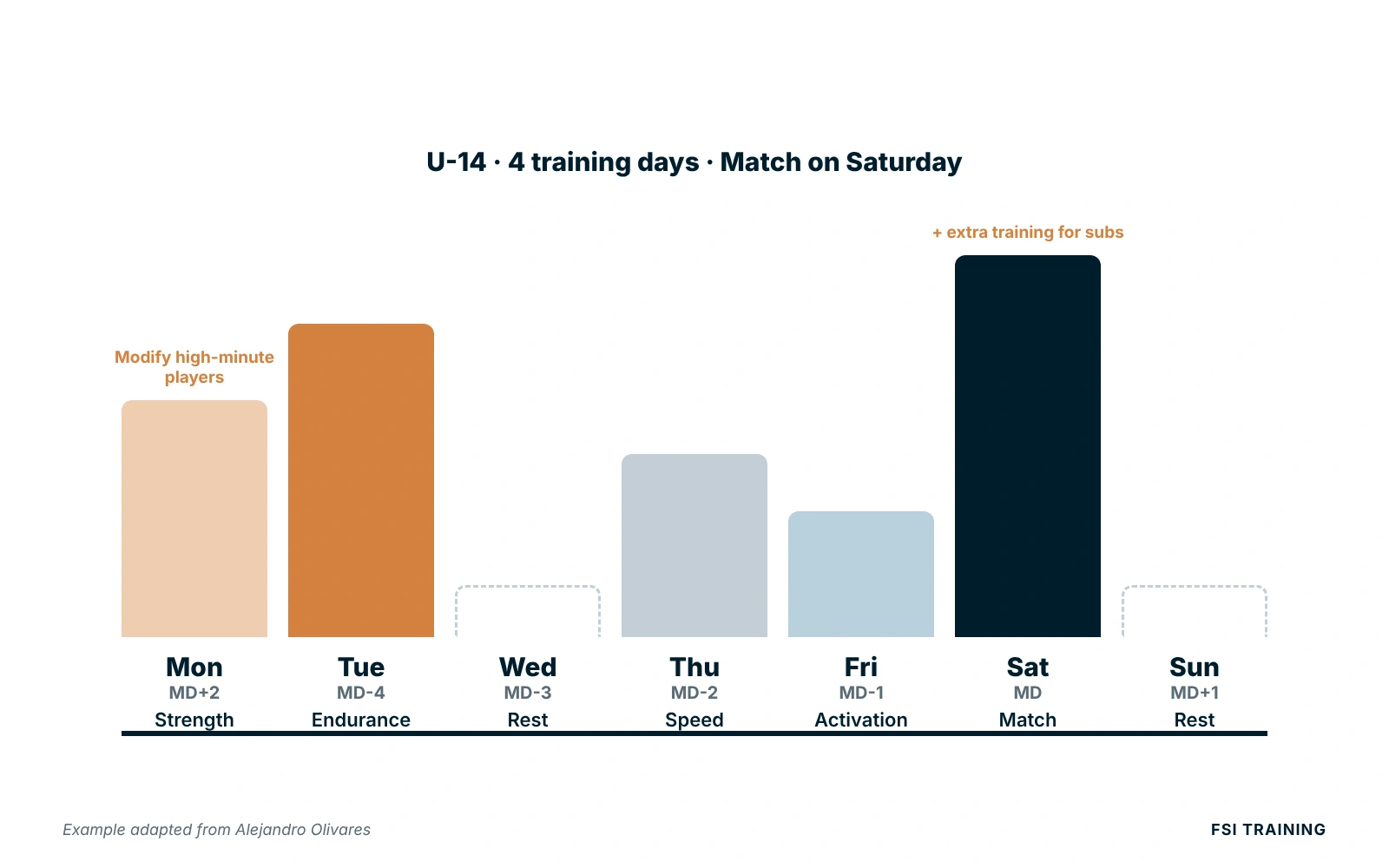
| U-14 | Monday, Tuesday, Thursday and Friday | Same as above, plus an activation session on Friday. Extra training for substitutes and load adjustments for high-minute players come into play. |
| U-16 | Tuesday to Friday | Strength, endurance, speed and activation. With two consecutive days off, it’s worth setting recovery work at home. |
| U-15, match on Sunday | Tuesday to Friday | The ideal four-day week: two days of recovery, two of loading and two of tapering. |
| U-18 | Monday to Friday | The classic microcycle: activation, strength, endurance, speed and activation. |
| U-18, Wednesday and Saturday | Monday, Tuesday, Thursday and Friday | No endurance or speed sessions: the matches provide that load. The key is individualisation. |
| U-17, Saturday and Sunday | Tuesday to Friday | Endurance is dropped. The only loading session is strength, followed by speed and activation. |
Olivares acknowledges that some of these weeks aren’t ideal, for example when there’s only one recovery day and three tapering days. But the schedule rules and the goal is to make the best of it.
Individualise: the difference between starters and substitutes
On the same day, the session can be recovery for some players and loading for others. The two basic tools are:
- Substitutes’ training: those who didn’t play or played little do extra load, on match day or the day after.
- Modify high-minute players: their load is reduced in the next session. This is especially important at U-14, when many players are in the middle of their growth spurt.
With two matches a week this becomes essential, because rotations mean every player arrives with a different load.
5 keys to planning your next week
- Start with the schedule. First mark the recovery, loading and tapering days, then decide the content.
- Use space as a lever. More metres per player means more running and more sprinting; fewer metres, more accelerations and changes of direction.
- Watch your coaching style. The way you run a drill raises or lowers the load.
- Not everyone needs the same. Top up substitutes and protect those who played a lot of minutes.
- With the youngest, less structure and more play. Reduced spaces, lots of ball contact and other sports on days off.
If you want to learn how to plan and manage load with professionals who apply it every week, take a look at our Master’s in Football Strength & Conditioning or our High Performance Football Coach Master’s. And if you’re interested in how the gym and the pitch fit together, don’t miss the FSI Talks episode on integral periodisation.
References
- Gabbett, T. J. (2016). The training–injury prevention paradox: Should athletes be training smarter and harder? British Journal of Sports Medicine, 50(5), 273–280. https://doi.org/10.1136/bjsports-2015-095788
- Guridi Lopategui, I., Castellano Paulis, J., & Echeazarra Escudero, I. (2021). Physical demands and internal response in football sessions according to tactical periodization. International Journal of Sports Physiology and Performance, 16(6), 858–864. https://doi.org/10.1123/ijspp.2019-0829
- Silva, J. R., Rumpf, M. C., Hertzog, M., Castagna, C., Farooq, A., Girard, O., & Hader, K. (2018). Acute and residual soccer match-related fatigue: A systematic review and meta-analysis. Sports Medicine, 48(3), 539–583. https://doi.org/10.1007/s40279-017-0798-8
Powered by Froala Editor