This article is based on the teachings of Irineu Loturco, FSI lecturer and Director of Sports Science at the São Paulo High Performance Centre (NAR-SP). With more than 110 scientific papers, he has devoted much of his work to strength training for football players, working with elite clubs and with the Brazilian national team.
Why acceleration decides matches
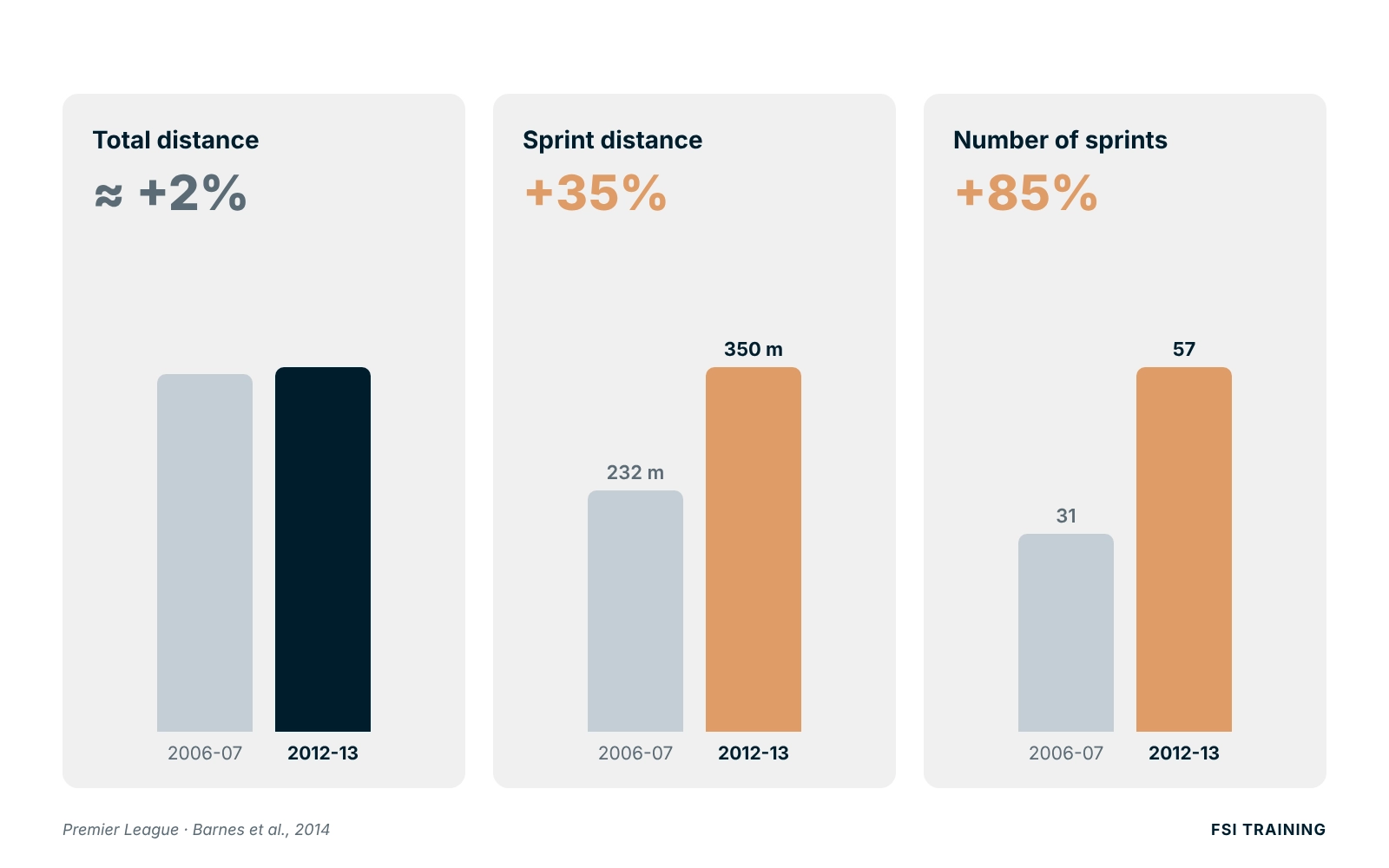
Elite football isn’t played by running more, but by running faster. In the Premier League, between 2006 and 2013 the total distance covered per match barely changed. Sprint distance, however, rose by 35% and the number of sprints by 85% (Barnes et al., 2014).
And those are the actions that decide games. In the Bundesliga, straight sprinting was the most frequent action before a goal: the scorer performed one in 45% of the goals analysed (Faude et al., 2012).
How a football player accelerates (and why they’re not a sprinter)
Before choosing exercises, you need to understand what sprints look like in a match. Loturco sums them up like this:
- Very short: most of them under 10 metres.
- Frequent: between 30 and 60 per match, in both the first and second half.
- Almost never from a standing start: they usually begin at moderate speed.
- Not always in a straight line: many start with a change of direction.
A sprinter keeps accelerating beyond 60 metres. A football player only has a few metres to do it, so what makes the difference are the first steps, which is where the greatest acceleration happens.
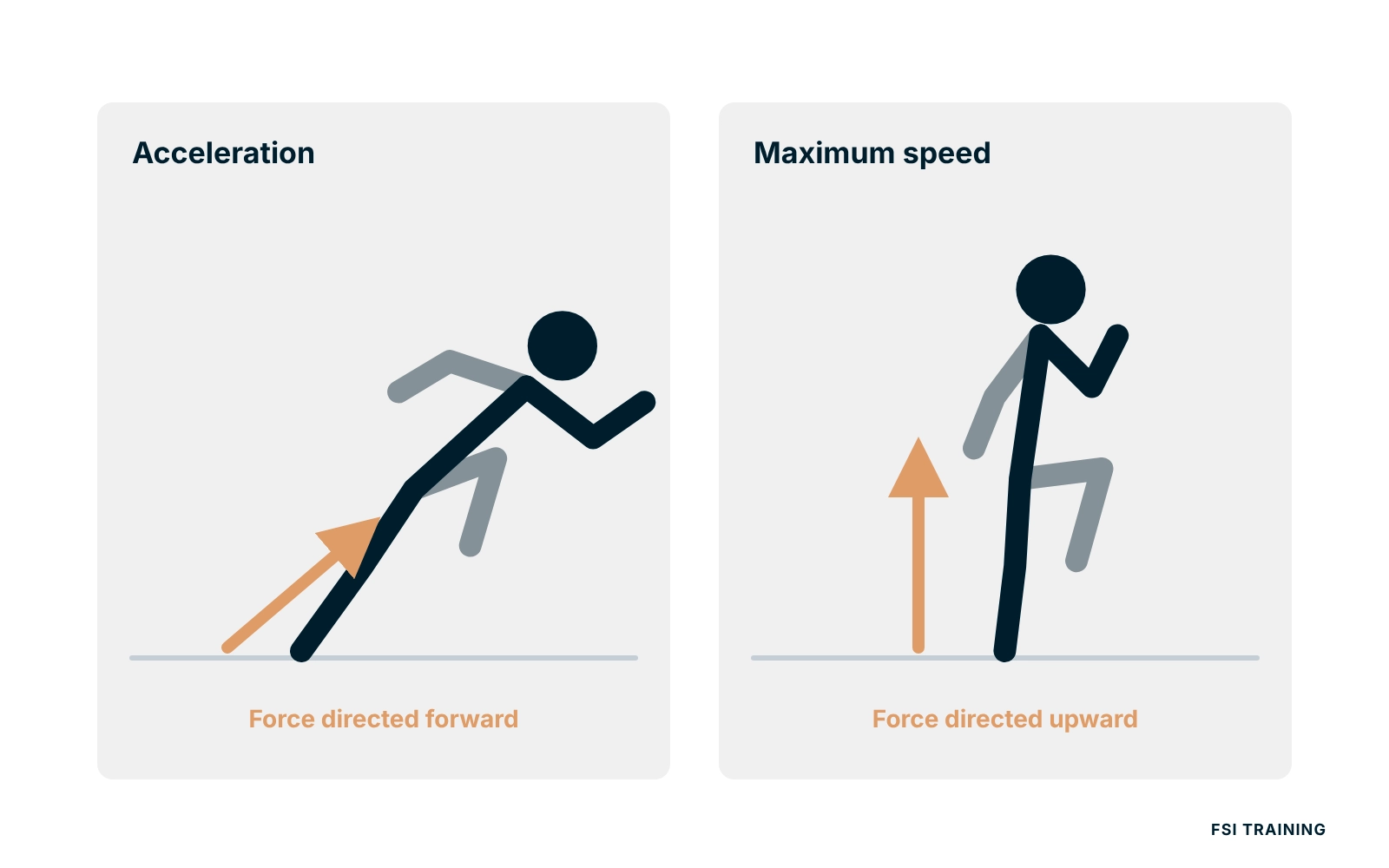
In that phase the body is leaning forward and the force against the ground has to be directed forwards. That’s why being strong isn’t enough.
The key: the player who accelerates the most isn’t necessarily the one who produces the most force, but the one who is best at directing it horizontally. It’s a technical quality that can also be trained.
A worrying fact for youth football: in Loturco’s experience, many players lose acceleration capacity as they turn professional. The training model plays a part, but so does the game itself. More hours of aerobic and ball work interfere with neuromuscular adaptations.
4 strength methods that transfer to acceleration
1. Loaded vertical exercises
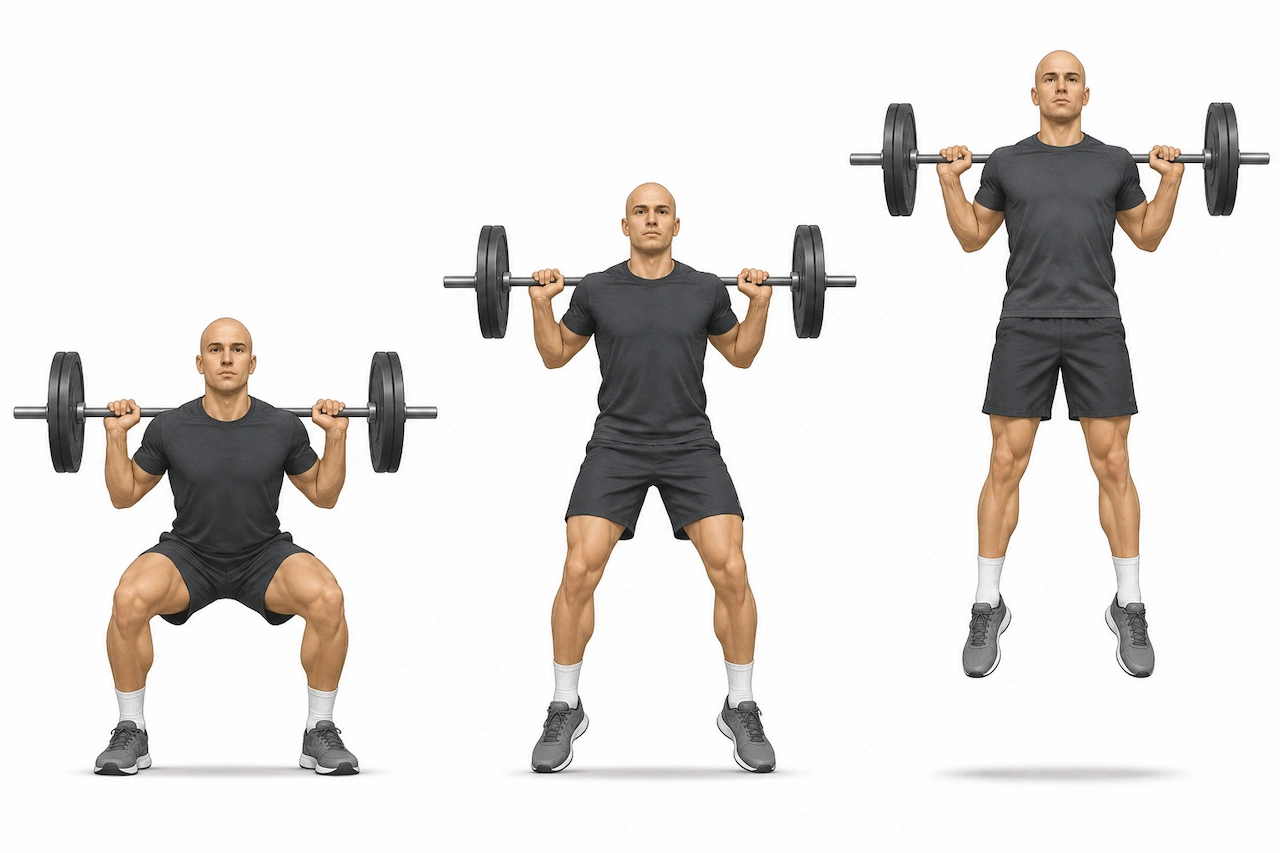
The jump squat or the half squat push vertically, but they have something in common with acceleration: the load lengthens the time over which force is applied. In the first steps of a sprint there is no flight phase and the foot stays in contact with the ground for longer, so that “time to push” is very similar.
That’s why a loaded jump usually transfers more to the first metres than an unloaded one. Loturco often works with the optimum power load: the weight at which the player produces maximum power. In elite U-20 players, training the jump squat slightly above or below that load improved 5 and 10 m sprint performance (Loturco et al., 2020).
2. Hip thrust
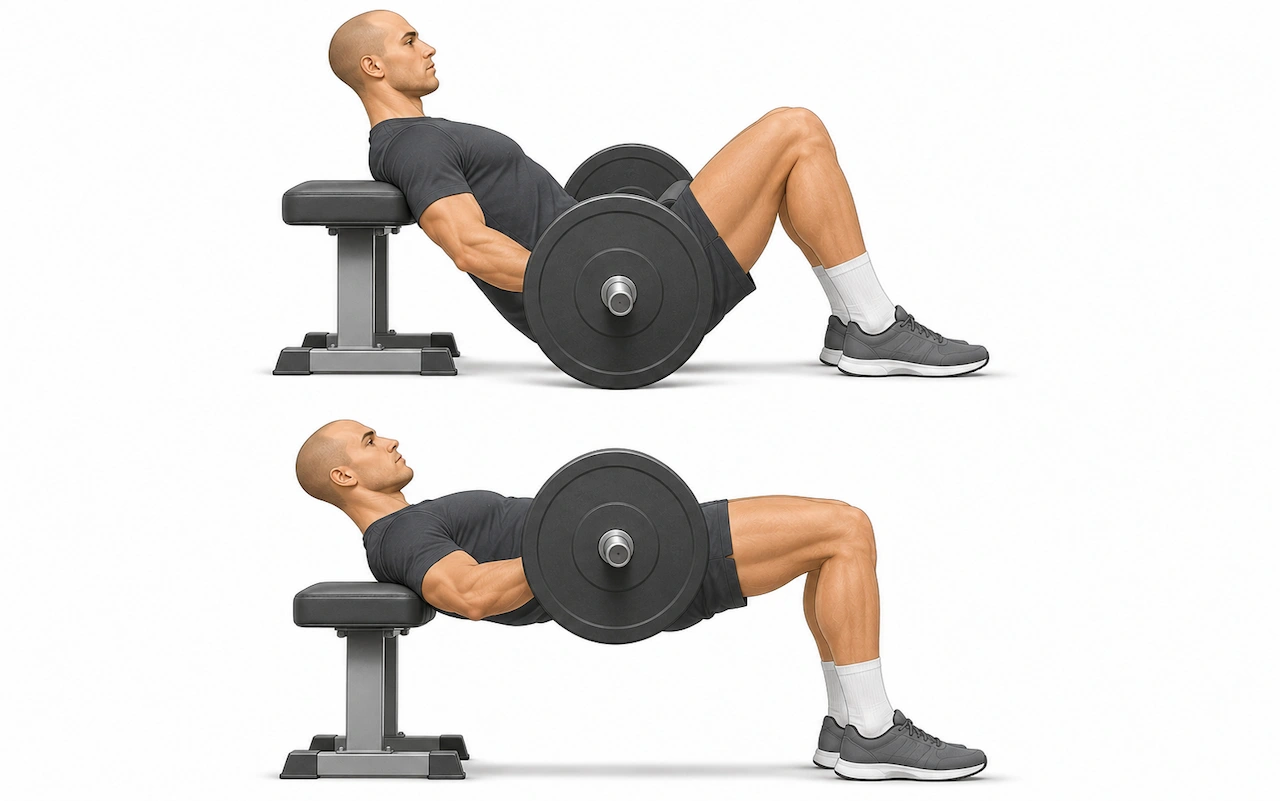
It’s an anteroposterior exercise: force is applied in the same direction as the push in acceleration. In elite sprinters, including three Olympians, hip thrust power showed a correlation of 0.93 with the maximum acceleration phase (0–10 m) (Loturco et al., 2018).
It also works as a pre-activation. In football players, a few sets of hip thrusts improved 5, 10 and 20 m sprint times 4–8 minutes later. In addition, the optimum power load gave better results than a very heavy load (Dello Iacono & Seitz, 2018).
3. Horizontal jumps
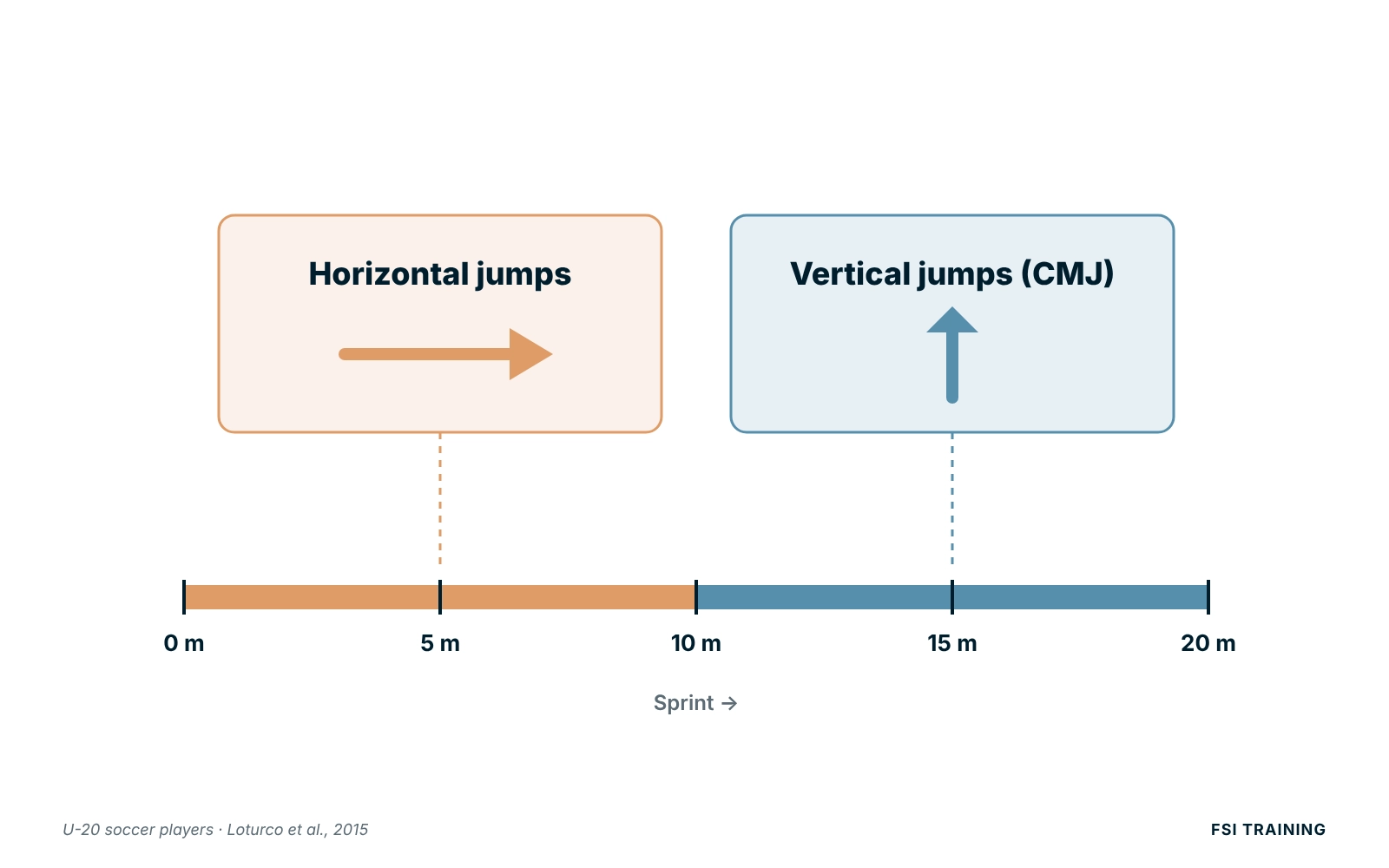
They are among the easiest to fit into the routine. In U-20 football players, horizontal jumps transferred mainly to the first 10 metres, while vertical jumps (CMJ) transferred more to the 10–20 m phase (Loturco et al., 2015).
Loturco’s guidelines:
- Low volume. In preseason, for example, 4–6 sets of 4–6 jumps twice a week.
- Always maximal and without fatigue. Done at the end of a hard session, they are useless.
- The warm-up is a good time. Many of the Brazilian teams he advises do them there, because it’s the only slot they have.
4. Resisted sprints
The sled is the most studied option, but not the only one: there are also parachutes, bands, vests or hills. With very heavy loads, up to 80% of body mass, players have been shown to improve their ability to apply force horizontally (Morin et al., 2017).
But here Loturco adds a very practical nuance. In his experience, heavy loads didn’t fit into the professional team’s routine, and in a pilot with an U-20 side they ran into problems with 40% loads. With loads of up to 20% of body mass they achieved improvements without any issues. If you want to go deeper into how to prescribe the load, we explain it in our sprint training guide.
The combination that worked in a professional team
Loturco’s proposal is to mix vertical and horizontal methods, because each one targets a different piece: the time over which force is applied and its orientation.
He tested it with professional players from a first-division club in the Campeonato Paulista over a 5-week preseason. All of them did jump squats at their optimum power load. On top of that, one group added sled sprints (5–20% of body mass) and the other, vertical and horizontal jumps. Both groups improved their 5 to 30 m sprint and change of direction (Loturco et al., 2017).
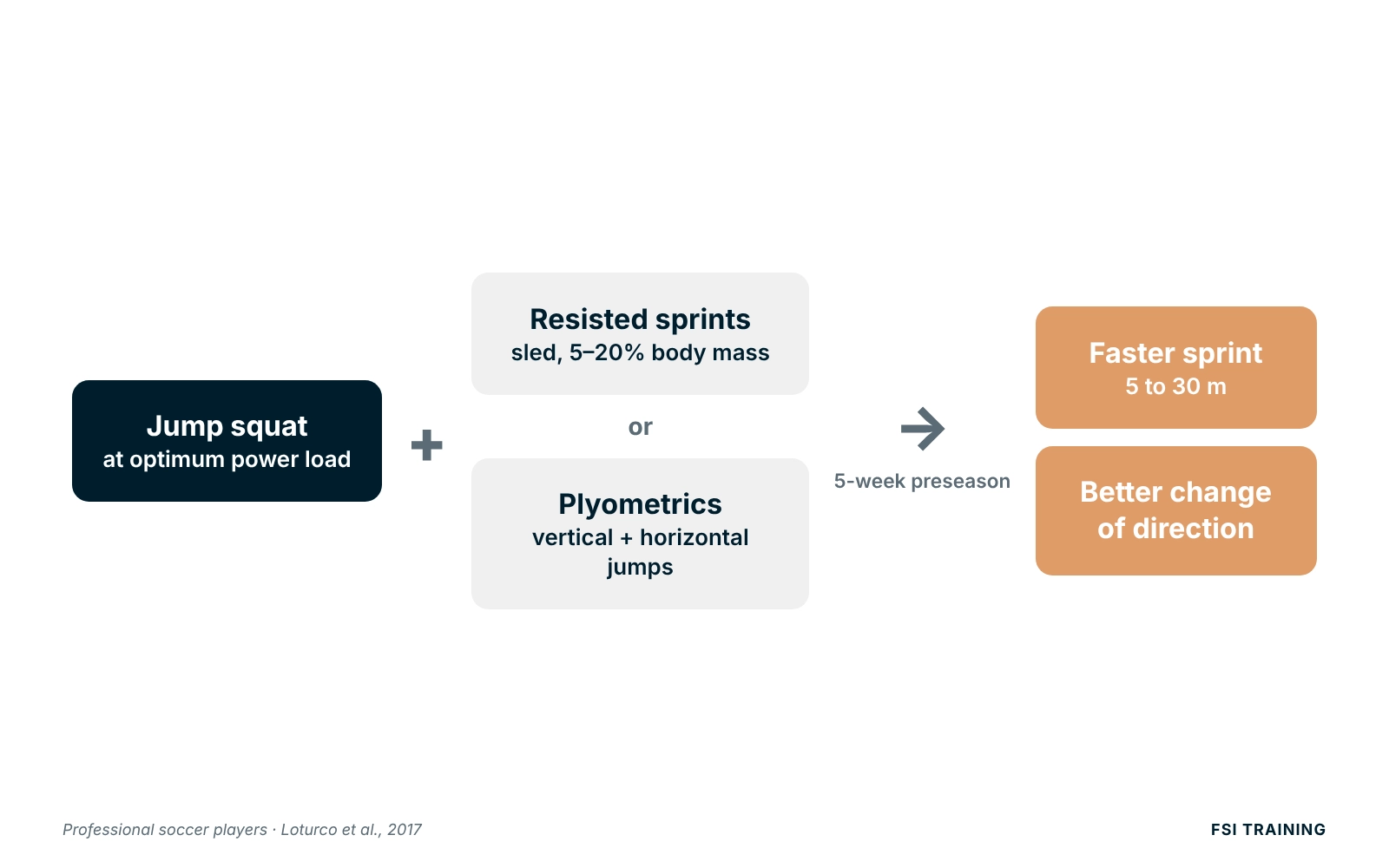
The most useful takeaway for day-to-day work: it was integrated into the preseason smoothly and without interfering with the head coach’s work.
How to apply it during the season
- Don’t drop it after preseason. Adaptations depend on frequency. With 1–2 sessions a week you can maintain the capacity, even with two matches a week.
- Quality over quantity. Few repetitions, at maximum speed and with the player fresh.
- Make use of the gaps. The warm-up or the start of the session works well for low-volume jumps and activations.
- Don’t forget the upper body. Arm action also influences the first steps, as we explain in our article on upper body training in football.
- In youth football, monitor acceleration through maturation. It’s a quality that can be lost if it isn’t trained (more in the FSI Talks episode on strength training for young football players).
The most effective isn’t always the best
This is the message Loturco closes his class with: adapt your methods to your group. The best method isn’t the most powerful one on paper, but the one you can apply every week, with your schedule and your players, to improve acceleration or at least maintain it throughout the season.
If you want to learn how to programme this kind of work with professionals who apply it at elite level, take a look at our Master’s in Football Strength & Conditioning.
References
- Barnes, C., Archer, D. T., Hogg, B., Bush, M., & Bradley, P. S. (2014). The evolution of physical and technical performance parameters in the English Premier League. International Journal of Sports Medicine, 35(13), 1095–1100. https://doi.org/10.1055/s-0034-1375695
- Dello Iacono, A., & Seitz, L. B. (2018). Hip thrust-based PAP effects on sprint performance of soccer players: Heavy-loaded versus optimum-power development protocols. Journal of Sports Sciences, 36(20), 2375–2382. https://doi.org/10.1080/02640414.2018.1458400
- Faude, O., Koch, T., & Meyer, T. (2012). Straight sprinting is the most frequent action in goal situations in professional football. Journal of Sports Sciences, 30(7), 625–631. https://doi.org/10.1080/02640414.2012.665940
- Loturco, I., Pereira, L. A., Kobal, R., Zanetti, V., Kitamura, K., Abad, C. C. C., & Nakamura, F. Y. (2015). Transference effect of vertical and horizontal plyometrics on sprint performance of high-level U-20 soccer players. Journal of Sports Sciences, 33(20), 2182–2191. https://doi.org/10.1080/02640414.2015.1081394
- Loturco, I., Kobal, R., Kitamura, K., Cal Abad, C. C., Faust, B., Almeida, L., & Pereira, L. A. (2017). Mixed training methods: Effects of combining resisted sprints or plyometrics with optimum power loads on sprint and agility performance in professional soccer players. Frontiers in Physiology, 8, 1034. https://doi.org/10.3389/fphys.2017.01034
- Loturco, I., Contreras, B., Kobal, R., Fernandes, V., Moura, N., Siqueira, F., Winckler, C., Suchomel, T., & Pereira, L. A. (2018). Vertically and horizontally directed muscle power exercises: Relationships with top-level sprint performance. PLoS ONE, 13(7), e0201475. https://doi.org/10.1371/journal.pone.0201475
- Loturco, I., Pereira, L. A., Reis, V. P., Bishop, C., Zanetti, V., Alcaraz, P. E., Freitas, T. T., & McGuigan, M. R. (2020). Power training in elite young soccer players: Effects of using loads above or below the optimum power zone. Journal of Sports Sciences, 38(11–12), 1416–1422. https://doi.org/10.1080/02640414.2019.1651614
- Morin, J.-B., Petrakos, G., Jiménez-Reyes, P., Brown, S. R., Samozino, P., & Cross, M. R. (2017). Very-heavy sled training for improving horizontal-force output in soccer players. International Journal of Sports Physiology and Performance, 12(6), 840–844. https://doi.org/10.1123/ijspp.2016-0444
Powered by Froala Editor