
Why does a team dominate possession but struggle to create scoring opportunities? How can a 4-4-2 outperform a 4-3-3? What separates a team that presses effectively from one that simply chases the ball?
The answer lies in soccer tactics: the individual and collective behaviors that allow teams to exploit space, create advantages, defend with organization, and respond to different situations throughout a match.
In this 2027 guide to soccer tactics, you'll learn how to understand the main formations, identify attacking and defensive strategies, analyze matches, and connect tactical decisions with scientific evidence.
The key idea: a formation describes how players are positioned, while tactics explain what they do, when they do it, and why. Two teams can both play in a 4-3-3 formation and behave in completely different ways.
1. What Are Soccer Tactics and How Do They Work?
Soccer tactics are the principles, decisions, and individual and collective behaviors a team uses to solve the situations that arise during a match. They include how to attack, defend, reorganize after winning or losing possession, and exploit set-piece situations.
Understanding tactics means looking beyond where players are positioned. It requires examining how they interact with the ball, their teammates, their opponents, and the available space.
The Difference Between Tactics, Strategy, and Formations
Although these terms are often used interchangeably, they describe different concepts:
- Strategy: the overall game plan a team prepares for a match, considering its own characteristics, the opponent, and the competitive context.
- Tactics: the decisions and actions that allow players to execute, adapt, or modify that plan during the game.
- Formation: the team's reference positional structure, commonly represented by systems such as 4-3-3, 4-4-2, or 3-5-2.
- Game model: the set of principles and behaviors that define how a team intends to play throughout the different phases of a match.
For example, a team may start in a 4-3-3 formation, adopt a strategy based on drawing the opponent's pressure, and execute tactical behaviors such as building up with three players, using third-man combinations, or occupying spaces between defensive lines.
The Fundamental Principles of Soccer Tactics
Although different coaching approaches use different terminology, several principles consistently appear in tactical analysis:
- Width: occupying wide areas to stretch the opponent's defensive structure.
- Depth: threatening spaces in front of or behind the opponent's defensive lines.
- Support: providing useful passing options for the player in possession.
- Mobility: changing positions to create solutions and disrupt the opposition.
- Compactness: reducing the space between teammates and defensive lines.
- Cover: protecting teammates and the areas that may become exposed.
- Balance: maintaining an organization that allows the team to attack without becoming unnecessarily vulnerable when possession is lost.
These principles do not operate independently. Stretching the field, for example, can create space in central areas, while an inward movement can open the outside channel for another player to advance.
2. Soccer Formations Explained: 4-3-3, 4-4-2, 4-2-3-1, and 3-5-2
Soccer formations represent the initial distribution of players on the field. However, they should not be interpreted as rigid structures. A team may adopt different shapes when attacking, defending, and transitioning between phases.
The following illustration compares four of the most widely recognized formations, showing player positioning, potential strengths, and important tactical considerations.
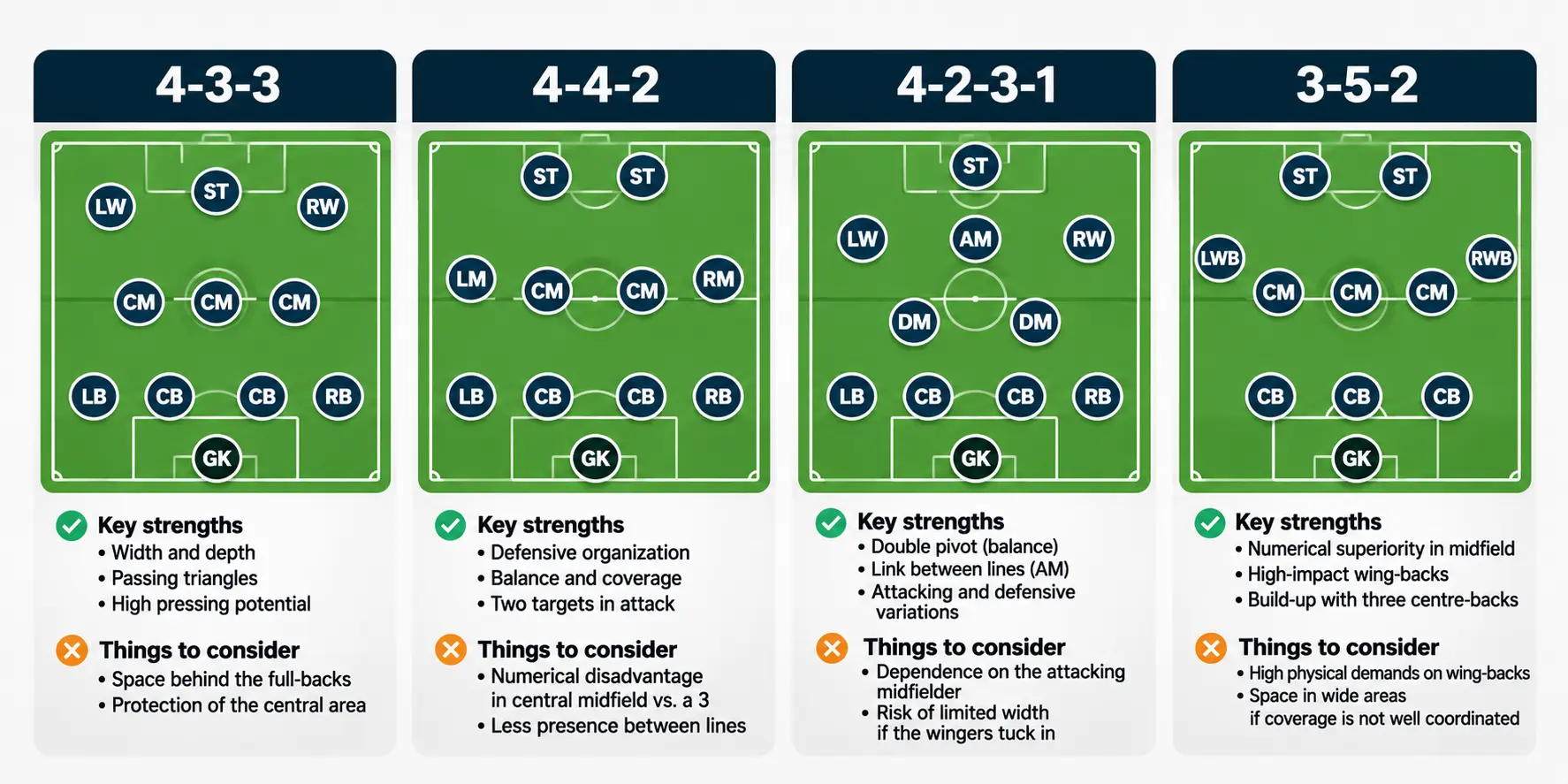
4-3-3 Formation: Width, Central Combinations, and Pressing
The 4-3-3 formation organizes players into four defenders, three midfielders, and three forwards. It can support balanced occupation of the field's different channels and provide several connections between defense, midfield, and attack.
Potential strengths: attacking width, the presence of natural wingers, passing triangles, and opportunities to press the opponent's buildup with three forwards.
Potential weaknesses: difficulties protecting certain central spaces or defending wide areas when the fullbacks advance and possession is lost.
Practical example: when a winger maintains width, the central midfielder can attack the space between the opposing fullback and center back. If the fullback overlaps, the winger may move inside to receive between the lines.
4-4-2 Formation: Defensive Organization and Direct Play
The 4-4-2 formation uses four defenders, four midfielders, and two forwards. It can provide a recognizable defensive structure in a mid-block or low block, often organized into two lines of four players.
Potential strengths: wide defensive coverage, coordination between lines, and two attacking players positioned close to the opponent's defensive line.
Potential weaknesses: a numerical disadvantage in central midfield against certain systems with three central midfielders, unless tactical adjustments are made.
Practical example: against a team with three central midfielders, one striker can block the passing lane toward the opposing defensive midfielder while the nearest midfielder steps forward to press the central receiver.
4-2-3-1 Formation: Double Pivot and Between-the-Lines Play
The 4-2-3-1 formation combines four defenders, two holding midfielders, three attacking midfielders behind the striker, and one central forward.
The double pivot can provide passing options during buildup and improve protection of certain central areas. Meanwhile, the attacking midfielder can receive between the lines or join the striker during defensive pressing.
Key tactical consideration: observe how the two holding midfielders coordinate their positioning. If both occupy the same line and offer similar passing options, the team may lose opportunities to progress through midfield.
3-5-2 Formation: Wing-Backs, Central Superiority, and Wide Defensive Coverage
In the 3-5-2 formation, three center backs, five midfielders—typically including two wing-backs—and two forwards form the reference structure.
Wing-backs play an important role in occupying wide areas, while the three center backs can provide specific solutions during the buildup phase.
Key tactical consideration: analyze what happens when the opponent pins a wing-back and attacks the space behind them. The team's ability to shift across the field and coordinate defensive coverage becomes particularly important.
What Is the Best Soccer Formation?
There is no universally superior soccer formation. Its effectiveness depends on the players' characteristics, the coach's principles, interactions with the opponent, and the context of the match.
A more useful question is not whether the 4-3-3 is better than the 4-4-2, but what advantages each structure provides in a particular situation and how the team can exploit them.
3. Types of Soccer Tactics: Attacking, Defending, and Transitions
To understand a soccer match, it is useful to examine what each team intends to do in possession, out of possession, and during the first moments following a change of possession. Set pieces must also be considered.
Attacking Soccer Tactics: Positional Play, Direct Play, and Counterattacks
Positional play. This approach develops attacks through a collective organization designed to occupy spaces, establish connections, and create advantages. It does not necessarily mean completing a large number of passes: possession should help the team progress or generate favorable situations.
Direct play. This approach prioritizes reaching advanced areas through longer passes or rapid progression. It may involve targeting aerial duels, finding a striker, or competing for second balls.
Counterattacking. A form of attacking transition in which a team attempts to exploit the opponent's temporary defensive disorganization immediately after recovering possession.
Wide attacking play. This approach seeks to create advantages through width, combinations between fullbacks and wingers, overlapping runs, switches of play, and crosses.
Central attacking play. This approach attempts to progress through the spaces between the opponent's defensive lines using supporting movements, coordinated positioning, and line-breaking passes.
Numerical, Positional, and Qualitative Superiority
One of the foundations of modern soccer tactics is the creation of advantages. Three concepts help explain how these advantages emerge:
- Numerical superiority: having more players than the opponent in a particular area, such as a three-player buildup against two pressing forwards.
- Positional superiority: placing a player in a position that makes defensive intervention difficult and facilitates progression, even without a numerical advantage.
- Qualitative superiority: creating a favorable matchup based on player characteristics, such as an exceptionally fast winger facing a defender in open space.
The relationship between space and time also matters. An advantage can disappear if the pass arrives too late or if the receiving player needs several touches before making the next decision.
Third-Man Combinations: How to Break Pressing Lines
The concept of the third man in soccer describes a sequence in which one player helps connect with another player who initially lacks a direct or favorable passing lane.
Imagine a center back trying to find a midfielder positioned behind the opponent's pressing line. Instead of passing directly, the center back plays to a nearby teammate, who quickly connects with the intended receiver.
The tactical value lies not only in the passing combination but also in the players' movements, body orientation, and timing.
Defensive Soccer Tactics: High Press, Mid-Block, and Low Block
Teams can organize their defensive structures at different heights on the field, although these reference positions do not automatically determine defensive aggression or effectiveness.
- High press: aims to disrupt the opponent's buildup and recover possession in advanced areas.
- Mid-block: organizes the defense in intermediate areas, attempting to control space and activate pressure in specific situations.
- Low block: prioritizes protecting areas close to the team's own goal and may create opportunities for counterattacking after regaining possession.
Pressing effectiveness depends on collective coordination. A striker may pressure the opposing center back, but if teammates fail to close the corresponding passing lanes, that action may open spaces rather than restrict them.
Counterpressing: When to Recover Possession and When to Drop Back
Counterpressing involves attempting to regain possession immediately after losing the ball. It can take advantage of nearby players and prevent the opponent from launching a counterattack.
However, pressing is not always the best decision. If the team is too stretched, cannot close the available spaces, or the opponent has a favorable passing option, reorganizing defensively may be more effective.
When analyzing counterpressing, consider:
- How many players are close to the ball.
- Which passing lanes are available to the opponent.
- Whether there is defensive cover behind the first pressing player.
- Which areas would become exposed if the opponent breaks the press.
Attacking and Defensive Transitions
Transitions in soccer occur when possession changes. These moments are particularly important because both teams may be adjusting their organization.
During an attacking transition, the team that regains possession must decide whether to attack immediately or secure the ball and organize a more structured attack.
During a defensive transition, the team that loses possession must decide whether to attempt an immediate recovery, delay the opponent's progression, or retreat into a defensive structure.
In both situations, the players' positions before possession changes are crucial. Losing the ball in the opponent's half has very different consequences when the team maintains an effective rest-defense structure compared with situations in which defenders are left isolated.
Set Pieces: An Essential Phase of Tactical Analysis
Corner kicks, wide free kicks, throw-ins, and other set-piece situations allow teams to prepare highly specific behaviors.
A useful analysis includes the initial organization, blocking or decoy movements, spaces targeted, defensive assignments, and protection against a possible loss of possession.
These situations deserve a dedicated section in tactical reports because their structure and preparation can differ considerably from open play.
4. How to Analyze a Soccer Match Step by Step
Learning how to analyze soccer tactics requires moving beyond observing individual actions to identifying collective patterns and explaining their consequences.
Professional match analysis is not about collecting as many statistics as possible or describing everything that happens. It is about selecting relevant information to answer specific questions about the game.
Step 1. Identify the Initial Formations and Their Transformations
Start by identifying each team's reference formation, but examine how it changes during attacking and defensive phases. A team may defend in a 4-4-2 and attack with three players in its first buildup line.
Step 2. Observe How Each Team Progresses in Possession
Analyze where the buildup begins, who provides support, how passing lanes are created, and which mechanisms allow the team to overcome the opponent's pressure.
Pay close attention to off-the-ball movements. Many tactical advantages emerge before a player receives possession.
Step 3. Identify Defensive Height and Pressing Triggers
Simply stating that a team presses high is not enough. Ask what triggers the pressure: a pass toward a fullback, a player receiving with their back to goal, a poor first touch, or a backward pass?
Then observe how teammates react and which areas remain protected.
Step 4. Analyze Transitions and Vulnerable Spaces
Select several recoveries and turnovers in different areas of the field. Examine the first decision, available supporting players, defensive coverage, and the speed at which each team reorganizes.
Step 5. Identify Patterns and Test Your Hypotheses
When you identify a particular behavior, review additional sequences before concluding that it represents a consistent pattern.
For example, if a team repeatedly progresses down the right flank, determine whether this results from a stable numerical advantage, a favorable matchup, or a recurring defensive response from the opponent.
Video and data can complement each other. Video provides context for decisions, while data helps describe the frequency, distribution, and evolution of specific behaviors.
Practical Example: Analyzing a 4-3-3 Against a 4-4-2
Imagine a training or match situation in which a team organized in a 4-3-3 attempts to build up against an opponent defending in a 4-4-2.
The following diagram illustrates a possible progression sequence. The attacking team attempts to attract the opponent's pressure, create an interior passing lane, and exploit the space that opens between defensive lines.
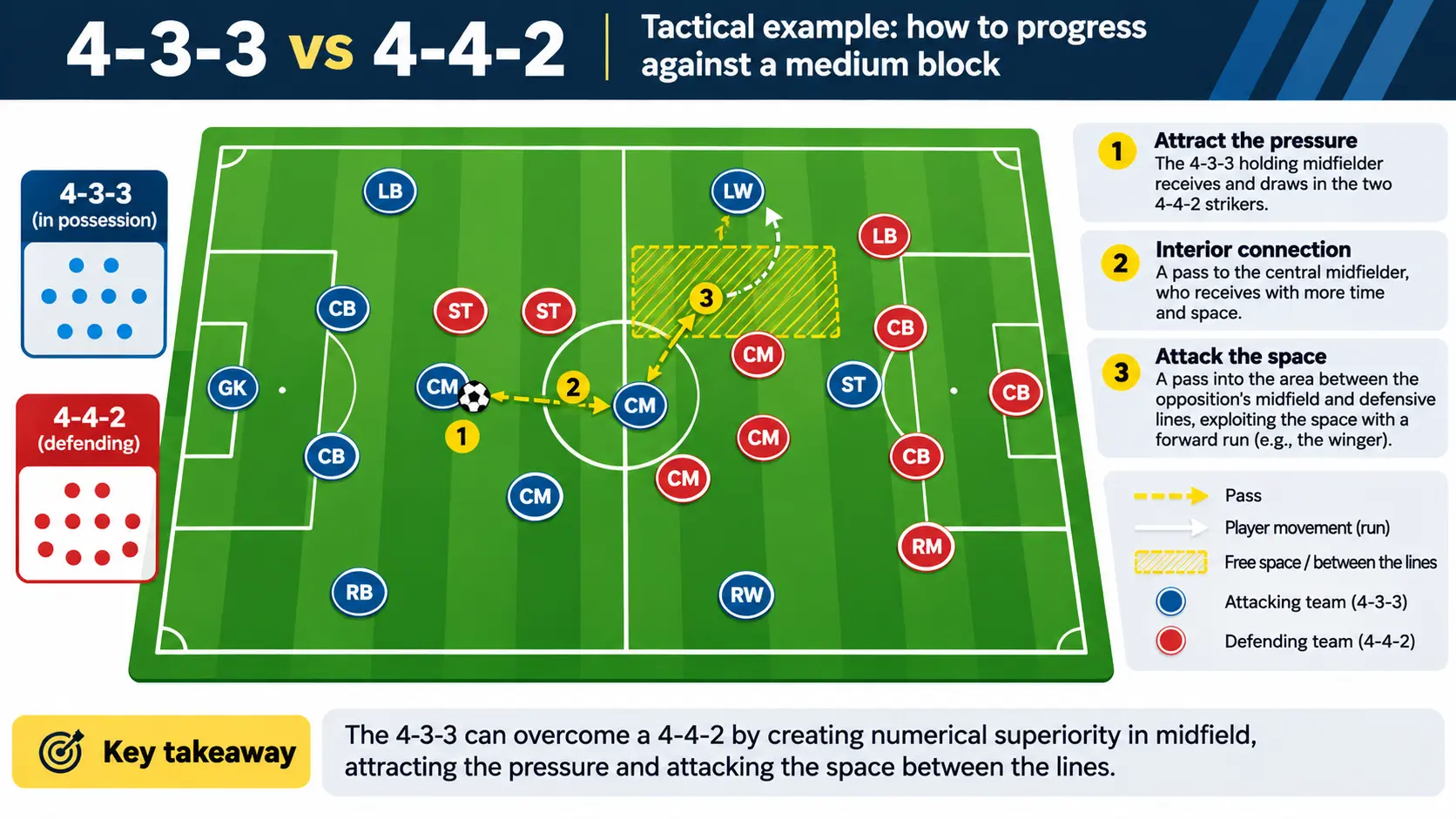
- Initial observation: the opponent's two forwards attempt to disrupt the center backs' buildup options.
- Possible solution: the defensive midfielder moves closer to the first buildup line, or a fullback changes position to create an additional passing connection.
- Opponent's response: a midfielder leaves their position to pressure the new receiver.
- Attacking opportunity: space appears behind the player who has stepped forward to press.
- Decision: the attacking team must recognize the right moment to connect with a central midfielder, winger, or third player.
The goal of tactical analysis is not to conclude that the 4-3-3 always beats the 4-4-2. Instead, it is to understand which behaviors create an advantage, how the opponent responds, and which opportunities emerge afterward.
Soccer Tactical Analysis Checklist
- What formation does each team use in and out of possession?
- How does each team occupy central and wide spaces?
- Which players pin defenders, and which attack open spaces?
- Where and when does each team attempt to recover possession?
- What happens immediately after losing the ball?
- Which patterns repeat, and which depend on the match context?
- What tactical adjustments do coaches introduce during the game?
- Which conclusions can be translated into training decisions?
To learn more about the professional responsibilities of this role, explore our guide on how tactical analysts work in professional soccer teams.
5. Soccer Tactics in 2027: What Scientific Research Tells Us
Modern tactical analysis can benefit from scientific research, particularly when match observation is combined with positional data and knowledge of the training process.
Scientific research does not provide a universal formula for winning soccer matches. However, it can help us better understand the relationships between tactical organization, space, collective behavior, and physical demands.
How Tactical Behavior Influences Physical Performance
A study by José Asián-Clemente, Luis Suárez-Arrones, Bernardo Requena, and Alfredo Santalla, published in the Journal of Human Kinetics in 2022, analyzed 816 individual observations involving 54 professional soccer players from three leading teams in Spain's First Division.
The researchers investigated the relationship between different tactical behaviors and physical performance, considering teams with different structures and playing styles.
The practical implication is important: distance covered and high-intensity running actions should be interpreted in the context of what a team is trying to accomplish tactically.
A sprint may be performed to press an opponent, attack space behind the defensive line, offer support, or recover a defensive position. Without understanding the context, the same physical metric can lead to incomplete interpretations.
Possession Games vs. Position Games: What Is the Difference?
In 2024, José Asián-Clemente, Borja Muñoz, José Vicente Beltrán-Garrido, and Bernardo Requena published a study comparing the running demands of possession games and position games, while also examining how different field dimensions affect the same type of training task.
This research highlights an important consideration: two exercises that appear to focus on ball possession can impose different demands on players.
From a tactical perspective, it is useful to distinguish between maintaining possession as the primary objective of a task and occupying specific positions and spaces to reproduce principles of the team's game model.
Research: Possession or Position Games: What Is the Key in Soccer? (2024).
How Field Size Influences Soccer Training Demands
A 2026 study by José Antonio Asián-Clemente, Bernardo Requena, José Vicente Beltrán-Garrido, and Piotr Żmijewski examined how field dimensions influence the physical demands of position and possession games across different playing positions.
Field size is therefore more than a minor detail in session design. Changing the playing area can modify participation conditions and the demands experienced by individual players.
However, this does not mean that increasing field size automatically improves tactical performance. Training tasks should be adapted to the specific objective being developed.
Why Defensive Positioning Matters in Transition Games
Another 2026 study by José A. Asián-Clemente, Bernardo Requena, Luis Suárez-Arrones, and Piotr Żmijewski investigated the importance of defensive player positioning in transition training tasks.
Its approach reinforces an important methodological principle: when designing a training exercise, deciding how many players participate is not enough. Coaches must also consider where players begin, which spaces they need to defend, and which behaviors the task is intended to encourage.
Research: Is the Positioning of Defensive Players an Aspect to Consider in Soccer Transition Games? (2026).
How Positional Data Improves Tactical Analysis
A systematic review published in Sports Medicine examined 77 studies investigating collective tactical behaviors using positional data and identified 27 tactical variables organized into six categories.
These tools make it possible to study aspects such as spatial organization, coordination between teammates, and adaptation to different playing conditions.
However, the researchers also emphasized the importance of contextualizing the data and making the findings more relevant to the practical needs of coaching staff.
Reference: A Systematic Review of Collective Tactical Behaviours in Football Using Positional Data (2019).
How to Apply Scientific Evidence to Tactical Training
Research on small-sided and conditioned games shows that factors such as the number of participants, field dimensions, and task rules influence technical, tactical, and physical responses.
Before designing a training exercise, coaches should consider three questions:
- Which behavior are we trying to improve? For example, recognizing third-man opportunities to overcome defensive pressure.
- Which conditions make that behavior more likely to emerge? Playing areas, available players, and rules can be adjusted accordingly.
- How will we evaluate whether it occurred? By observing decisions, interactions, and how those behaviors transfer to game situations.
A systematic review focused on soccer training task design supports the importance of manipulating practice conditions according to the intended training objectives.
From Understanding Soccer Tactics to Becoming a Professional Tactical Analyst
Professional tactical analysis requires a strong understanding of the game's principles and the ability to transform observations into useful information for coaches and players.
The following image illustrates a common tactical analysis workflow: reviewing video sequences, identifying collective behaviors, and interpreting tactical and statistical information.

FSI Training's Master's in Football Tactical Analysis, directed by Víctor Mañas and Álvaro Reina, covers topics related to individual and collective analysis, opposition scouting, set-piece analysis, video and data tools, and the application of tactical analysis in competitive environments.
The objective is not simply to recognize formations but to develop the ability to interpret what happens on the field and communicate findings that can support the coaching staff's decisions.
Explore FSI Training's Master's in Football Tactical Analysis.
6. Frequently Asked Questions About Soccer Tactics
What Are the Main Types of Soccer Tactics?
The main types of soccer tactics include attacking behaviors, defensive organization, transitions, and set pieces. Common examples include positional play, direct play, counterattacking, high pressing, mid-block defending, low-block defending, and counterpressing.
What Is the Difference Between Soccer Tactics and Formations?
A formation represents a team's reference positional structure, such as 4-3-3 or 4-4-2. Tactics refer to the actions and decisions players make to solve specific situations during a match. The same formation can produce very different tactical behaviors.
Which Soccer Formation Is Better: 4-3-3 or 4-4-2?
Neither formation is better in every situation. The 4-3-3 can facilitate certain central and wide connections, while the 4-4-2 may provide different attacking and defensive advantages. Effectiveness depends on player characteristics, collective organization, and the opponent.
What Is High Pressing in Soccer?
High pressing is a defensive approach designed to disrupt the opponent's buildup and recover possession in advanced areas of the field. It requires coordinated movements, effective space coverage, and recognizable pressing triggers.
What Is a Low Block in Soccer?
A low block is a defensive structure positioned close to a team's own goal. Its primary purpose is usually to protect high-value spaces and make it difficult for opponents to create scoring opportunities, while potentially enabling counterattacks after regaining possession.
What Is Counterpressing in Soccer?
Counterpressing is the attempt to regain possession immediately after losing the ball. It can prevent the opponent from progressing, but it requires proximity, coordination, and a defensive structure that reduces the risk of being bypassed.
How Can I Learn to Analyze Soccer Tactics?
Start by identifying team formations, observing behaviors in and out of possession, studying transitions, and reviewing video sequences to recognize recurring patterns. As your understanding develops, incorporate data, prepare tactical reports, and test your conclusions against real match situations.
What Tools Do Professional Soccer Tactical Analysts Use?
Professional tactical analysts commonly use video analysis platforms, event-tagging software, event databases, data visualization tools, and positional tracking data when available. The specific tools depend on the club's resources and the coaching staff's requirements.
What Should I Study to Become a Soccer Tactical Analyst?
It is advisable to develop knowledge of tactical principles, formations, observation methodologies, video analysis, data interpretation, and communication with coaching staff. Specialized education can help structure this learning and apply it in professional environments.
Why Is Science Important in Soccer Tactical Analysis?
Scientific research allows professionals to systematically investigate the relationships between space, movement, organization, and performance. Combined with observation and coaching experience, it can improve game interpretation and the design of training tasks.
Conclusion: understanding soccer tactics means understanding the decisions that shape the game, rather than simply memorizing formations. Analyzing a match effectively requires studying how teams create advantages, occupy spaces, press opponents, transition between phases, and respond to the opposition.
The next step is learning how to connect these observations with scientific evidence, performance data, and real training and competitive situations.
Powered by Froala Editor